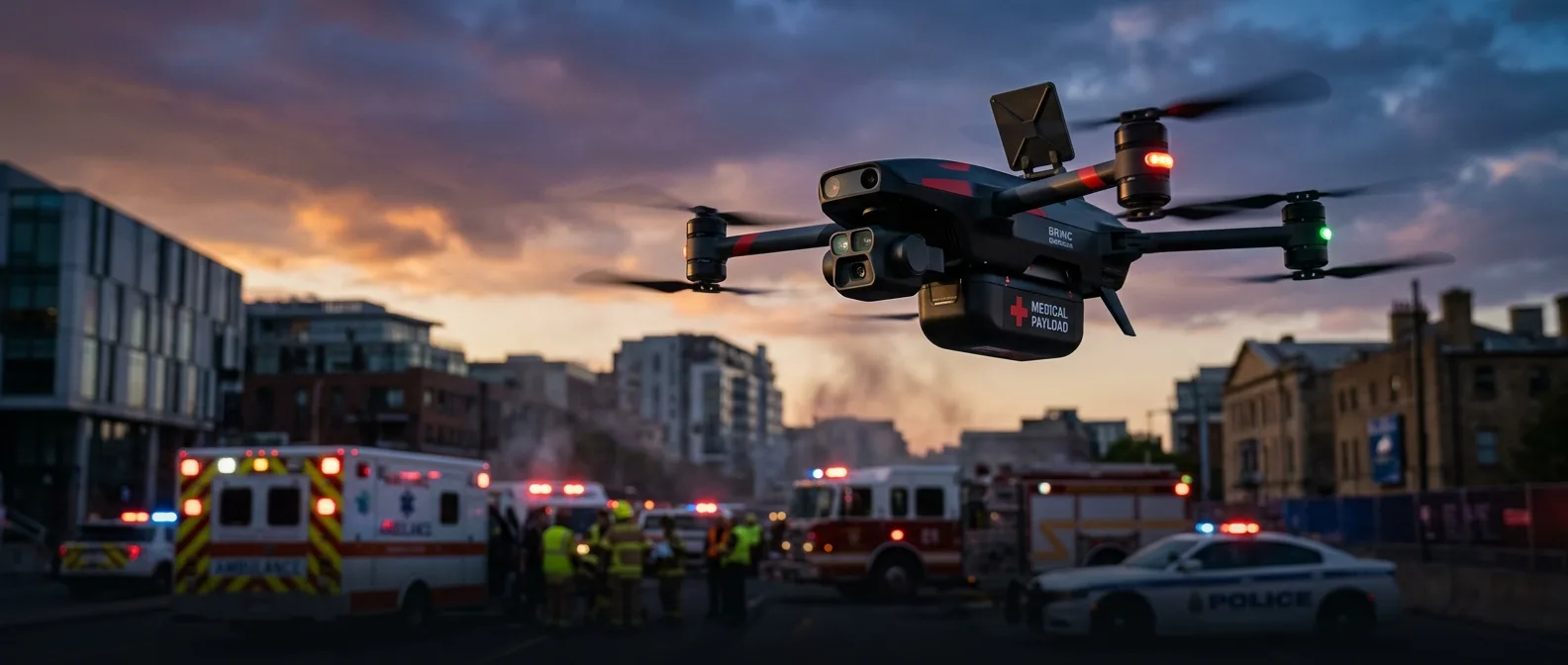
A drone that sits in its box for 25 minutes after every mission, charging — a problem every police department in America knows too well. The BRINC Guardian promises to shatter this reality by combining Starlink satellite connectivity with autonomous battery swapping for the first time. The question isn't whether it'll work. It's how fast emergency services will ditch their Chinese hardware for this American-made alternative.
🚁 Guardian Station: The End of Charging Downtime
Here's the brutal truth about today's DFR (Drone as First Responder) systems. After a drone completes a mission, it sits for 20-25 minutes charging. During a busy shift, that gap can mean the difference between immediate response and delays that cost lives.
The Guardian Station attacks this problem robotically. The drone lands, swaps batteries automatically, loads the right equipment based on the call type, and returns to the air. Zero human intervention. The result? 95% operational availability instead of the 50% most systems deliver today.
But the real breakthrough isn't just speed — it's intelligence. Instead of sending a basic camera drone to every call, the Guardian can automatically select what to carry: defibrillators for cardiac arrests, Narcan for overdoses, flotation devices for water rescues. AI analyzes the 911 call and makes the decision before the drone even leaves the base.
Equipment That Adapts to the Emergency
The Guardian's payload system reads 911 call data and automatically selects mission-specific equipment. Heart attack? It grabs an AED. Overdose? Narcan gets loaded. Water rescue? Flotation devices are ready. This isn't just a flying camera anymore — it's a mobile emergency response toolkit that thinks ahead.
📡 Starlink Connectivity: When Satellites Change the Game
Most DFR drones depend on cellular networks for communication. When those fail — and they fail exactly when you need them most, during earthquakes, floods, major incidents — the drone becomes an expensive toy flying blind.
The Guardian integrates Starlink connectivity. That means it maintains data connection almost anywhere, even in remote areas where traditional infrastructure is unreliable. For many departments, especially outside major cities, this removes a significant adoption barrier.
The revolution doesn't stop at connectivity. Operating range extends from the usual three miles to eight. Speed hits 60 mph. Flight time exceeds one hour. Together, these specs mean fewer launch bases and lower costs to cover entire cities.
Cameras That See Everything
The imagery you get determines the decisions on the ground. The Guardian carries a camera system that redefines what a public safety drone can see. 4K video with 640x zoom — enough to identify faces from over 1,000 feet up. Dual HD thermal cameras with zoom, a first for drones in this category.
Instead of descending close to confirm what it's seeing, the Guardian can stay high and safe while providing useful imagery even in complete darkness. The integrated 1,000-lumen SkyBeam light, laser rangefinder, and speaker system three times louder than a patrol car complete the picture.
⚡ Response Process That Never Sleeps
Beyond raw specifications, the Guardian's real advantage lies in its integration with existing emergency workflows. Through partnership with Motorola Solutions, the system connects directly to call dispatch platforms.
AI can scan incoming 911 calls for keywords like "heart attack" or "allergic reaction," helping operators quickly decide whether to deploy a drone and what equipment it should carry. Officers can even trigger drone launches through their radios if they're in danger.
The integration embeds the drone directly into dispatch operations. When executed properly, officers don't think about deploying a drone — it simply launches automatically.
🏭 American Manufacturing and Strategic Independence
The announcement of the new Seattle factory isn't coincidental. The Guardian will be built in a facility that doubles BRINC's manufacturing capacity, with a vertically integrated supply chain based in the United States. This matters as the US pushes for strengthened domestic drone manufacturing.
More than 900 public safety agencies already use BRINC products. Over 20% of SWAT teams in the US run BRINC platforms. The demand justifying the new factory is already documented.
Cost remains the real unknown factor. BRINC platforms cost significantly more than DJI equivalents, even after tariffs narrowed the gap. By the end of 2026, the Guardian's first real operational performance will determine whether the cost difference is justified.
🎯 Replacing Police Helicopters?
Here's where things get interesting. The Guardian is designed to track moving suspects, including vehicles. Instead of engaging in high-speed chases, officers could rely on a drone for overhead surveillance, reducing ground-level risks.
DFR programs already do something similar on a limited scale today. But with longer flight time, higher speeds, and better connectivity, the Guardian could extend this capability significantly. It's not a complete helicopter replacement, but it might start overlapping with some of those roles.
The economics make sense too. A police helicopter costs $3-5 million and requires a pilot, fuel, and maintenance. A Guardian system costs a fraction of that and operates autonomously. For smaller departments that can't afford helicopters, this could be transformative.
Integration with 911 Systems
Another key change is how the drone fits into existing workflows. Through the Motorola Solutions partnership, the Guardian integrates into dispatch platforms. AI can scan incoming 911 calls for keywords, helping operators quickly decide whether to deploy a drone and what it should carry.
This type of integration makes the drone feel less like a separate tool and more like part of the system itself. When it works correctly, the technology disappears — it's just there when you need it.
"It's no longer just about getting a drone to the scene first. It's about what that drone can actually do once it gets there."
Blake Resnick, CEO BRINC
🔮 The Next Day of Emergency Drones
DFR programs are already expanding across the country. But the conversation is shifting. It's no longer just about getting a drone to the scene first — it's about what that drone can actually do once it gets there. The Guardian was built around this idea. Always ready. Always connected. And increasingly capable of acting, not just observing.
If this vision plays out in real missions, the role of drones in emergency response could look very different, very soon. The remaining question isn't whether the technology will work — it's how quickly agencies will be willing to pay for it.
In the end, the Guardian might be the drone that drives the final transition from Chinese to American equipment in public safety. If Motorola makes it easy to procure and the price doesn't completely disappoint, we'll see.
When the first Guardian systems deploy in 2026, departments will discover whether autonomous battery swapping, Starlink connectivity, and AI-driven payload selection justify their cost. The alternative: expensive technology addressing problems that manual systems already solved adequately.
Sources: