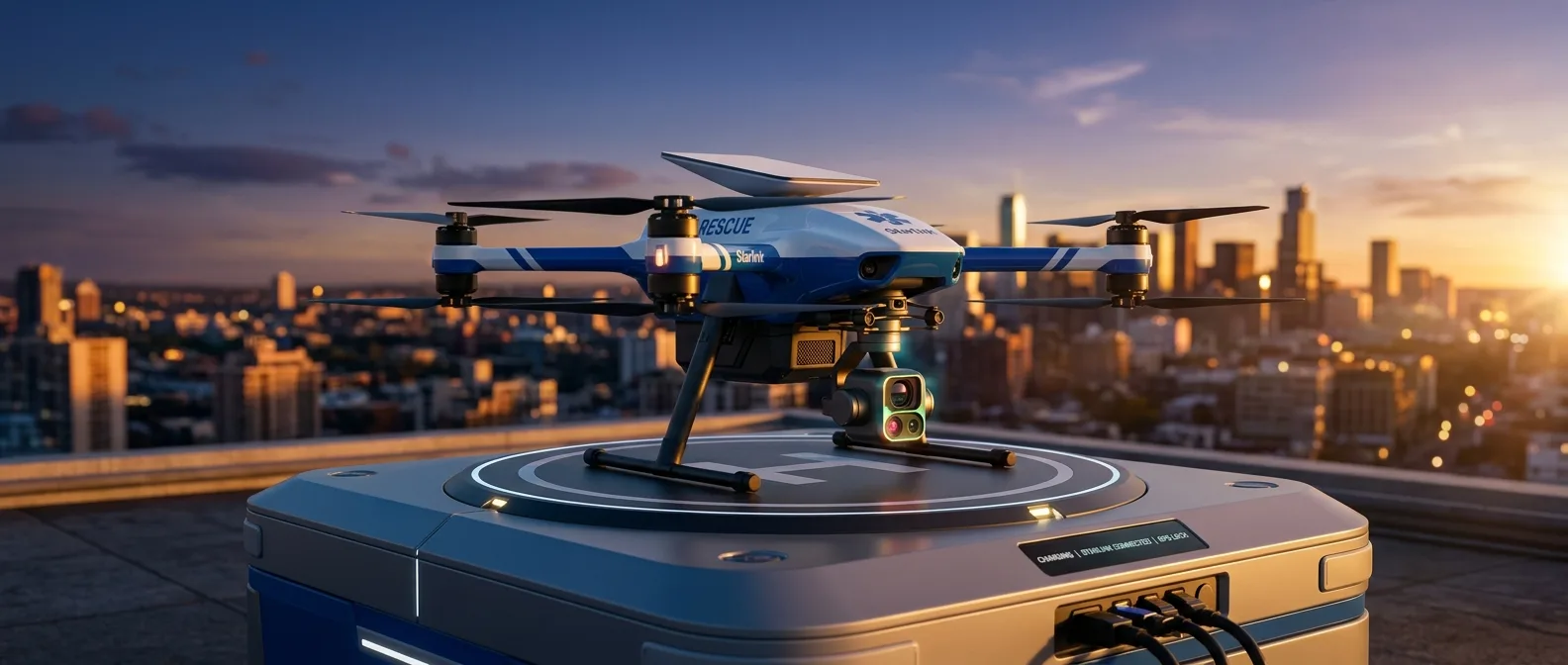
Seattle, 2026. BRINC just unveiled the Guardian — the world's first drone with built-in Starlink connectivity designed exclusively for 911 calls. Forget those limited drones that stop every 25 minutes for charging. The Guardian changes more than what a drone can do in an emergency.
📖 Read more: BRINC Guardian: First Starlink-Connected 911 Emergency Drone
🚁 The Drone That Never Goes Offline
Today's DFR (Drone as First Responder) programs have a fundamental problem. After each mission, drones need to sit charging for 20-25 minutes. When you have multiple emergencies in the same shift, this delay becomes critical. The Guardian solves this with a completely different approach. When it returns to the Guardian Station (its base), a robotic system automatically replaces the batteries and loads the appropriate equipment based on the nature of the next call. All without human intervention.95% Operational availability
8 miles Operating range
62 minutes Flight time
📡 Starlink: The Invisible Advantage
Here's where the Guardian's real innovation hides. While most DFR drones rely on cellular networks — which often fail at the worst moments — the Guardian has built-in satellite connectivity through Starlink. Think about what this means: Natural disasters that knock out cell towers. Rural areas with poor coverage. Underground garages. Mountain villages. The Guardian maintains stable data connection almost everywhere. The 8-mile range is nearly double today's systems that max out at 3 miles. Combined with a top speed of 60 mph and over an hour of autonomy, the Guardian covers significantly more geographic area with fewer installations.From Observer to Lifesaver
Most DFR drones today are essentially flying cameras. They provide visual information to dispatchers and officers before they arrive on scene. The Guardian goes much further. It can carry and deliver vital equipment: defibrillators (AED) for heart attacks, Narcan for overdoses, EpiPen auto-injectors, even life preservers for water rescues.Motorola Solutions' AI system can analyze keywords from 911 calls ("heart attack," "allergic reaction") and automatically decide what equipment to load onto the Guardian before it even takes off.
📖 Read more: BRINC Guardian: Emergency Drone Powered by Starlink
🔍 Visual Capabilities That Redefine the Category
The Guardian's camera system is where you see the difference from the competition. This isn't just a 4K camera — it's a complex optical system with components that exceed its weight class. The specs speak for themselves: 4K video with 640x total zoom, enough to identify details from over 300 meters altitude. Two HD thermal cameras with zoom — something that doesn't exist on any other drone in this weight category. For an intruder hiding in a drainage canal or a lost child in the woods, thermal zoom changes the equation of how you conduct search and rescue. Instead of forcing the drone down close to the danger zone, you can confirm what you're seeing from distance.Tools for Real Operations
The system includes a 1,000-lumen spotlight that serves as a visual reference point for ground teams during night operations. The built-in laser rangefinder provides precise distance data. The speaker and siren system broadcasts sound three times louder than a patrol car. For vehicle pursuits, this means the Guardian can position itself above a fleeing car, broadcast immediate verbal commands, and maintain overhead tracking that ground units follow on their screens.⚡ The Technology That Makes the Difference
The Guardian Station — the robotic charging base — is the key that unlocks true operational capability. Consider the scenario: Multiple simultaneous emergencies, an active shooter incident, floods with multiple rescue calls. With today's systems, once the drone returns after the first call, it needs to wait 25 minutes. The Guardian swaps its battery and leaves again in under a minute."This is truly the most capable 911 response drone ever built. The Guardian is more of a direct competitor to police helicopters than anything the drone industry has produced to date."
Blake Resnick, Founder and CEO of BRINC
Motorola Integration Changes Distribution
The partnership with Motorola Solutions changes the distribution equation. Motorola already has supply contracts with nearly every police department in the US. A department already buying Motorola radios and running CommandCentral doesn't need separate vendor evaluation. Officers can even trigger drone launches directly from APX NEXT smart radios when they hit the emergency button. Officer in danger → immediate drone launch, without waiting for dispatch confirmation.📖 Read more: BRINC Guardian: Emergency Drone with Starlink Connectivity
🏭 The New Factory and Strategic Move
BRINC didn't just announce a new product. They simultaneously opened a new Seattle factory that doubles their production capacity. Why did this happen? The company's revenue tripled in 2025. Monthly production increased five-fold. These numbers indicate demand was already exceeding what the old factory could produce. The new factory isn't preparing BRINC for growth — it's helping them fill orders already placed.US Manufacturing
All critical components from domestic suppliers, none from China
Vertical Integration
Engineering and production at the same location for faster development
The Geopolitical Dimension
BRINC was placed on China's "unreliable entities" list in late 2024. The company's response? A claim that their supply chain architecture had already been designed to be resilient before geopolitical pressure arrived. More than 900 public safety departments already use BRINC products. Over 20% of US SWAT teams run BRINC platforms. Newport Beach committed $2.05 million for a BRINC DFR network earlier in 2025.🎯 Frequently Asked Questions
Can the Guardian replace police helicopters?
Not completely, but it's starting to overlap with some of their roles. The Guardian can track moving suspects and vehicles, often preventing the need for dangerous high-speed pursuits. With longer flight time, higher speeds, and better connectivity than today's DFR drones, the Guardian can significantly extend this capability.What makes Starlink connectivity so important?
Most DFR drones rely on cellular networks that fail exactly when you need them most: earthquakes, floods, mass casualty events. Starlink doesn't need a cell tower. This isn't incremental improvement — it rewrites the operational ceiling for the entire category.How much does the Guardian cost?
BRINC hasn't announced official pricing yet. However, BRINC platforms cost significantly more than equivalent DJI even after tariffs. The real variable is how much the CommandCentral integration reduces the friction that has kept the majority of US services on Chinese hardware. Over 80% of US public safety departments still use Chinese hardware. The Guardian gives them a compelling alternative — if the pricing justifies the performance. By late 2026, the first real operational performance data will tell us if this vision works as promised.Sources: