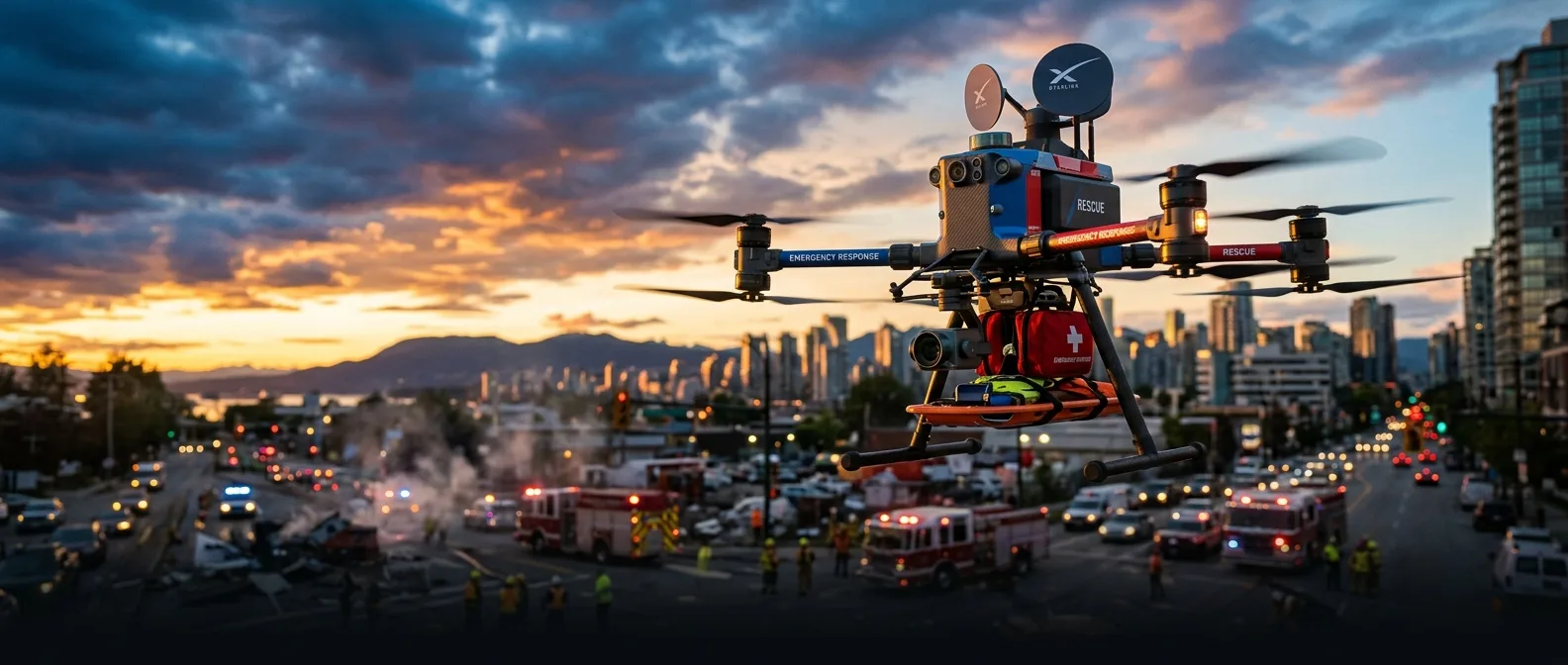
Drone First Response (DFR) programs aren't experiments anymore. Dozens of American cities have already deployed programs that send drones to emergency scenes before any other vehicle. But the Guardian brings something missing from every other system: unlimited range.
🚀 Game-Changing BRINC Guardian Features
While today's DFR drones stop at three miles due to connectivity limits, the Guardian reaches eight miles from its station. The difference isn't just numbers — it's what this means for coverage. A city needs fewer base stations to blanket its entire territory.
Guardian technical specs: 62-minute flight time, 4K camera with 640x zoom, dual HD thermal cameras, IP55 weather resistance, and integrated Starlink connectivity.
The most impressive feature is the automatic resupply system. The Guardian Station swaps batteries and loads equipment without human intervention. While current systems wait 20-25 minutes for charging between missions, the Guardian is ready in seconds. Result? 95% operational availability instead of the 50% we see today.
Life-Saving Equipment Payload
Beyond cameras, the Guardian carries medical equipment. Automated defibrillators for cardiac events, Narcan for overdoses, life preservers for water rescues. The AI system analyzes the nature of the 911 call and selects appropriate equipment automatically. "Heart attack" triggers defibrillator loading. "Allergic reaction" loads an EpiPen.
This transforms the drone from observer to active rescue team member. It doesn't just watch what's happening — it intervenes.
📡 Starlink: The Technological Heart
Satellite connectivity is the real innovation. Most DFR systems rely on cellular networks that fail exactly when we need them most: earthquakes, floods, major fires. Where cell towers go down, the Guardian keeps working.
BRINC tested the system in a natural disaster simulation in San Francisco in January 2026. With cellular networks down for six hours after a 7.2 earthquake, the Guardian maintained uninterrupted connectivity through Starlink, coordinating rescue operations across four neighborhoods simultaneously. No other system can do this right now.
Cameras That See Everything
The Guardian's optical system surpasses anything we've seen in this drone class. Six optical lenses on the front section, including a 640x zoom telephoto and dual HD thermal cameras with zoom capability. This means it can identify details from over 300 meters altitude, even in complete darkness.
The integrated 1,000-lumen SkyBeam spotlight and acoustic siren system that's three times louder than a police cruiser complete the equipment. During vehicle pursuits, the drone can stay overhead, relay instructions directly to the driver, and guide ground units without dangerous street chases.
🏭 American Manufacturing in Seattle
BRINC opened a new Seattle factory that doubles its production capacity. All critical components are sourced domestically, without dependencies on China — something that became even more important after the company was added to China's "unreliable entities" list in 2024.
Behind this expansion lies a tripling of BRINC's revenue in 2025 and a five-fold increase in monthly production. The orders justifying the new factory are already on the books — over 900 public safety agencies already use BRINC products, while over 20% of SWAT teams in the US have adopted the company's platforms.
"Consolidating engineering and manufacturing in Seattle represents a strategic advantage for BRINC. As demand for 911 response drones accelerates, we're committed to building this capability here in the United States."
Blake Resnick, CEO & founder BRINC
Partnership with Motorola
Motorola Solutions operates as the exclusive North American distributor for the Guardian. This isn't a random choice — Motorola already has supply relationships with nearly every public safety agency in the US. An agency that already buys Motorola radios and uses CommandCentral doesn't need a separate vendor evaluation for the Guardian.
The integration extends to APX NEXT smart radios: an officer in danger can activate the emergency button and automatically send the Guardian to their location, without waiting for operations center confirmation.
⚖️ Can It Replace Police Helicopters?
This is the question everyone asks, but few answer honestly. The Guardian is designed to track moving suspects, including vehicles. Instead of dangerous high-speed pursuits, officers can rely on a drone that monitors from above, reducing ground-level risks.
It doesn't fully replace a helicopter — it doesn't carry passengers and doesn't have the same presence. But for many of a police helicopter's daily tasks, the Guardian offers 80% of the functionality at a fraction of the cost.
24/7 Availability
Automatic battery and equipment swapping without human intervention
Global Coverage
Starlink satellite connectivity for operation anywhere on Earth
Advanced Imaging
Dual thermal cameras and 640x zoom optical lens
Rescue Equipment
Medical equipment transport based on emergency type
Cost and Availability
BRINC hasn't announced an official price for the Guardian, but the company's products cost significantly more than DJI equivalents, even after tariff charges. First deliveries are scheduled for Q4 2026, with larger orders getting priority.
What makes the difference is that the Guardian isn't just a better drone — it's an integrated system that plugs into existing public safety infrastructure. For many agencies, this will be the deciding factor.
🎯 Frequently Asked Questions
How does automatic battery swapping work?
The Guardian Station uses a robotic arm that removes the depleted battery and installs a charged one in under 30 seconds. The system features a four-battery storage that charges continuously.
What happens if Starlink connectivity is lost?
The drone has backup cellular connectivity and can operate autonomously for return to base. It also has programmed emergency routes.
Can it operate in bad weather?
With IP55 resistance, the Guardian can fly in light rain and wind. In extreme weather conditions, the system automatically delays takeoff for safety reasons.
The Guardian rewrites emergency response — drones arrive before humans, assess danger, and deliver medical equipment within minutes. Instead of sending humans into danger first and asking questions later, we send intelligence. We send selective observation. We send equipment that can save lives before the first patrol arrives.
The technology is impressive, but watch how quickly departments adapt. When officers see the drone arrive first, assess the situation, and provide information before they even get in the patrol car, something fundamental shifts in how they think about safety. The question is no longer whether drones will become part of daily policing. The question is how fast.