📖 Read more: DJI Avata 3: What to Expect from DJI's Next FPV Drone
The 4 FPV Ecosystems
Before choosing goggles, you need to decide which FPV system you're investing in. This decision matters more than the goggles themselves, because each system only works with its own accessories. You can't, for example, use DJI goggles with a Walksnail air unit — or vice versa. The four ecosystems:
1. DJI: The most complete and popular digital system. Best-in-class image quality, but a closed ecosystem — goggles work ONLY with DJI air units (O3/O4). No analog, Walksnail, or HDZero support. Ideal for cinematic FPV and DJI drones (Avata 2, FPV).
2. Walksnail Avatar: Caddx's digital system. Open ecosystem — the Walksnail Goggles X support Walksnail, analog, AND HDZero (via HDMI). Excellent image quality at competitive prices. Continuously improving through firmware updates.
3. HDZero: A digital system designed for ultra-low latency — originally built for racing. The lowest latency on the market (sub-5ms). The HDZero Goggles 2 also support analog via a built-in receiver. Open ecosystem — goggles accept HDMI input.
4. Analog: The classic (and cheapest) technology. Low resolution, but minimal latency. Huge variety of goggles — from €50 (~$49) box goggles to €500+ (~$489+) binocular models. Ideal for beginners, Tiny Whoop, or tight-budget setups.
Rule of thumb: FPV goggles are a long-term investment — unlike drones, they don't crash, don't break easily, and you'll use them for years. Invest as much as you can. Better to buy a cheaper drone and better goggles than the other way around.
DJI Goggles: The Full Comparison
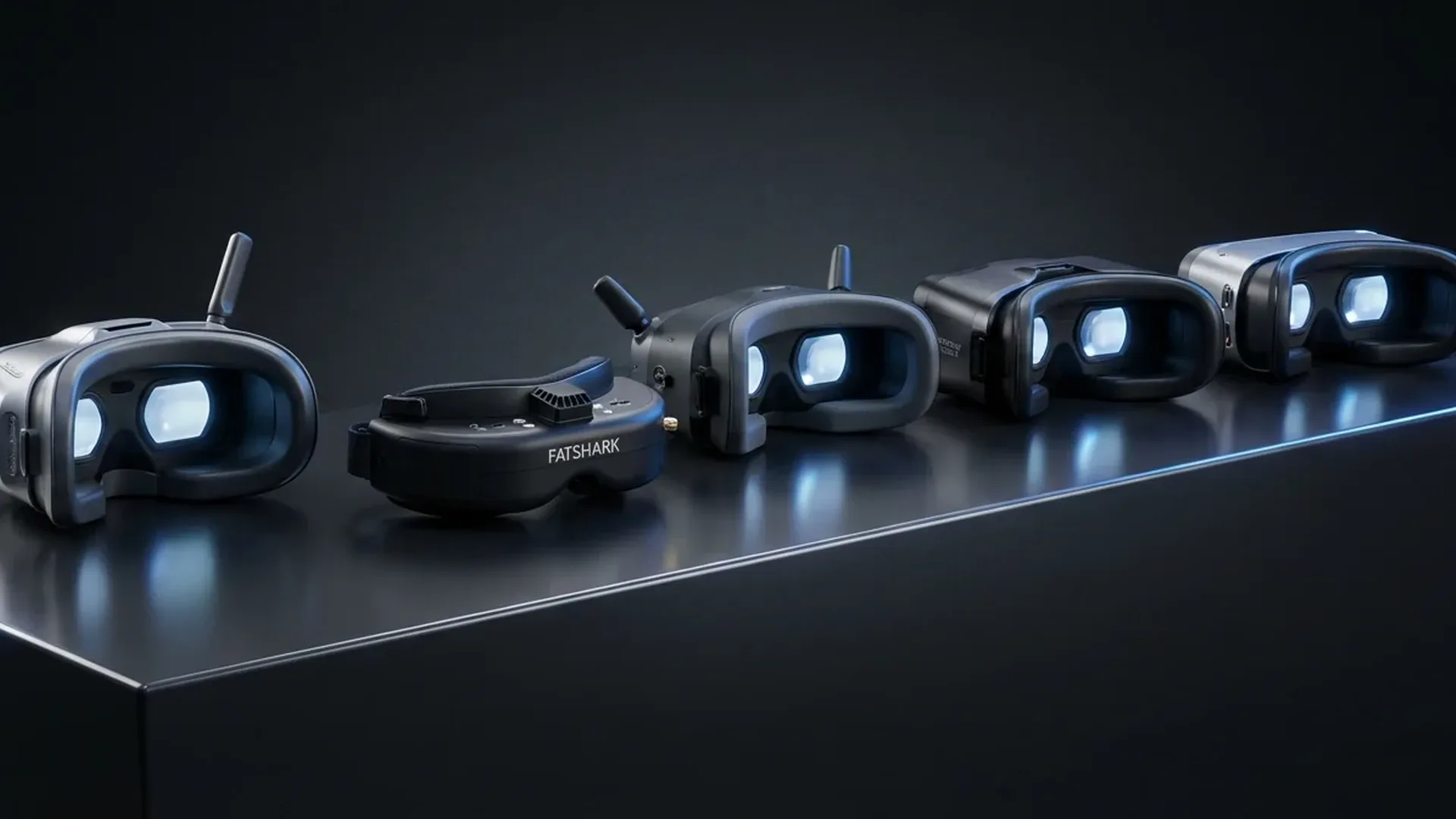
DJI offers four goggle models in its current lineup. If you're flying DJI drones (Avata 2, DJI FPV) or using DJI O3/O4 air units, these are the only goggles that will work. Note: DJI goggles do NOT support analog, Walksnail, or HDZero.
| Feature | Goggles 3 | Goggles N3 | Goggles 2 | Integra |
|---|---|---|---|---|
| Price | ~€460 (~$499) | €351 (~$229) | €743 (~$449) | €482 (~$349) |
| Display | 100Hz OLED | 60Hz LCD | 100Hz OLED | 100Hz OLED |
| FOV | 44° | 54° | 51° | 44° |
| Resolution | 1920×1080 | 1920×1080 | 1920×1080 | 1920×1080 |
| IPD Adjustment | 56-72mm | No | 56-72mm | 56-72mm |
| Focus Adjustment | -6.0 to +2.0 | No | -8.0 to +2.0 | No |
| Battery | 3000mAh (built-in) | 2450mAh (built-in) | External 1800mAh | 2500mAh (built-in) |
| Weight | 470g | 536g | 290g (no battery) | 410g |
| DVR | ✅ | ✅ | ✅ | ✅ |
| Analog Support | ❌ | ❌ | ❌ | ❌ |
Our recommendation: If you're buying now, the DJI Goggles 3 (~€460 / ~$499) are the best choice. They feature 100Hz OLED, IPD adjustment, focus adjustment, a built-in 3000mAh battery, DVR, and USB-C video output. Their only weakness? The relatively narrow FOV (44°). If you prefer a wider FOV, the Goggles 2 offer 51° but cost €743 (~$449 MSRP) due to limited remaining stock.
The Goggles N3 (€351 / ~$229 on Skroutz) are the budget DJI option. Advantages: low price, built-in battery, you can wear glasses inside. Drawbacks: 60Hz LCD (slightly slower response), no IPD adjustment, no focus adjustment, and no O3 air unit support. If these don't bother you, it's excellent value. The Integra (€482 / ~$349) mirrors many Goggles 2 features (OLED, 100Hz), but lacks focus adjustment — a problem if you wear glasses.
Walksnail Avatar Goggles
Walksnail (by Caddx) has taken the market by storm over the past two years. The big advantage? Excellent image quality at competitive pricing, and — crucially — the top Walksnail goggles support MULTIPLE systems.
Walksnail Goggles X (~€425 / ~$459): Arguably the best all-around FPV goggles of 2026. 100Hz OLED, 1920×1080, 50° FOV, IPD 54-74mm, focus adjustment -6.0 to +2.0, HDMI input, analog support, DVR, just 290g. They support Walksnail, analog, AND HDZero (via HDMI). If you want ONE pair of goggles for everything, these are it.
Walksnail Goggles L (~€185 / ~$200): The budget option — box goggles with 60Hz LCD, 1920×1080, 75° FOV (very wide, more immersive but lower sharpness at edges). No IPD adjustment, no HDMI input, fixed internal antennas. Latency is ~10ms higher than the Goggles X in 100fps mode. A decent entry into the Walksnail ecosystem if you don't need top-tier performance.
HDZero: The Low-Latency King
If one thing matters in racing, it's latency — the delay between what the camera sees and what you see in the goggles. This is where HDZero dominates. With sub-5ms latency in optimal conditions, it's the closest to analog in speed while delivering digital clarity.
HDZero Goggles 2 (~€600 / ~$650): Flagship binocular goggles. 90Hz OLED, 1920×1080, 46° FOV, IPD 58-72mm, focus +4 to -7, HDMI input, built-in analog receiver, DVR. Extremely versatile — they accept HDZero, analog, and Walksnail (via HDMI). Important note: the built-in analog receiver doesn't match the performance of external modules (ImmersionRC RapidFire, TBS Fusion), so if you want top-tier analog, you'll need an external module.
HDZero BoxPro (~€280-325 / ~$300-350): The budget alternative. 100Hz LCD box goggles, 1920×1080, 56° FOV. No IPD, but spacious — glasses fit inside. HDMI input, analog support. An excellent entry point into HDZero.
Analog: The Classic Choice
Despite the rise of digital FPV, analog goggles still have their place: they're cheap, lightweight, have minimal latency, and are ideal for Tiny Whoop or tight-budget pilots. The variety is huge — from €55 (~$54) box goggles to €500+ (~$489+) binocular flagships.
Top Binocular Analog Goggles
Skyzone SKY04X Pro (~€460 / ~$500): The pinnacle of the analog world today. OLED 1920×1080, 52° FOV (the widest on any binocular goggles!), IPD 58-71mm, focus -6 to +2, DVR, HDMI input, headtracking, included SteadyView receiver. Accepts external modules (RapidFire, Fusion). If you fly exclusively analog, these are the undisputed top pick.
Fatshark HDO+ (~€600 / ~$650): A legacy FPV manufacturer — OLED 1920×1080, 50° FOV. Not recently updated, pricier, no included VRX module. However, build quality is exceptional and custom lenses/faceplates make Fatsharks among the most comfortable goggles available.
Budget Box Goggles (Analog)
Skyzone Cobra SD (~€155 / ~$170): The best budget option available. 800×480 LCD, 50° FOV, DVR, diversity receiver, HDMI input (supports HDZero/Walksnail but with added latency). 18650/2S-6S or USB-C power. 332g. Outstanding value for money.
BetaFPV VR04 (~€70 / ~$75): The cheapest reliable option. Built-in DVR, upgradable antenna, auto channel search, integrated battery. Drawbacks: 16:9 only (4:3 cameras stretch), no diversity receiver. For the €70 it costs, it does an exceptional job as a first pair of goggles.
"FPV goggles don't crash into fields, don't break props, don't hit trees. Buy the best you can — they'll follow you through every drone you build for the next 3-5 years."
Binocular vs Box: Which Form Factor Suits You?
The big question isn't just which brand, but which goggle form factor suits you. There are two categories:
Binocular goggles (e.g., DJI Goggles 3, Walksnail Goggles X, Skyzone SKY04X Pro): Compact, lightweight, two small displays (one per eye). FOV 37°-52°. Require IPD adjustment. More expensive ($500-$800). Sleeker appearance, easier to transport.
Box goggles (e.g., HDZero BoxPro, Skyzone Cobra SD, BetaFPV VR04): Larger, single big screen. FOV 50°-80° (more immersive). No IPD adjustment needed. Cheaper ($55-$350). Fit glasses inside. Less sleek but very practical.
If you wear glasses: Pay special attention. Binocular goggles typically can't fit glasses inside — you'll need focus adjustment or custom diopter lenses. Box goggles fit glasses (on most models). The DJI Goggles N3 explicitly state you can wear glasses inside.
Technical Specs That Matter
Let's break down the features you should examine before buying:
Resolution & Display Type
Resolution determines how sharp the image is. For digital systems (DJI, Walksnail, HDZero) that send 720p or 1080p feeds, 1080p goggles make a huge difference. For analog, cameras send low-resolution signals, so 720p goggles suffice. Display technology also matters: OLED > LCD, due to higher contrast, more vibrant colors, and faster refresh rates.
Field of View (FOV)
FOV indicates how large the image appears. Larger FOV = more immersive. Box goggles: 50°-80°. Binocular: 37°-52°. But excessively wide FOV can make the edges blurry. For racing, many pilots prefer a smaller FOV (40°-45°) for “tunnel vision” — seeing everything without moving your eyes.
IPD (Interpupillary Distance)
The distance between the centers of your pupils. Critical ONLY for binocular goggles — if the setting doesn't match, the image appears blurry at the edges or doesn't merge properly. Box goggles don't need IPD since you're looking at one screen. Measure your IPD (average ≈ 63mm) before buying.
Latency
The most important parameter for racing. Latency is measured in milliseconds (ms) — how much time passes from when the camera “sees” something until it appears on your goggles. Analog: ~20-30ms. HDZero: ~5ms. DJI/Walksnail: ~25-40ms (depends on mode). For casual flying, ≤40ms is fine. For racing, \<10ms makes a massive difference.
DVR (Digital Video Recorder)
The ability to record what you see onto a micro SD card. Extremely useful: if you crash, you can review the DVR footage to find your drone. Nearly all modern goggles (except the cheapest) include DVR.
Which Goggles Are Right for You?
The choice depends on three factors: (1) what you fly, (2) your budget, (3) what you'll fly in the future.
"I fly DJI drones (Avata 2, DJI FPV) or build custom with O3/O4″ → Goggles 3 (~€460 / ~$499) for the best experience, Goggles N3 (€351 / ~$229) for budget. No second-guessing needed.
"I want a custom FPV drone, freestyle/racing, flexibility" → Walksnail Goggles X (~€425 / ~$459). They support Walksnail, analog, and HDZero. Best value for money. Alternatively, HDZero Goggles 2 (~€600 / ~$650) if you want the lowest latency.
"I'm just starting out, budget ≤€200 (~$195)" → Walksnail Goggles L (~€185 / ~$200) if you want digital. BetaFPV VR04 (~€70 / ~$75) or Skyzone Cobra SD (~€155 / ~$170) if you want analog. Or better yet, a BetaFPV Cetus Pro kit (~€150-180 / ~$147-176) that includes drone + goggles + TX as an all-in-one.
"Analog only, top quality" → Skyzone SKY04X Pro (~€460 / ~$500). The undisputed king of the analog world.
"Racing only, lowest possible latency" → HDZero Goggles 2 (~€600 / ~$650) or HDZero BoxPro (~€280-325 / ~$300-350) for budget. HDZero was literally built for racing.
Mistakes to Avoid
The FPV goggles market has pitfalls. Here are some classic ones:
- Buying without knowing which FPV system you want: Goggles are NOT universal. If you buy DJI goggles and later want Walksnail, you'll need to replace everything. Decide on a system first, then goggles.
- Buying ultra-cheap analog goggles without DVR: If you crash without DVR, you won't find your drone. The extra €50 (~$49) for goggles with DVR is worth every cent.
- Ignoring IPD: If you have unusually narrow or wide IPD (below 57mm or above 70mm), check the specs before buying binocular goggles.
- Buying the Eachine EV800D: It used to be the classic budget recommendation, but build quality has dropped sharply in recent years — many counterfeits are circulating. Go with the BetaFPV VR04 or Skyzone Cobra SD instead.
- Leaving goggles in the sun: The optics act like a magnifying glass — sunlight can burn the displays. ALWAYS keep goggles with displays facing away from the sun.
Accessories & Upgrades
A few accessories that will significantly improve your experience:
- Analog Receiver Modules (ImmersionRC RapidFire, TBS Fusion): If you use binocular analog goggles (Skyzone, Fatshark), these modules dramatically improve signal reception. True diversity and sync pulse reconstruction. Price: ~€100-150 (~$98-147).
- Antennas: A quality antenna (e.g., patch + omnidirectional combo) makes a huge difference in range. Price: €15-40 (~$15-39) per set.
- Custom Foam/Faceplate: If the stock foam doesn't fit your face, aftermarket faceplates dramatically improve comfort. Price: €10-30 (~$10-29).
- Diopter Lenses: If you wear glasses and your goggles lack focus adjustment, custom diopter lenses are the solution. Price: €15-40 (~$15-39).
Frequently Asked Questions (FAQ)
Can I use DJI Goggles with a non-DJI drone?
Only if the drone has a DJI air unit (O3 or O4 Lite). DJI goggles do NOT accept analog or other digital systems. If your drone runs Walksnail or HDZero, you need the corresponding goggles.
Which goggles are the most comfortable?
It depends 100% on your facial structure. Generally, box goggles (Skyzone Cobra, HDZero BoxPro) are more forgiving, especially if you wear glasses. Binocular goggles need correct IPD — if they don't match, they become uncomfortable fast. Best advice: try them at an FPV meetup before buying.
Analog or Digital FPV?
If you're starting now: digital (Walksnail or HDZero). Better image, DVR, better range. If you want ultra-low latency racing or a very low budget: analog. In competitive drone racing, many events still use analog.
How much does a complete FPV setup cost?
Budget analog: ~€200-300 (~$195-293) (goggles + TX + drone or kit). Decent digital: ~€500-900 (~$489-879) (Walksnail Goggles L/X + TX + 5″ BNF drone). Premium: €1,000+ (~$978+) (HDZero/DJI Goggles 3 + custom build). Goggles typically account for ~30-50% of the total budget.
How long does goggle battery last?
Most goggles with built-in batteries (DJI Goggles 3, N3, Integra) last 2-3 hours — plenty for a session. Goggles with external batteries (DJI Goggles 2, Skyzone, HDZero) can be powered by LiPo drone batteries (2S-6S) — effectively unlimited runtime as long as you have charged batteries.