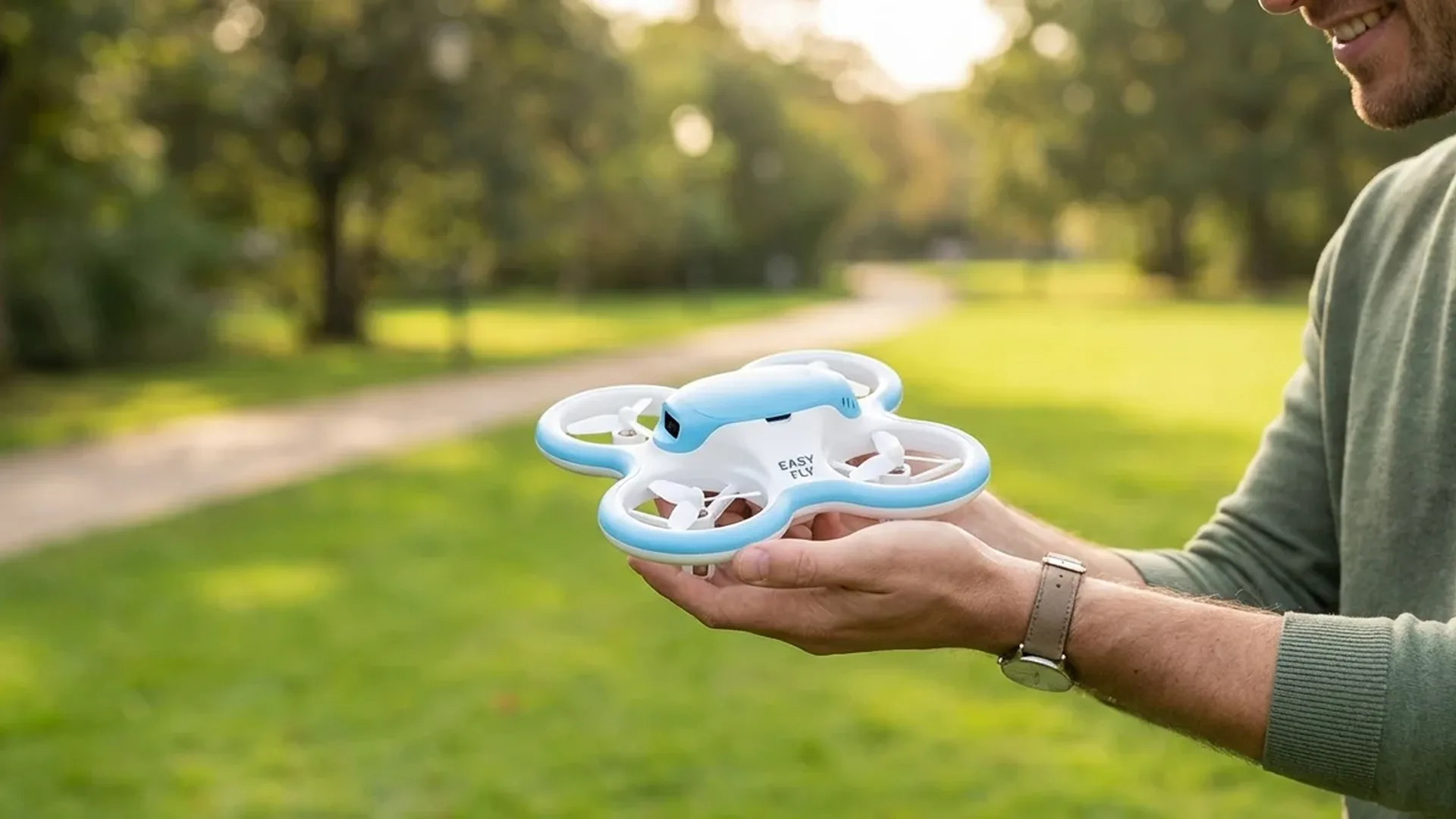
🤔 Why Buy a Drone in 2026?
Three years ago, a drone with a decent camera cost at least €700-800 (~$685-780) and had zero obstacle avoidance. If it hit a tree, you paid. Today, the situation has changed dramatically. You can buy a drone with a 4K camera, obstacle avoidance sensors, automatic return-to-home, and 3-axis gimbal stabilization — for less than €250 (~$245).
That doesn't mean every cheap drone is worth buying. The market is flooded with “drones” priced at €50-80 that can barely stabilize in the air. Those are NOT real drones — they're toys. A beginner drone needs GPS, return-to-home, a decent camera, and at least basic obstacle avoidance. Otherwise, the experience will disappoint you and the thing will end up in a drawer.
There's a reason DJI dominates the market, and it's not by accident. Their drones offer rock-solid flight stability, an app (DJI Fly) that actually works without crashing, GPS lock with 10+ satellites, and firmware updates that improve behavior after purchase. Alternatives exist — like Potensic — but when it comes to reliability, DJI operates on a different level.
⚖️ The 249-Gram Rule in Europe
Let's clarify something critical before discussing specific models: drones under 249 grams fall into the C0 category under EASA (European Union Aviation Safety Agency). This means that in most European countries — including Greece — you don't need an exam, you don't need a pilot certificate, and flight restrictions are minimal.
This explains why every worthwhile beginner drone weighs under 249 g. It's the magic number. If you buy something over 250 g (e.g., the DJI Air 3S at 724 g), you enter the open category A1 with class C1 — meaning you need an online examination from your national aviation authority.
Of course, even with a C0 drone, basic rules still apply: maximum altitude of 120 meters, always within visual line of sight, never over crowds without proper precautions, and avoid airport and military installation zones. Always check local regulations before flying.
🛒 What to Look for in Your First Drone
The market bombards you with specs: megapixels, bitrate, transmission range, APAS 6.0. But which specifications actually matter for a beginner? Let's break them down one by one.
Weight under 249 g: The single most important factor if you live in Europe. It guarantees freedom to fly without bureaucratic hurdles.
Obstacle avoidance: As a beginner, you WANT sensors. You might not appreciate them now, but when your drone heads straight for a branch and brakes on its own, you'll love them. The cheapest drones (under €200 / ~$195) usually lack this — and that means every mistake you make costs money.
Camera at least 4K/30fps: You don't need 6K or 100 megapixels. But at resolutions below 4K (e.g., 2.7K or 1080p), your footage looks blurry on YouTube and Instagram. The camera should have decent stabilization — ideally a 3-axis mechanical gimbal. Without a gimbal, your videos will be shaky.
GPS + Return-to-Home: Critical. If you lose signal or the battery runs low, a GPS-equipped drone flies itself back to the takeoff point. Without GPS, if you lose connection, you lose the drone. Literally.
Flight time ≥25 minutes: The reality is that 25-minute specs translate to roughly 18-20 minutes in practice (due to wind, cold temperatures, etc.). Anything with less than 20 minutes of advertised flight time means 12-14 minutes of actual flying — far too little.
🏆 The 5 Best Drones for Beginners (February 2026)
After testing and comparing with real European market prices, these are the drones that are genuinely worth buying as your first:
1. DJI Flip — The Best First Drone (€378 / ~$369)
If you have to pick ONE drone as a beginner in 2026, this is it. The DJI Flip combines a 1/1.3-inch 48-megapixel sensor, 4K/60fps HDR video, RAW/DNG photos, a 3-axis gimbal, and APAS 6.0 obstacle avoidance (forward + downward sensors) — all in a body under 249 g.
Its C0 classification (EASA) means zero paperwork in Europe. Battery life reaches 31 minutes on paper (expect around 23-25 in practice). The O4 video transmission reaches 8 kilometers under European CE regulations — more than enough for any beginner.
What makes the Flip special compared to older Mini models? It folds like a full-size drone (not the Mini's distinctive folding design), supports voice commands, and the entry price is outstanding. The only real downside: internal storage is a mere 2 GB — you absolutely need a microSD card.
Prices in Europe: €378 (~$369) base / €556 (~$543) with RC 2 controller / €676 (~$660) Fly More Combo (3 batteries, case, ND filters).
2. DJI Neo 2 — For Those Who Want Simplicity (€245 / ~$239)
The DJI Neo 2 is the most laid-back entry into the drone world. It weighs just 160 grams, takes off from the palm of your hand without a controller, and starts following you or executing automatic QuickShot maneuvers within seconds.
The major upgrade over the original Neo (€156 / ~$152) is omnidirectional obstacle avoidance with LiDAR. That was the Achilles' heel of the first Neo — it crashed into everything. The Neo 2 follows you through trees and buildings while automatically dodging obstacles.
The camera is decent: 4K video with 2-axis gimbal stabilization, face detection, and roughly 50 GB of internal storage. Good enough for selfies, social media, and TikTok? Absolutely. For serious photography? Not quite — it doesn't support RAW, only JPEG, and image quality in shadows falls short.
Where it truly shines: control options. You can fly it with nothing at all (gesture control), with your phone via DJI Fly, with an RC-N3 controller, or even with a motion controller. No other drone offers this many options at this price point.
Battery life (19 minutes advertised, roughly 14 real-world) is on the short side. That's why the Fly More Combo with extra batteries is a worthy investment.
Prices in Europe: €245 (~$239) drone only / €339 (~$331) FMC Drone Only / €409 (~$399) FMC complete / €589 (~$575) Motion FMC (with motion controller).
3. Potensic Atom 2 — The Non-DJI Alternative (~€270 / ~$289)
Not everyone wants DJI, and the Potensic Atom 2 proves there's a reliable alternative. It's a full folding drone with a 1/2-inch Sony sensor, 3-axis gimbal, 4K/30fps video, 48MP photos, 32 minutes of flight time, and a weight of exactly 249 g.
The price is competitive: approximately €270 (~$289) in Europe. Subject tracking works reasonably well — it follows you while cycling or running without major issues. The QuickShots (automatic camera movements) are intuitive even for someone flying for the very first time.
The downsides, however, are real: zero obstacle avoidance (significant for a beginner!), the 1/2-inch sensor falls noticeably behind the 1/1.3-inch sensors from DJI in shadows and low light, and those 48MP photos use Quad Bayer technology — meaning real resolution is roughly 12MP in standard shots. There's also no internal storage at all.
Why choose it? If you want a drone with 32 minutes of flight time, a 3-axis gimbal, and remote ID, and you don't mind the absence of obstacle avoidance.
4. DJI Mini 5 Pro — The Premium Choice (€819 / ~$799)
If your budget stretches to €800+ (~$780+), the Mini 5 Pro is the most advanced drone under 250 g ever built. Its 1-inch CMOS sensor delivers image quality that competes with much larger drones: 4K/120fps, D-Log M, 14 stops of dynamic range.
Omnidirectional obstacle avoidance with forward-facing LiDAR means you can fly even through forests with reasonable safety. The 225° roll rotation — switching from horizontal to vertical video at the press of a button — is outstanding for social media content. And of course, it shoots 50MP RAW/DNG photos.
Why isn't it ranked #1 for beginners? First, the price: €819 (~$799) for the base model alone. With the Fly More Combo you're looking at €1,029-1,159 (~$1,005-1,132). Second, the complexity of settings — D-Log, 10-bit color, manual ISO — can overwhelm someone just starting out. Third, in practice it exceeds 250 g if you attach a larger battery or ND filter, which could push it into a different regulatory category.
Prices in Europe: €819 (~$799) base / €1,029 (~$1,005) FMC RC-N3 / €1,159 (~$1,132) FMC RC2.
5. DJI Mini 4 Pro — The Proven Value (€871 / ~$851 FMC)
Although it launched before the Mini 5 Pro, the Mini 4 Pro remains an excellent purchase. Its 1/1.3-inch sensor delivers 48MP RAW photos, 4K/60fps, and even 4K/100fps slow motion. Omnidirectional obstacle avoidance works reliably, and battery life is respectable.
Its main advantage today? The price. Now that its successor exists, you can find the Mini 4 Pro at discounted prices. If you don't need the 1-inch sensor, 4K/120fps, or LiDAR, it gives you 85% of the experience at a lower cost.
Price in Europe: €871 (~$851) Fly More Combo with RC2.
💶 How Much Budget Do You Actually Need?
Let's look realistically at what a beginner needs to spend:
- Under €200 (~$195): Only the original DJI Neo at €156 (~$152) is worth considering in this price range. But it lacks obstacle avoidance, battery life is short (~18 minutes), and the camera is mediocre. For beach or mountain selfies, it works. For anything more serious, it falls short.
- €200-400 (~$195-390): The “sweet spot” for beginners. This is where you'll find the Neo 2 (€245 / ~$239), the Potensic Atom 2 (~€270 / ~$289), and the DJI Flip (€378 / ~$369). Our recommendation: the Flip is worth the extra €100-130 over the others thanks to its superior camera and RAW file support.
- €400-700 (~$390-685): This is Fly More Combo territory (DJI Flip FMC at €676 / ~$660) — and the investment is well worth it. Three batteries means roughly 75-90 minutes of total flight time.
- €800+ (~$780+): Mini 5 Pro (€819 / ~$799) or Mini 4 Pro (€871 / ~$851 FMC) — “advanced beginner” drones you won't outgrow easily.
💡 Practical tip: In February 2026, if you spend €378 (~$369) on the DJI Flip + €30 (~$29) for a 128 GB V30 microSD card + €20 (~$20) for an ND filter set = €428 (~$418) total, you have a setup that produces video and photos on par with beginner drones that cost €800+ (~$780+) just two years ago.
🚫 Mistakes Every Beginner Makes
Having watched dozens of beginners start their drone journey, these mistakes are repeated with clockwork precision:
1. Flying without learning the regulations. In Europe, if you fly near an airport or over people, the consequences are fines — and they can reach thousands of euros. Download the DJI Fly Safety Map before launching anything.
2. Buying only one battery. The battery drains faster than you think — especially in windy conditions. The Fly More Combo (3 batteries) isn't a luxury, it's a necessity.
3. Flying in Sport Mode without experience. In Sport Mode, obstacle avoidance is disabled. A beginner can easily fly at 12 m/s straight into a wall. Stay in Normal or Cine mode until you feel 100% confident.
4. Skipping compass/IMU calibration. Every time you change location, run a compass calibration through DJI Fly. Without it, the drone can behave unpredictably.
5. Underestimating the wind. A drone under 250 g = very light = vulnerable to gusts. If wind speeds exceed 20-25 km/h, don't fly. Even if the specs say “handles level 5 wind,” it wobbles noticeably in practice.
🎯 Our Recommendation
If you asked us “which ONE drone should I buy as a beginner in Europe,” the answer is clear: DJI Flip at €378 (~$369). It delivers 4K/60fps HDR, 48MP RAW, a 3-axis gimbal, obstacle avoidance, 31 minutes of flight time, and C0 classification — at a price that won't break the bank.
Want something simpler for selfies and social media? DJI Neo 2 at €245 (~$239). Looking for an alternative outside the DJI ecosystem? Potensic Atom 2 at ~€270 (~$289). Want the absolute best without leaving beginner territory? DJI Mini 5 Pro at €819 (~$799).
Ultimately, the most important thing isn't which drone you buy — it's that you get outside, fly, make mistakes, learn, and enjoy an experience that just a few years ago was unthinkable at these prices. Happy flying.