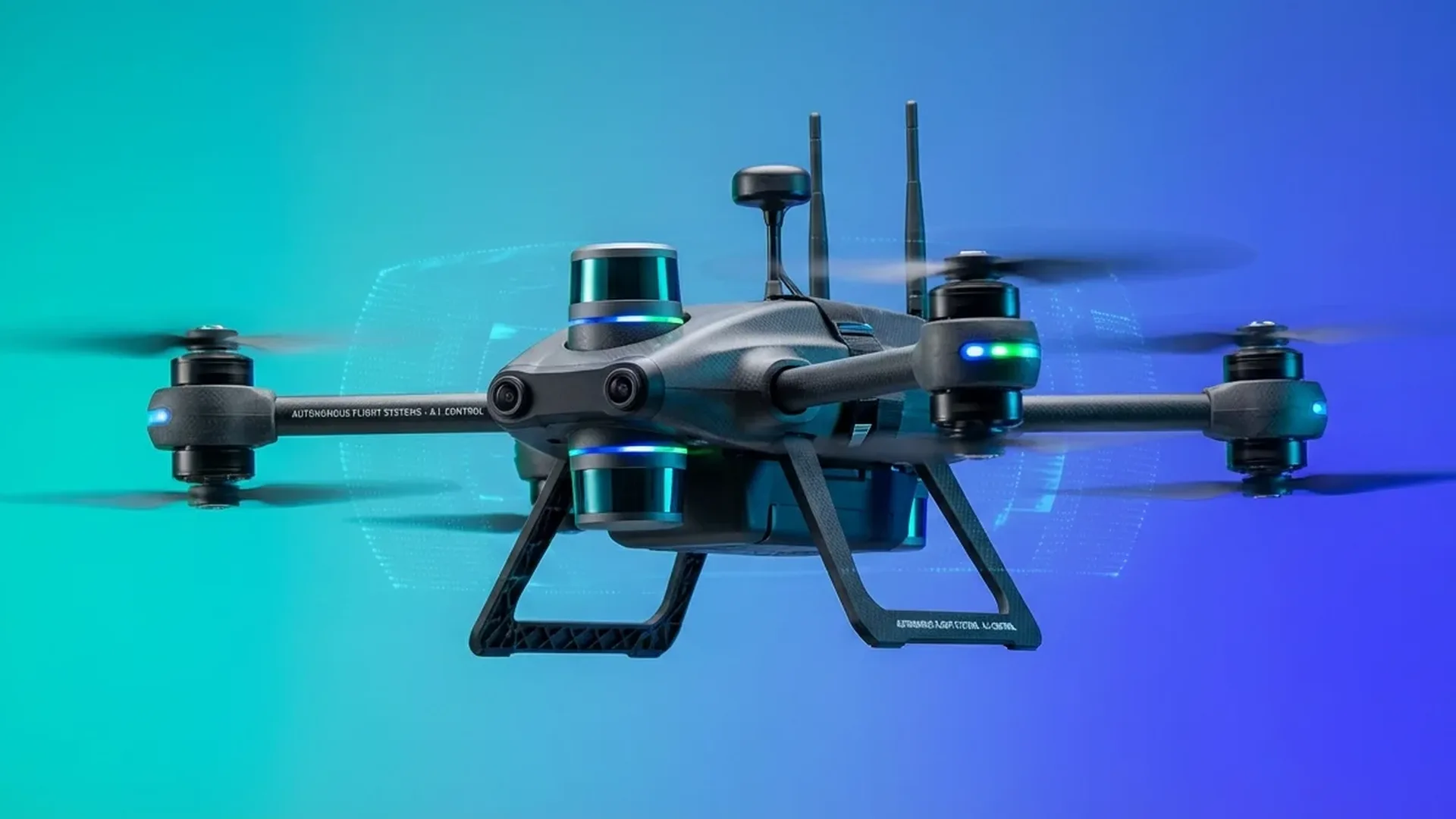
What Does “Autonomous” Drone Mean?
The International Civil Aviation Organization (ICAO) classifies unmanned aircraft into two basic categories: remotely piloted and fully autonomous. In practice, however, autonomy isn't an on/off state — there's an entire spectrum of levels.
A drone may feature autonomous functions like altitude hold (altitude stabilization), GPS waypoint navigation, return-to-home (automatic return) or follow-me (user tracking) without that meaning it flies entirely on its own. Full autonomy means the drone plans, executes and completes a mission without any operator in the control loop.
The 4 Levels of Autonomy
The industry uses a 4-level system, similar to that of autonomous vehicles, to describe autonomous flight capabilities:
Assisted Flight (Pilot Assist)
Basic altitude and position stabilization. The operator has full control, but barometer and gyroscope sensors keep the drone stable. Example: DJI Mini 4 Pro (~€700 / ~$759) in ATTI mode.
Partial Autonomy
GPS waypoint navigation, follow-me, orbit. The drone executes programmed routes, but operator oversight is required. The DJI Air 3S (~€1,010 / ~$1,099) performs complex waypoint missions.
High Autonomy
Autonomous obstacle avoidance, dynamic rerouting, automatic takeoff/landing. The operator intervenes only in emergency situations. Example: Skydio X10 with omnidirectional sensors.
Full Autonomy
The drone autonomously completes a mission without operator oversight, handling normal conditions. Zipline's drones operate at Level 4 autonomy for medical supply deliveries.
Autonomous Deliveries: Zipline & Wing
The two biggest players in autonomous aerial deliveries — Zipline and Wing (Alphabet/Google) — have proven that autonomous drones can operate commercially at scale.
Zipline: 1+ Million Deliveries
Zipline began operations in Rwanda in 2016 delivering blood and medical supplies to rural clinics. By April 2024, it had completed over 1 million commercial deliveries and over 70 million autonomous miles.
Zipline currently operates in 7 countries: Rwanda, Ghana, Nigeria, Ivory Coast, Kenya, Japan and the USA. In Ghana, it delivered over 1 million COVID-19 vaccine doses, reducing vaccine stockouts by 60% and missed vaccination opportunities by 42%.
| Feature | Zipline Platform 1 | Zipline Platform 2 |
|---|---|---|
| Type | Fixed-wing | VTOL (vertical takeoff/landing) |
| Weight | 20 kg (44 lbs) | Not published |
| Payload | 1.8 kg (4 lbs) | 3.6 kg (8 lbs) |
| Speed | 101 km/h (63 mph) | 110 km/h (70 mph) |
| Range | 80 km (50 mi) radius | 16 km (10 mi) radius |
| Delivery | Parachute drop | Wire lowering within 1 m accuracy |
| Autonomy Level | Level 4 | Level 4 |
In early 2025, Zipline started a partnership with Walmart in the Dallas–Fort Worth area of Texas, using the new Platform 2 drones for retail home deliveries. These drones take off vertically, fly at 100 meters altitude and lower packages via wire with 1-meter accuracy.
Wing (Alphabet): The First Certified Drone Airline
Wing, a subsidiary of Alphabet Inc. (Google's parent company), became the first drone delivery company to receive an Air Operator Certificate from the FAA in April 2019. The company operates in Australia, USA, Finland and Ireland.
Wing's drones use a hybrid design: vertical takeoff/landing with multiple rotors and fixed wings for efficient long-distance flight. Wing's UTM (Unmanned Traffic Management) system optimizes each flight path, while black-and-white cameras detect obstacles without recording identifiable details — ensuring privacy. In Q1 2022 alone, Wing made over 50,000 deliveries.
Drone-in-a-Box: 24/7 Autonomous Bases
Drone-in-a-Box (DiB) systems represent the most advanced level of autonomous operation: a drone that lives, charges, takes off and executes missions entirely on its own from an automated base. No pilot, no on-site technician.
DJI Dock 2
75% smaller and 68% lighter than its predecessor. IP55 protection, 10 km radius, automatic charging in 32 minutes, takeoff in 45 seconds. DJI Dock 2 + Matrice 3D/3TD system: ~€18,000–€27,000 (~$20,000–$30,000).
Percepto AIM
Autonomous industrial facility inspection platform. Drones execute scheduled data-capture missions without human intervention — ideal for oil, energy and port facilities.
Skydio X10
Omnidirectional obstacle avoidance, NightSense, NVIDIA Jetson Orin. Designed for autonomous missions in complex environments. Price: ~€9,200–€11,000 (~$10,000–$12,000).
Why Drone-in-a-Box?
The primary driver for DiB adoption is labor cost reduction. An industrial inspection that required a specialized pilot, travel and permitting can now be executed automatically — day or night, in any weather conditions (within limits). DJI's FlightHub 2 platform enables management of multiple Dock stations from a single control center, in real time.
BVLOS & U-Space Regulations
Beyond Visual Line of Sight (BVLOS) flight is the key to mass deployment of autonomous drones. Without BVLOS approval, a drone is limited to about a ~500-meter radius. With BVLOS approvals, range extends to dozens of kilometers.
EU Regulatory Framework
EASA (European Union Aviation Safety Agency) has established a three-tier category system for drone flights:
| Category | Flight Type | Requirements |
|---|---|---|
| Open | Low risk, VLOS | Registration, exam, <120 m altitude |
| Specific | Medium risk, BVLOS | Risk assessment (SORA), STS scenarios |
| Certified | High risk, passenger transport | Full aircraft certification |
In 2024, EASA approved the first certification basis for a UAV flight controller under ETSO-C198 (Embention autopilot) — a significant step toward integrating autonomous drones into European airspace.
Remote ID & U-Space
Remote ID works like a drone's "license plate": it broadcasts position, identity and direction data in real time. Since 2024, it's mandatory in the US (FAA) and is gradually being implemented in the EU. Remote ID equipment cost: ~€90–€275 (~$100–$300).
U-Space is the European drone air traffic management (UTM) system, designed to enable thousands of autonomous flights simultaneously in urban environments. It includes:
- U1: Basic services (registration, identification, geofencing)
- U2: Flight plan management, approvals, notifications
- U3: Dynamic management in dense traffic, conflict resolution
- U4: Full automation, integration with manned traffic
5G technology plays a critical role, as the standard mandates latency below 1 ms in ultra-reliable low-latency (URLLC) mode — vital for real-time control of autonomous BVLOS flights.
Applications in Greece
Greece, with its 6,000+ islands and challenging mountainous terrain, is an ideal field for autonomous drone applications. Sectors with enormous potential:
Medical Transport
Delivery of blood, vaccines and medications to islands and remote communities. Pilot programs are being evaluated in the Aegean. Zipline showed it reduces delivery times by 61% and blood wastage by 67%.
Precision Agriculture
Autonomous spraying and mapping drones in olive groves, vineyards and fields. Scheduled flights without an operator reduce costs and increase spraying accuracy.
Infrastructure Inspection
Autonomous inspection of solar parks, wind turbines, power lines and telecom towers. Drone-in-a-Box systems operate 24/7 without an on-site pilot.
The Future: Swarms & Cities 2030
The next phase of autonomous flight isn't just about individual drones, but about swarms that cooperate with each other. Swarm intelligence algorithms allow dozens or hundreds of drones to map an area, execute search-and-rescue missions or monitor wildfires — autonomously and in coordination.
The unmanned aerial systems (UAS) market is expected to nearly double from $12.5 billion in 2024 to $20 billion by 2034, according to GlobalData. In this market, autonomous systems will hold the largest growth share.
What's Coming Next?
- Urban deliveries in <30 minutes — Zipline-type Platform 2 drones in European cities
- Fully autonomous industrial inspections — Drone-in-a-Box at every major facility
- Medical deliveries to Greek islands — Pilot programs underway
- U-Space U3/U4 — Dynamic management of thousands of autonomous flights in urban space
- Swarm missions — Dozens of drones in autonomous mapping and rescue missions
From Rwanda to Dallas, from Finland to the Aegean, autonomous drones are no longer asking whether they'll change the world — they're asking how fast. And the answer, in 2026, is: faster than you think.