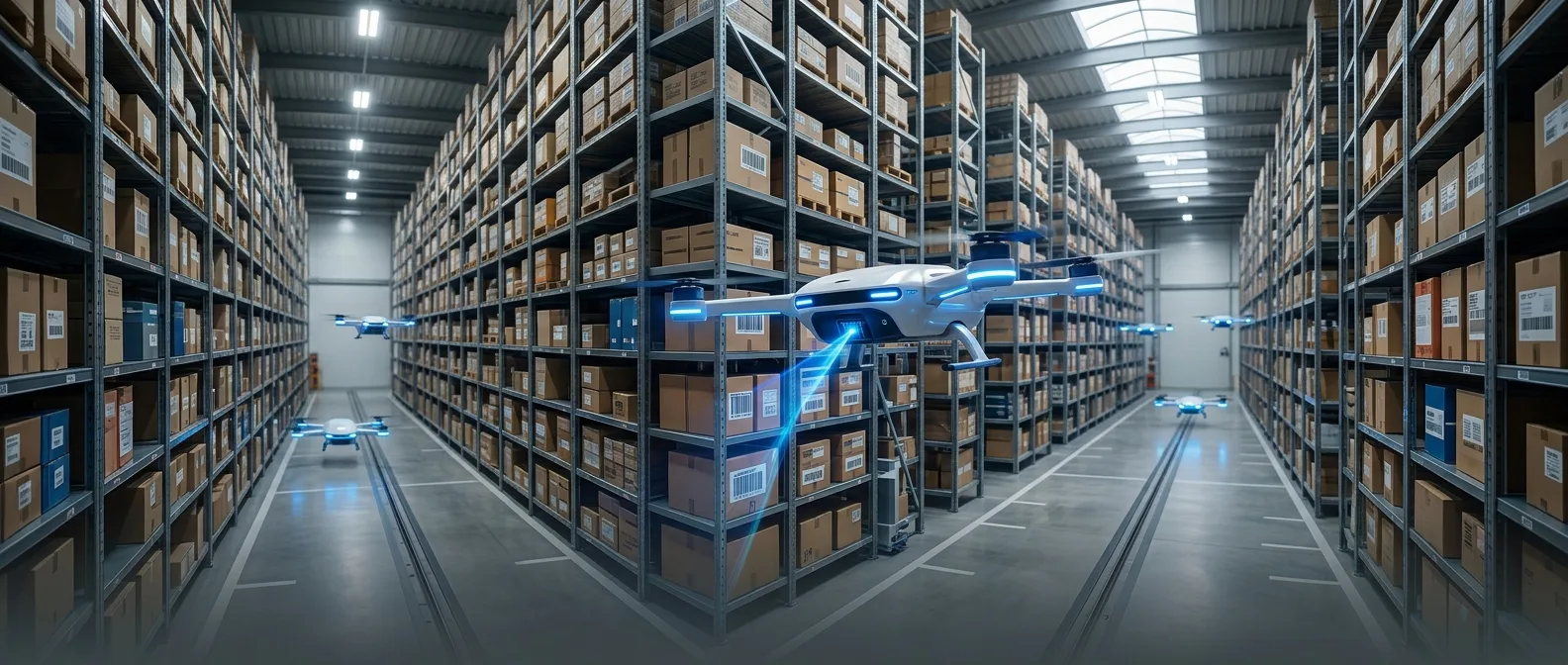
Forty autonomous drones fly through America's largest wine and spirits distributor every single day. This isn't science fiction — it's Southern Glazer's new reality, where 18 months of deployment have completely transformed how the company counts inventory.
Picture this: drones weaving between towering pallets in Raymore, Missouri, scanning barcodes and flagging discrepancies without disrupting normal warehouse operations. Corvus Robotics' autonomous drones have caught over 35,000 confirmed inventory errors in just 5,000 flights. That's one error every seven scans.📖 Read more: 40 Warehouse Drones Cut Inventory Errors by 35,000 in 18 Months
🔄 The Age of Autonomous Warehouse Drones
Corvus One drones aren't just flying cameras. They run on Embodied AI — artificial intelligence that actually understands its environment. These machines recognize products, track locations, and navigate between sky-high shelves loaded with pallets. The system operates 24/7 without human oversight. Each drone executes autonomous counting missions, syncs data with the company's Warehouse Management System, and creates high-resolution images from every scan.Technical Details That Make the Difference
Every Corvus One packs custom cameras designed for warehouse environments, obstacle-avoidance sensors, and software that processes barcode data in real time. They spot misplaced pallets, identify missing LPNs (License Plate Numbers), and log any anomaly in inventory placement. The breakthrough? Operations don't stop for counting. Drones fly above workers, between aisles, without affecting productivity.40+ Autonomous Drones
9 Distribution Centers
35,000+ Confirmed Errors Found
⚡ From Quarterly to Bi-Weekly Inventory Counts
The impact goes beyond technology — it's economic. Southern Glazer's jumped from quarterly inventory counts to biweekly cycles. That means six times more counts without additional labor costs. The numbers are striking: 100 basis points improvement in cases per hour, roughly 1% productivity increase. Sounds small? In a warehouse processing thousands of cases daily, this translates to hundreds of thousands in annual savings.The Human Side of Warehouse Automation
Here's what's even more interesting: workers aren't losing jobs. Instead, 60-70 labor hours per week per site get freed from manual counting and redirected to higher-value tasks."Instead of doing general counts, our teams focus on resolving confirmed discrepancies. The system provides them with high-resolution images, scanned labels, and historical video logs tied to specific storage locations."
Karli Sage, VP Supply Chain Management, Southern Glazer's
📖 Read more: Lucid Bots Raises €18M for Cleaning Drones and Robotics
🎯 Why Now? The Business Case for Inventory Drones
The timing isn't random. Southern Glazer's is North America's largest alcoholic beverage distributor, with revenues exceeding $26 billion. In food and beverage distribution, where profit margins are tight, even small improvements in inventory accuracy create massive downstream impact.The Complexity of Modern Inventory Management
High SKU counts, fast-moving products, strict service level requirements — these characteristics make beverage warehouses particularly demanding. Every pallet represents significant value, and one misplaced case can cost thousands in lost sales. Traditional counting models couldn't keep up. Quarterly inventory counts spotted problems too late. By then, errors had already affected customer orders, stock levels, and ultimately profits.What the Drones Detect
- Misplaced pallets: Products in wrong locations
- Missing LPNs: Lost License Plate Numbers that complicate tracking
- Incorrect placements: Violations of storage system protocols
- Inventory discrepancies: Gaps between physical and digital stock
📖 Read more: AI and Drones: How Artificial Intelligence Changes Drones
🧬 The Technology Behind Corvus One Drones
Embodied AI is the key. Unlike simple drones following programmed routes, Corvus One machines "understand" their environment. They use computer vision to recognize barcodes, AI to interpret spatial data, and machine learning to improve accuracy with every flight.Real-Time Data and WMS Integration
Every scan syncs automatically with Southern Glazer's WMS. This means managers get real-time inventory visibility without delays, manual data entry, or human errors. The system also creates searchable, time-stamped footage from every scan. When problems arise, teams can see exactly what happened, when, and how. Root-cause analysis and coaching become much easier.📊 Numbers That Speak for Themselves
After 18 months of operation, the results are crystal clear:Counting Frequency
From quarterly to biweekly — 6x more counts at the same cost
Productivity
100 basis points improvement in cases per hour — faster order fulfillment
Human Resources
60-70 hours/week/site freed for higher-value tasks
Scaling to 9 Facilities — What This Means
Expanding to nine facilities with over 40 drones isn't just tech flexing. It's proof the technology has moved past pilot stage and become core infrastructure. Each new site coming online learns from previous deployments. Regular cross-site operational reviews let facilities share best practices and continuously improve integration of autonomous inventory systems into daily operations.📖 Read more: Anti-Drone Technology: How They Catch Drones