📡 Phase 1: Detection — How We Spot a Drone
Before a drone can be neutralized, it must first be detected. This is harder than it sounds: modern drones are small, fly low, and don't show up easily on conventional radar. The solution lies in multiple sensors working simultaneously.
RF Detection (Radio Frequency)
The most widespread method. Specialized receivers scan the radio spectrum for control signals between a drone and its operator. Companies like Dedrone (Germany/USA) and DroneShield (Australia) specialize in this technology. DroneShield, founded in 2014, became the best-performing stock on the S&P/ASX 200 index by 2024, reaching a market cap of A$2.9 billion (~€1.8 billion / ~US$1.9 billion). Its products are deployed in over 40 countries — including the US, France, and Poland — and are actively used in the Ukraine conflict.
Radar Detection
Specialized micro-Doppler radar can distinguish a drone from birds thanks to the distinctive signature of spinning propellers. Companies like Blighter (UK) combine radar with electro-optical sensors in the AUDS (Anti-UAV Defence System), developed in partnership with Chess Dynamics and Liteye Systems. AUDS was deployed against ISIS drones during the Battle of Mosul (2016-2017).
Acoustic, Optical & Thermal Detection
Acoustic sensors can “hear” a drone's characteristic buzz from 300-500 meters away. Meanwhile, EO/IR cameras (electro-optical/infrared) provide visual confirmation and identification. In integrated C-UAS deployments, these sensors work together: radar detects, the camera identifies, and RF recognizes the type.
Why Layered Detection Is Critical
No single sensor is reliable enough on its own. Autonomous drones without RF links evade RF detectors. Small low-altitude drones escape radar. City noise confuses microphones. Only a combination of multiple technologies delivers reliable 24/7 coverage.
🛡️ Phase 2: Soft-Kill — Electronic Neutralization
Once a drone is detected, the first line of response is typically electronic interference — the so-called “soft-kill” approach. It doesn't physically destroy the drone but forces it to lose control or perform a “soft” landing.
RF Jamming
The jammer emits a powerful signal on the 2.4 GHz and 5.8 GHz frequencies (the control channels of common drones), severing the link between drone and pilot. Most drones, upon losing signal, activate fail-safe protocols — either Return to Home (RTH), hover-in-place, or simply descend. Example: DroneShield's DroneGun — a handheld jamming “rifle” weighing about 6 kg, with a range of 1-2 kilometers.
GPS Spoofing
A more sophisticated technique that broadcasts fake GPS signals to the drone, “convincing” it that it's somewhere else. The result: diversion, forced landing, or RTH to a location chosen by the defender. More complex than jamming but far more controllable.
Protocol Hijacking (Cyber Takeover)
The most elegant solution: instead of blocking the signal, you take over control yourself. Israeli company D-Fend Solutions developed the EnforceAir system, which identifies the drone's communication protocol, “hacks” it in real time, and safely lands it at a predetermined point. This means no debris falling to the ground — critically important in urban environments or near crowds.
💥 Phase 3: Hard-Kill — Physical Destruction
When electronic countermeasures aren't enough — for instance, against autonomous drones with no RF link, or loitering munitions (kamikaze drones) — physical destruction is required. This is where “hard-kill” systems come in.
Nets & Net Launchers
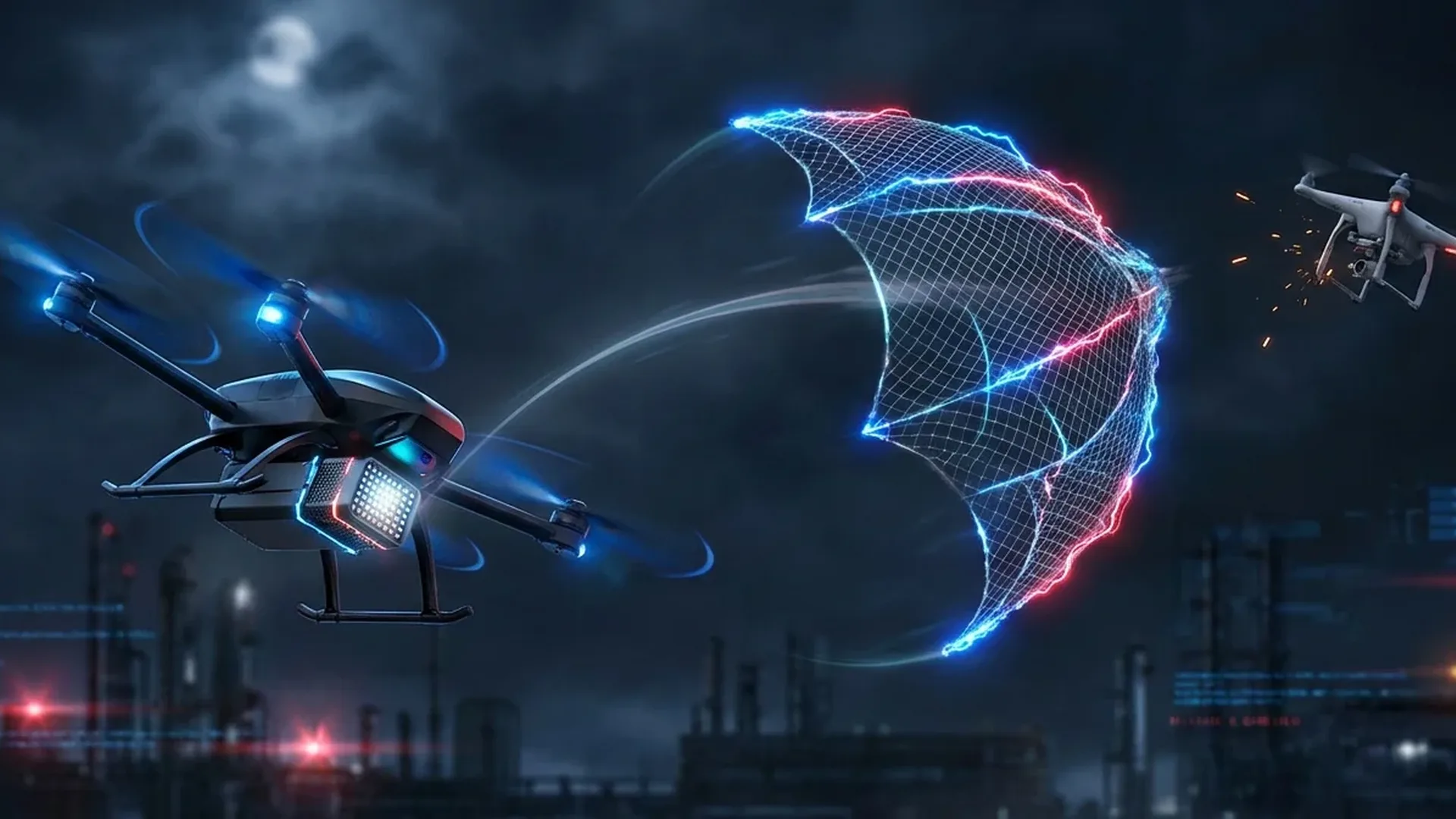
British company OpenWorks Engineering developed SkyWall, a shoulder-launched net-firing system that resembles a bazooka. It fires a capsule that deploys a net, trapping the drone, and lowers it safely via parachute — no uncontrolled crash. Range: approximately 100 meters. In the Netherlands, police tested trained eagles to snatch small drones mid-air — a solution later abandoned due to practical difficulties.
More advanced: US-based Fortem Technologies builds the DroneHunter, an autonomous interceptor drone that chases the intruder, fires a net, and carries it to a safe location. Ideal for protecting VIP events, airports, and military installations.
Kinetic Systems (Projectiles & Fire)
From anti-aircraft cannons to specialized counter-drone interceptor missiles. US defense giant Raytheon (now RTX) developed the Coyote, a small, affordable interceptor drone/missile designed to neutralize UAS. Already in active service with the US military, it costs significantly less than a traditional Patriot missile ($100,000-$150,000 per launch).
⚡ Directed Energy — The Lasers of the Future (That Arrived Today)
The most revolutionary development in Counter-UAS over recent years is directed energy weapons (DEW). These are High-Energy Laser (HEL) and High-Power Microwave (HPM) systems that neutralize drones almost instantly, at a cost of just a few dollars per “shot.”
Iron Beam / Laser Dome (Israel)
Developed by Rafael Advanced Defense Systems in collaboration with Lockheed Martin, Iron Beam (official English name: Laser Dome, Hebrew: Or Eitan) was officially integrated into the Israeli armed forces in December 2025. It uses a 100 kW fiber laser, firing hundreds of small coin-sized beams at the target. Once a beam is detected to have “hit,” the others redirect to the same spot, concentrating energy until destruction.
In May 2025, Rafael announced the first combat use of laser systems, shooting down 40 Hezbollah UAVs in October 2024 during the Gaza conflict. Cost per intercept: approximately $3 (~€2.75), versus $100,000-$150,000 (~€92,000-€138,000) per Iron Dome missile. Range: up to 10 km. A lighter variant, Lite Beam (10 kW, 2,000 m range), mounts on light vehicles for mobile protection.
Comparison: Cost of Downing a Drone
| Method | Cost/Shot | Range | Speed |
|---|---|---|---|
| Iron Beam (Laser) | ~$3 (~€2.75) | Up to 10 km | Near-instant |
| Iron Dome (Missile) | $100K-$150K | 70+ km | Fast |
| RF Jamming | <€500 (~$545) equip. | 1-5 km | Instant |
| SkyWall (Net) | ~€40 (~$44)/capsule | ~100 m | Moderate |
| Coyote Interceptor | ~$70K-$100K | 5+ km | Fast |
DragonFire (United Kingdom)
A comparable program is being developed by the UK — DragonFire, an HEL system expected to be operational by 2027. Turkey has also developed the ALKA system by Roketsan, a dual electromagnetic/laser DEW. According to reports, ALKA was used to shoot down a Wing Loong II UAV in Libya — if confirmed, this would represent the first time a vehicle-mounted combat laser destroyed a combat vehicle under genuine wartime conditions.
HPM — High-Power Microwave
An alternative to laser: microwave beams “fry” the drone's electronic circuits in fractions of a second. Unlike lasers, HPM isn't as affected by weather conditions (clouds, rain, dust) but offers lower precision. The technology is still in early stages of commercial development.
🏙️ Real-World Applications
Counter-UAS systems aren't lab prototypes anymore — they're in daily use across dozens of scenarios.
Airports
Drones near airports cause runway closures, flight cancellations, and millions in damages. London Gatwick Airport shut down for 3 days in December 2018 due to drone incursions, affecting 140,000 passengers.
Prisons & Facilities
Drones are used to smuggle drugs, phones, and weapons into correctional facilities. C-UAS systems like DroneShield's are installed at prisons worldwide.
Major Events
Super Bowl, Olympics, G7 summits — every major event now includes a C-UAS umbrella. D-Fend Solutions provides “controlled landing” protection without violent takedowns.
Battlefield
In Ukraine, DroneShield equipment, RF jammers, and electronic countermeasures form standard kit for every brigade. FPV drones are countered with personal handheld jammers.
⚖️ Legal Framework & Challenges
C-UAS deployments aren't legally straightforward. In most countries — including EU member states — jamming radio frequencies and destroying UAVs is only legal for government agencies (military, police, aviation authorities). Private use of jammers is a criminal offense in many jurisdictions, as it can interfere with critical telecommunications, cellular networks, and even aviation signals.
Additionally, destroying a drone over an urban area carries risks to bystanders — falling debris, LiPo battery fires, or injury. This is precisely why solutions like EnforceAir (controlled landing) and SkyWall (net + parachute) are considered more suitable for urban scenarios.
Who Is Allowed to Use C-UAS in the EU?
- Military & Air Force — full spectrum of C-UAS
- Police — with special authorization
- Airport authorities — in coordination with civil aviation
- Private citizens — PROHIBITED from using jammers & DEW
- Private citizens may only use passive detection (RF sensors, cameras)
🔮 What's Coming: Trends 2026-2030
Counter-UAS technology is evolving rapidly, with several trends set to reshape the market over the coming years.
AI-Powered Detection: Artificial intelligence that automatically identifies drones — distinguishing them from birds, aircraft, or noise — through machine learning applied to radar, RF, and camera data. Dramatically reduces false positives.
Swarm vs Swarm: As drone swarms become an increasing threat, the answer may be defensive swarms — AI-driven interceptor drones that autonomously hunt intruders. Fortem Technologies is already developing such scenarios.
Laser Miniaturization: The transition from a system the size of “6 city buses” (THEL, early 2000s) to a lightweight 10 kW Lite Beam on a light vehicle (2024) illustrates the rapid miniaturization. By 2030, lasers the size of personal weapons are anticipated.
Integrated Multi-Layer Defense Systems: Israel's model — Arrow 2/3 + David's Sling + Iron Dome + Iron Beam — demonstrates the philosophy: each threat tier is handled by a different system. This “layered shield” approach is becoming the standard for NATO nations.
🌍 Global Outlook & Emerging Markets
Greece, as a NATO member with extensive maritime borders and numerous islands, faces growing challenges from unauthorized drone flights. The Hellenic Air Force has been discussing fortifying critical infrastructure with C-UAS, especially following incidents of drone flights over military bases on the islands. Meanwhile, the USAF already operates MQ-9 Reapers from Larissa Air Base, underscoring the country's strategic importance in Eastern Mediterranean surveillance.
On a commercial level, Greek airports and ports are examining C-UAS integration, following the lead of major European airports. The local security market is expanding, with interest from companies operating in tourism, sporting events, and critical energy infrastructure. As prices for detection-only systems drop below €10,000 (~$11,000), even mid-sized organizations are beginning to adopt passive counter-drone monitoring.