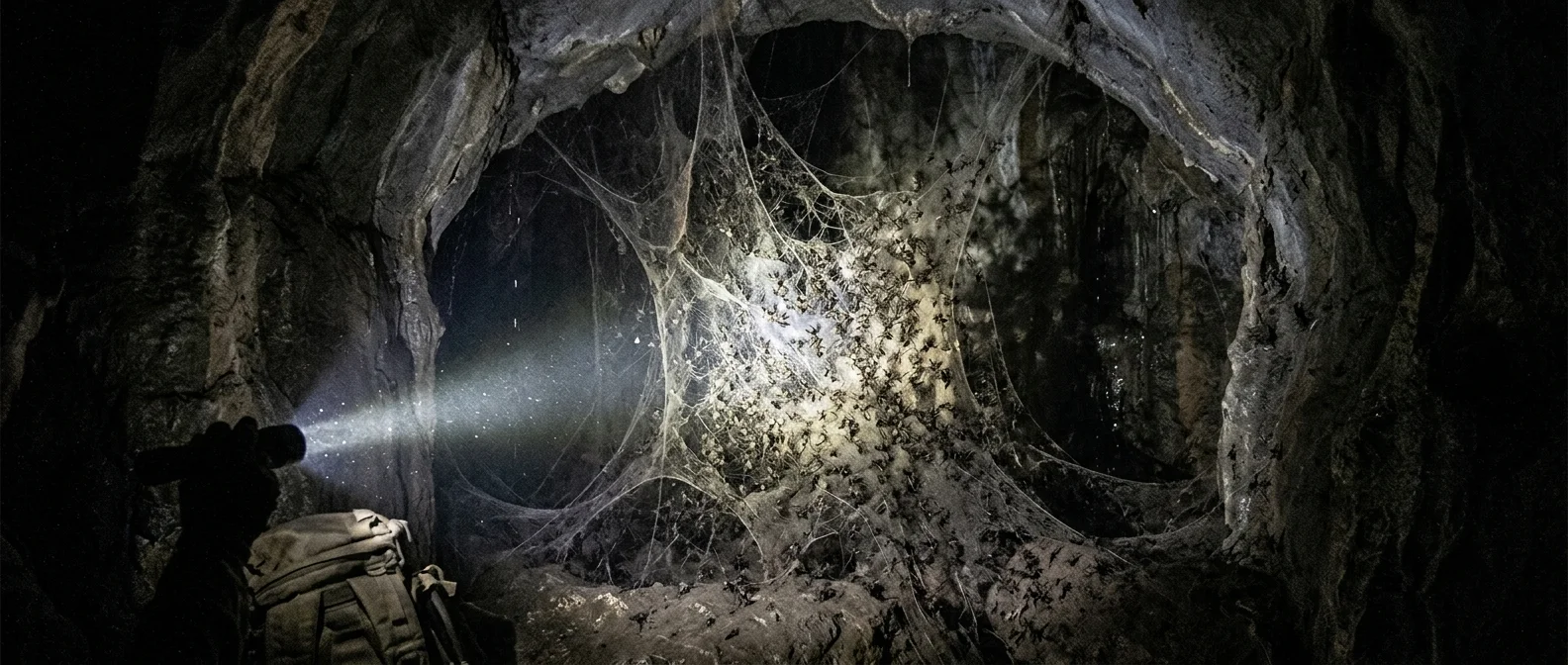
Deep beneath the mountains of the Vromoner gorge, on the Greek-Albanian border, exists a world no one imagined. Inside a hydrogen sulfide-filled cave, devoid of any trace of light, over 111,000 spiders from two different species live together in a massive shared web. They don't fight, they don't compete — they coexist. This discovery fundamentally changes what we know about the behavior of these ubiquitous creatures.
📖 Read more: Spiders Keep Fireflies as Living Bait to Lure 10x More Prey
The Sulfur Cave
The Sulfur Cave, as it's known, sits in the Vromoner gorge, precisely on the Greek-Albanian border. Carved over millennia by sulfuric acid formed from hydrogen sulfide oxidation in groundwater, this cave represents one of nature's most extreme environments. A sulfur-rich stream, fed by natural springs, runs through the entire length of the cave, filling it with hydrogen sulfide gases. The smell resembles rotten eggs. For most organisms, this is a lethal environment. For these spiders, it became home.
Speleologists from the Czech Speleological Society first discovered the giant web in 2022 during an exploration mission in the gorge. What they encountered left them speechless: in absolute darkness, massive networks of silk threads covered walls and ceilings across an impressive expanse. The team alerted researchers, launching the study that would reveal something unprecedented.
The Colony by Numbers
- 69,000 Tegenaria domestica (barn funnel weaver)
- 42,000 Prinerigone vagans (small spider)
- Location: Greek-Albanian border
- Published: Subterranean Biology, November 2025
Two Species, One Web
István Urák, associate professor of biology at Sapientia Hungarian University of Transylvania in Romania, led the study. DNA analysis revealed two dominant species: Tegenaria domestica, the common house spider that builds funnel-shaped webs, with approximately 69,000 individuals, and the smaller Prinerigone vagans, with over 42,000 individuals.
The remarkable aspect isn't just the numbers — it's the peaceful coexistence. Normally, Tegenaria domestica would hunt and consume the smaller Prinerigone vagans without hesitation — they're predator and prey respectively. In the cave's absolute darkness, however, the spiders' vision is severely limited, which appears to eliminate the predatory relationship between them. Unable to see its “enemy,” the larger spider doesn't recognize it as food. Instead of war, they found peace in the darkness.

The Cave's Food Chain
How do 111,000 spiders survive in a dark, toxic environment without any sunlight? The answer lies in a remarkable food chain based entirely on chemistry. Sulfur-oxidizing bacteria thrive in the cave's stream, forming white microbial biofilms — slimy secretions that protect the microorganisms. These biofilms feed swarms of non-biting midges, which in turn become food for the spiders.
The chain is simple but extremely effective: chemical elements > bacteria > biofilm > midges > spiders. Clouds of midges hover near the cave entrance, providing endless food for the spider metropolis. This chemosynthesis-based food chain resembles hydrothermal vents on the ocean floor — ecosystems that function entirely without sunlight.
📖 Read more: Four-Eyed Prehistoric Creature: The Ancestor We All Share
Genetic Adaptation to Darkness
The Sulfur Cave spiders aren't just random visitors — they've established permanent residence and taken root. Molecular analyses revealed that spiders inside the cave are genetically different from the same species living on the surface. This genetic divergence suggests the cave population has begun adapting to its extreme environment, developing characteristics not found in their surface-dwelling relatives.
Additionally, the sulfur-rich diet affects the spiders' microbiomes. Gut content analyses showed that cave spiders' microbiomes are significantly less diverse compared to the same species outside the cave. The reduced gut microbiome diversity reflects their monotonous diet — midges that feed exclusively on sulfur biofilms.
Colonial Behavior: The Big Surprise
Most spiders are solitary creatures. They hunt alone, weave their webs alone, and eat alone — often consuming their mates after reproduction. Colonial behavior, where hundreds or thousands of spiders share a common web and cooperate, is extremely rare in arachnology — fewer than 25 species worldwide exhibit it. In the Sulfur Cave, two species no one suspected could cooperate managed exactly that.
"We often believe we know a species completely, that we understand everything about it," Urák told LiveScience. "Yet unexpected discoveries continue to emerge. Some species display remarkable genetic plasticity, which usually becomes apparent only under extreme conditions. Such conditions can trigger behaviors not observed under 'normal' circumstances."

Comparison with Other Extreme Ecosystems
The Sulfur Cave ecosystem resembles other extreme environments where life finds a way. Hydrothermal vents on the ocean floor, Romania's Movile Cave sealed for 5.5 million years, and underground karst rivers — all share a common characteristic: life based on chemosynthesis instead of photosynthesis. The Sulfur Cave adds spiders to this club of exceptional creatures.
The size of this colony makes it globally unique. While colonial spiders exist in tropical forests — where social species build communal webs — the number of individuals in the Sulfur Cave exceeds any previous record. "This is a unique case of two species cohabiting in the same web structure in such enormous numbers," Urák emphasized.
Chemosynthesis
Sulfur bacteria instead of sunlight as the foundation of the food chain
📖 Read more: Galápagos Tortoises Return Home After 175 Years
Life in Darkness
Complete absence of light eliminates predatory relationships between species
Peaceful Coexistence
Predator and prey cooperate in a shared web within the cave
Genetic Divergence
Cave spiders evolving separately from external populations
The Researcher's Emotions
Urák didn't hide his admiration. "If I tried to express in words all the emotions that overwhelmed me when I saw the web, I would highlight wonder, respect, and gratitude," he told LiveScience. “You have to experience it to truly understand what you feel.” The natural world, he emphasized, still holds countless surprises.
The research was published in the scientific journal Subterranean Biology in November 2025. The team is already working on a new study that will reveal more details about the Sulfur Cave inhabitants. Meanwhile, they emphasize the need to preserve the colony, despite challenges created by the cave's location between two countries — a cave that belongs half to Greece and half to Albania.
Why This Matters
This discovery isn't just a curious story about spiders. It proves that life can adapt to completely extreme conditions in ways we never imagined. Species we considered fully understood — like the common house spider found in our basements — can exhibit entirely new and unpredictable behaviors when placed in unprecedented environments.
The Sulfur Cave reminds us that even at our doorstep — literally at the Greek borders — entire uncharted worlds exist. 111,000 spiders build a city together in darkness, feeding on sulfur bacteria, genetically adapted to an environment that would kill most organisms. And this is just the beginning — Urák's research team promises more revelations from the depths of this cave.