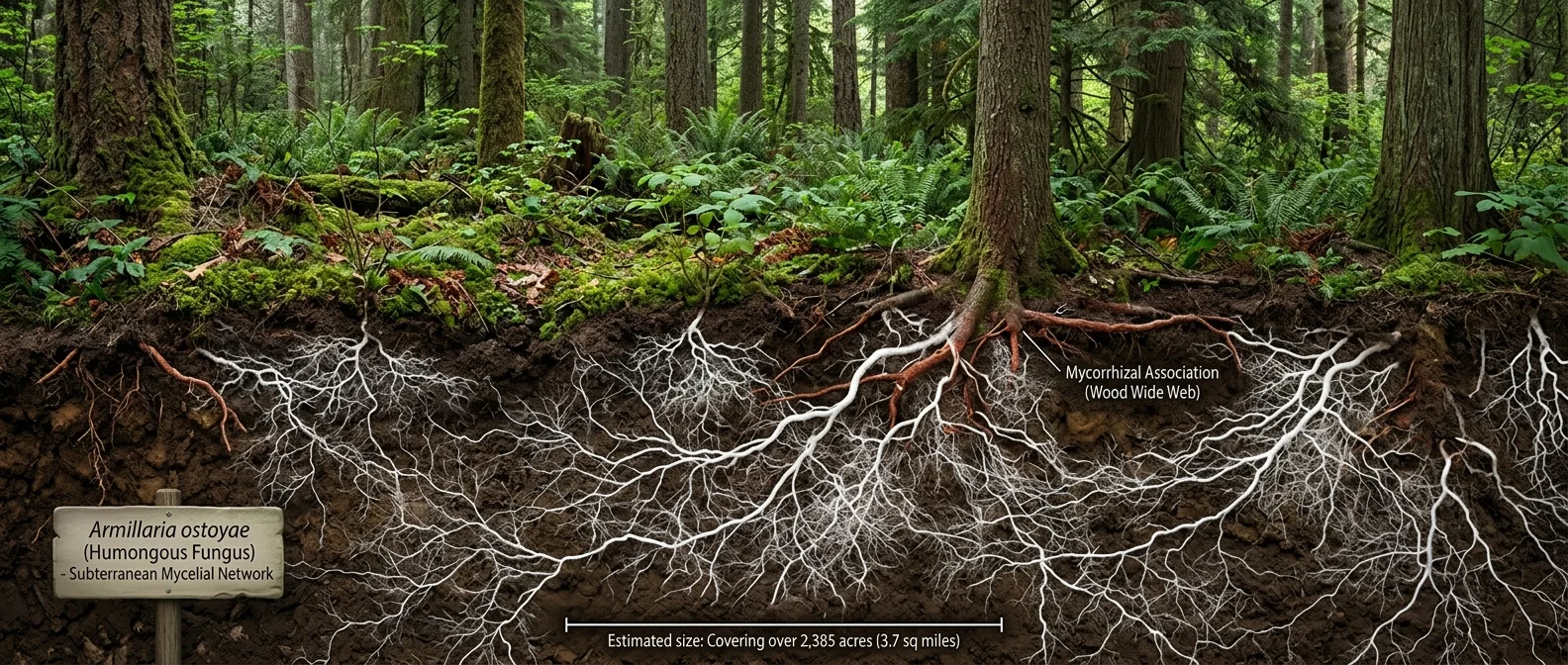
If someone asked you what the largest organism on the planet is, what would you say? A blue whale perhaps? A giant sequoia? Neither. The largest organism lives hidden beneath the soil of an Oregon forest — and it's a fungus. It covers an area larger than 1,600 football fields, weighs thousands of tons, and could be millennia old.
📖 Read more: Spinosaurus: Swimming Dinosaur Larger Than T. rex
The Colossus of the Blue Mountains
In the Malheur National Forest, in Oregon's Blue Mountains, lives Armillaria ostoyae — a fungus locals call the “Humongous Fungus.” It was discovered in the early 2000s when forest pathologist Catherine Parks and her team investigated massive, unexplained tree deaths across a vast mountain region. Analyzing DNA samples from mycelia at dozens of locations, they reached a stunning conclusion: all samples belonged to the same genetic clone. A single organism extended across 965 hectares — roughly 9.65 square kilometers. Its estimated mass exceeds 6,000 tons, and its age is calculated between 2,400 and 8,650 years. To grasp the scale: if you walked from one edge of the fungus to the other, you'd need over two hours of brisk walking.
Rhizomorphs: The Fungus's Underground Cables
Armillaria ostoyae spreads through rhizomorphs — dark, rope-like structures that resemble plant roots but aren't. These structures develop within the soil and can travel several meters to locate new host trees. Once they reach a tree's root, they penetrate the bark layer, extracting nutrients and water. Rhizomorphs exhibit characteristic bioluminescence — they glow faintly in darkness due to biochemical reactions. The tree gradually weakens — leaves yellow, growth stops, and eventually it dies. The process can take years or even decades, depending on the tree's resistance and soil conditions. On the surface, the only visible sign is gradual canopy thinning and clusters of honey mushrooms appearing at the trunk base each autumn.

Parasite or Recycler?
Armillaria ostoyae acts primarily as a necrotrophic parasite — it kills trees and feeds on dead tissue. This sounds destructive, but from an ecological perspective it plays a crucial role in forest ecosystem dynamics. The trees it kills create gaps in the forest canopy, allowing light to reach the understory. New plants sprout in these gaps, increasing biodiversity. Simultaneously, the fungus decomposes dead wood, releasing nutrients back into the soil. Nitrogen, phosphorus, and potassium return to the nutrient cycle. Without these decomposers, forest ecosystems would suffocate under layers of dead wood. In fact, 90% of terrestrial plants depend directly or indirectly on fungal action for nutrient recycling.
The "Wood Wide Web": Mycelial Networks
Beyond Armillaria, thousands of different fungal species form mycorrhizae — symbiotic relationships with plant roots. These mycelial networks transport water, nutrients, and even chemical danger signals between trees. When a tree comes under insect attack, it can send warning signals to its neighbors through mycelial threads. Suzanne Simard, forest ecology professor at the University of British Columbia, showed with radioactive carbon experiments that “mother” trees actively share sugars with young seedlings through mycorrhizal threads. A Douglas fir can connect underground with dozens or even hundreds of neighbors simultaneously through this network. This network enhances the forest's overall resilience to droughts, diseases, and environmental disturbances. Research has also shown that plants connected to mycorrhizal networks exhibit better growth and higher survival rates compared to isolated plants. This proves that fungi aren't simply parasites — they're fundamental pillars of forest health.
Pando: The Other Giant
While Armillaria holds the size record by mass, there's another contender. In Utah, an entire forest of quaking aspens (Populus tremuloides) is called Pando — Latin for “I spread.” It consists of 47,000 tree trunks sharing a single root system. Each trunk is a genetically identical clone, making Pando a single organism weighing approximately 6,600 tons, making it the heaviest known organism on the planet. The age of this root system is estimated at 80,000 years — though some researchers question this impressive estimate, arguing that the clonal root system may regenerate. Unfortunately, Pando is shrinking: overgrazing by deer and cattle prevents new shoots from developing into mature trunks, while older trunks age and fall. Scientists have installed fencing around sections of Pando to protect young trees, with encouraging results.

Fungi: The Invisible Heroes of Decomposition
Fungi constitute a separate taxonomic kingdom — Fungi — and are neither plants nor animals. They feed heterotrophically, secreting digestive enzymes into the environment and absorbing nutrients — a process completely different from photosynthesis or food ingestion. Without them, fallen leaves, dead trunks, and animal carcasses would accumulate endlessly. Certain fungal species, like white-rot fungi, are the only organisms capable of completely breaking down lignin — the polymer that makes wood hard. Before these fungi appeared about 300 million years ago, dead trees didn't fully decompose — and formed the massive coal deposits of the Carboniferous Period we burn today. The emergence of white-rot fungi ended wood accumulation and forever changed Earth's carbon cycle.
Sustainability and Threats
Mycelial networks face serious threats. Deforestation and land conversion to agricultural areas destroys mycorrhizae that take decades to develop. Fungicide use in agricultural areas eliminates beneficial fungi along with pathogens. Climate change gradually alters soil temperature and moisture, affecting fungal community composition. However, there are promising developments: mycoremediation uses fungi to clean contaminated soils of petroleum products and heavy metals, while mycorrhizal cultivation in nurseries significantly helps reforestation of damaged areas. You can make a difference by supporting sustainable forestry practices and reducing chemical pesticide use.
The Fungus That Makes History
The discovery of the massive Oregon Armillaria wasn't the first. In 1992, Smith, Bruhn, and Anderson published in Nature that an Armillaria bulbosa (now called A. gallica) in Michigan covered 15 hectares and was at least 1,500 years old. This study sparked intensive new searches in forests worldwide — from Europe to Asia. Today we know such giant fungal clones aren't rare — just invisible. Every time you walk among forest trees, you're stepping on invisible mycelial networks that may extend for kilometers. The truth is we live on a planet of fungi — we just don't see them. And perhaps that's the most fascinating part: Earth's largest organisms remain invisible to most humans who literally walk over them.
"The largest organism on Earth doesn't stand tall — it spreads silently beneath our feet."
— Catherine Parks, USDA Forest Service pathologistSources:
- Ferguson, B.A. et al. — "Coarse-scale population structure of pathogenic Armillaria species in a mixed-conifer forest in the Blue Mountains of northeast Oregon", Canadian Journal of Forest Research, 2003
- Smith, M.L., Bruhn, J.N. & Anderson, J.B. — “The fungus Armillaria bulbosa is among the largest and oldest living organisms”, Nature, 1992