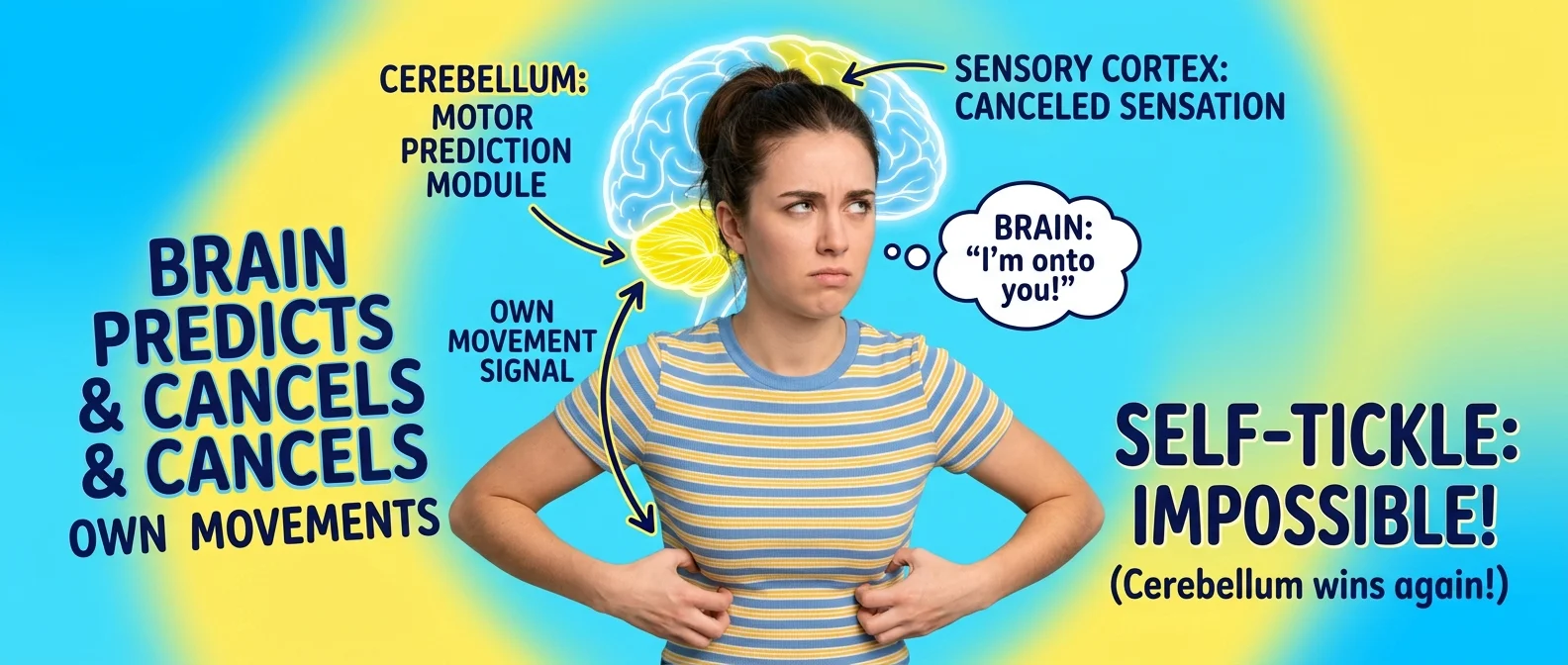
Try it right now. Run your fingers under your armpit. Nothing. No laughter, no squirming. Now imagine someone else making the exact same motion — and suddenly you're helpless. How does the identical physical contact trigger such different reactions? The answer lies deep inside the brain, in a structure most people have never heard of.
📖 Read more: Your Nose Recognizes 1 Trillion Scents: How?
The Cerebellum: The Hidden Predictor
At the back of your skull, beneath the cerebral hemispheres, sits a fist-sized structure: the cerebellum. For decades, neuroscientists believed its role was limited to coordinating movement. Walking, balance, fine manipulation of objects. But the cerebellum does something far more complex.
Every time you plan to move, your brain sends two signals simultaneously. The first goes to your muscles to execute the movement. The second — an internal copy called an efference copy — goes to the cerebellum. There, this structure creates a prediction: “If my hand touches this spot, expect this sensation.” When the actual sensation matches the prediction, the brain downplays it. It almost completely ignores it.
This is why you can't tickle yourself. It's not the pressure, speed, or location. It's that your brain already knows what's coming.
Efference Copy: The Internal Cancellation System
The idea of efference copy isn't new. German physiologist Helmholtz proposed it in the 19th century, observing that the world doesn't appear to move when we voluntarily move our eyes — but “jumps” if someone presses our eyelid from outside. The brain compensates for our own movements but can't compensate for external ones.
In tickling, exactly the same mechanism operates in touch. The cerebellum receives the efference copy, calculates what you'll feel, and sends a signal to the somatosensory cortex: “Ignore it, it's ours.” The sensory response drops dramatically. A light touch that would make you jump if done by someone else causes nothing when you do it.
📖 Read more: Why We Dream: The Science Behind Our Nightly Visions

The Robot That Revealed Everything
In 1998, neuroscientist Sarah-Jayne Blakemore at University College London designed an experiment that changed our understanding. She used a robotic arm that transferred a person's hand movement to their own palm — but with a small time delay.
When there was no delay, no one felt tickled. The cerebellum's prediction matched the sensation perfectly. But as soon as the delay increased — even by 200 milliseconds — volunteers began to feel ticklish. The greater the delay, the more intense the sensation. The prediction no longer matched. The brain treated the self-generated stimulus as external.
The experiment, published in Nature Neuroscience, revealed something fundamental: the tickling sensation doesn't depend on who touches you, but on whether the brain can predict the touch.
Why Surprise Is Essential
Think of tickling as an alarm system. A light, unpredictable touch on the skin could mean something important — an insect, a snake, something requiring immediate reaction. That's why the brain responds so intensely to external stimuli. But if it responded the same way to your own touches, it would be like the alarm going off every time you moved your hands.
📖 Read more: 10 Animals That Glow in the Dark: Bioluminescent Wonders
Evolution solved this problem: the brain dramatically reduces sensory signals it generates itself. It keeps only the detection of external stimuli active. This separation — self versus world — is a fundamental pillar of neural function.
An interesting point: the mechanoreceptors in your skin don't make the distinction. They send exactly the same signals whether you touch yourself or someone else does. The “filtering” happens exclusively in the brain.
Two Types of Tickling
Scientists distinguish two types of tickling, with names dating back to Darwin's era. Knismesis is the light, annoying sensation — like a feather passing over skin. You can feel this even when you do it to yourself, to some degree. Gargalesis is the intense, deep tickling that makes you laugh involuntarily. This is nearly impossible to self-induce.
Why the difference? Knismesis mainly activates superficial skin receptors and doesn't require much prediction — a very light stimulus suffices. Gargalesis, however, requires complex somatosensory processing and activation of the hypothalamus, a region connected to emotions. When the brain can fully predict such a stimulus, it blocks it.

📖 Read more: Bonobos Play Pretend: No Longer Just a Human Thing
Schizophrenia: When the Filter Breaks
One of the most striking findings came from an unexpected direction. People with schizophrenia can tickle themselves. This isn't anecdotal — it's a documented finding.
Blakemore's team used the robotic arm and found that in people with schizophrenia, the cerebellum doesn't effectively filter self-generated stimuli. The prediction mechanism doesn't work normally. And this explains something deeper: if you can't distinguish what your self generates from what the world generates, then auditory hallucinations — the “voices” — become understandable. They're internal speech that the brain treats as external.
This connection between tickling and schizophrenia wasn't obvious. But thanks to experiments with robots and magnetic imaging, neuroscience revealed that the ability to distinguish yourself from the world isn't philosophical — it's neurological.
The Evolutionary Root of Tickling
Why do we get tickled at all? If it's just a “bug” in the nervous system, why didn't evolution eliminate it? One theory says tickling functions as a social bonding mechanism. Parents and children, friends, couples — tickling causes laughter, and laughter strengthens social bonds.
We're not alone in this. In 2016, researchers Ishiyama and Brecht at Humboldt University Berlin discovered that rats emit ultrasonic sounds — a kind of “laughter” — when tickled on the belly. Moreover, rats actively seek tickling, chasing the researcher's hand. Neural activity during tickling was located in the somatosensory cortex — the same region activated in humans.
This means the tickling response has evolutionary roots of at least 80 million years, when rodents evolutionarily separated from primate mammals.
📖 Read more: Dolphins Sleep with Half Their Brain Awake
Open Questions and New Directions
Despite significant progress, much remains unanswered. Why are certain body parts more sensitive to tickling than others? The soles, armpits, ribs — the most “ticklish” spots — happen to be the most vulnerable to danger. Coincidence? Perhaps not.
A second question concerns children. Infants show tickling responses from their first months of life, but it's unclear whether the response is pleasure or discomfort — or something entirely different. Some researchers argue that the “ticklish” response in infants functions as an early body mapping system: the brain learns where the body ends and the world begins.
There's also a third question that remains open: why can't anyone be tickled while sleeping? If someone touches you lightly while you're asleep, the response is usually not laughter but awakening. The brain in sleep state seems to process sensory signals differently, prioritizing danger detection instead of laughter production. The exact neural basis of this change hasn't been fully clarified.
What we know for certain: the inability to tickle yourself isn't some quirk. It's a window into a fundamental brain mechanism — the way it distinguishes self from world, a capacity so deeply rooted that when it breaks, the entire perception of reality changes.
Sources:
- Blakemore, Wolpert & Frith, “Central cancellation of self-produced tickle sensation,” Nature Neuroscience, 1998
- Ishiyama & Brecht, “Neural correlates of ticklishness in the rat somatosensory cortex,” Science, 2016