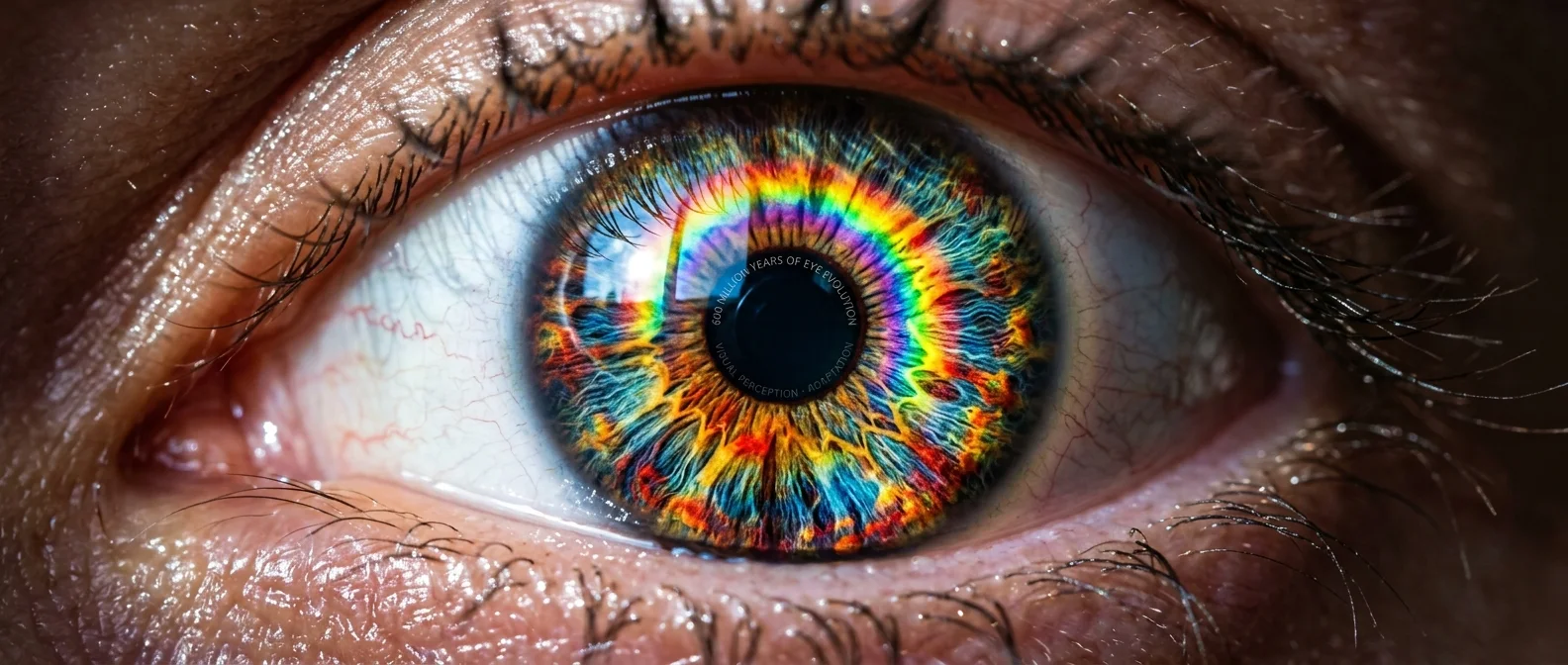
You watch a sunset and see red, orange, purple — while your dog sees only two muted shades. A hawk, however, sees colors you can't even imagine. Why? The answer lies in 600 million years of photoreceptor evolution, opsin proteins, and retinal development — a journey that begins with a single-celled bacterium and ends with the 6 million cones in the human eye.
📖 Read more: Mantis Shrimp: 50 MPH Punch That Boils Water
The Beginning: A Bacterium “Sees” Light
The story begins 3.5 billion years ago: cyanobacteria in primordial oceans developed light-sensitive proteins for photosynthesis. They didn't “see” — they chemically reacted to solar radiation, using rhodopsin molecules to convert light energy. But 600 million years ago, during the Cambrian Explosion — the greatest biological “burst” of biodiversity in Earth's history — the first multicellular animals developed photoreceptors: cells with opsins, proteins that change shape when they absorb photons. Retinal — a vitamin A derivative — receives the photon, changes molecular conformation (from 11-cis to all-trans retinal), and activates a cascade of signals through G-proteins that translates into electrical signals for the brain. This mechanism is so successful it remains essentially unchanged in all animals for hundreds of millions of years.
The first “eyes” were simple eyespots: clusters of photoreceptors without lenses, distinguishing only light from dark. In cnidarians (jellyfish) we still find such structures — the rhopalia, with statolith crystals for balance and simple photoreceptors. From there began the selection pressure: creatures that “saw” better hunted or escaped more efficiently.
From Spots to Cones: The Evolution of the Retina
The Cambrian retina evolved gradually: first sunken eyespots (cup eyes) that detected light direction, then Nautilus developed pinhole eyes without lenses (like camera obscura), and finally trilobites displayed the first compound eyes with crystalline calcite lenses 521 million years ago. Vertebrates followed a different path: they developed the “inverted” retina, where photoreceptors are located at the back, behind nerves and blood vessels — an apparent design “flaw” that evolution could never “fix.”

The Lamprey: 500 Million Years of Five Opsins
500 million years ago, the first vertebrates (jawless fish like today's lamprey) already had five types of opsins: four for cones (ultraviolet, blue, green, red) and one for rods (dim light vision). This means the first vertebrates had tetrachromatic vision — they saw colors we can't even imagine, including ultraviolet.
According to research by Wada, Terakita et al. in BMC Biology (2021) at Osaka City University, the lamprey possesses a unique color detection system in the pineal organ: two types of photoreceptor cells, each with different opsins — UV-sensitive parapinopsin and green-sensitive parietopsin in separate cells. In fish and reptiles, these two opsins were incorporated into a single cell — an evolutionary “merger” that improved signal-to-noise ratio in bright light.
The Great Loss: How Mammals Lost Their Colors
200 million years ago, mammalian ancestors lived under dinosaur feet — mostly nocturnal, small creatures hunting insects in darkness. Natural selection favored rods (dim light vision) over cones. Gradually, two of the four cone opsins were lost — ultraviolet and green. Most mammals ended up dichromatic: only blue (S-cone) and green/yellow (L-cone). That's why your dog sees the world in blue and yellow but can't distinguish red from green.
This “nocturnal bottleneck” 200-66 million years ago explains why dogs, cats, horses, and most mammals see significantly fewer colors than fish, birds, and reptiles. Mammals compensated with tapetum lucidum (reflective layer behind the retina that enhances night vision — why cat eyes “glow” at night) and many more rods. Even bulls don't actually “see” the red cape — they react to movement, since their dichromatic vision can't distinguish red from green.
The Trichromatic Revolution in Primates
30-40 million years ago, in our ancestors — Old World primates (African and Asian apes) — something extraordinary happened: the L-opsin gene (green/yellow), located on the X chromosome, duplicated through unequal recombination during meiosis. One copy gradually mutated to absorb longer wavelengths (red, ~560 nm). Suddenly, our ancestors acquired three cones: S (blue, 420 nm), M (green, 530 nm), and L (red, 560 nm) — trichromatic vision. The most likely evolutionary explanation: spotting ripe fruit among green leaves — red fruit in tropical forests means nutritious sugars, a massive survival advantage. An alternative hypothesis suggests trichromacy helped recognize facial flushing in companions — a sign of health or emotional state.
According to research by Hadyniak, Johnston et al. in PLOS Biology (2024) at Johns Hopkins University, red and green cone differentiation is controlled by retinoic acid — a vitamin A derivative. High retinoic acid levels early in development create more green cones, while low levels later lead to red ones. “This timing is hugely important for understanding how these cones are made,” said Robert Johnston. Remarkably: red and green cone opsin proteins are 96% identical — a minimal genetic difference creates a massive perceptual difference.

Why Color Blindness Exists — and Why It Varies
M (green) and L (red) genes are located on the X chromosome, so color blindness affects 8% of men but only 0.5% of women — women have two X copies, so one functional copy suffices. Johnston's research team mapped the retinas of 700 adults and discovered enormous variation in red/green cone ratios — ratios that, if they applied to arm length, would produce “strikingly different” sizes. Yet vision remains nearly identical. The brain compensates.
Some women may be tetrachromats: if they carry two slightly different L-opsins on their two X chromosomes, they acquire four cones instead of three — seeing shades invisible to the rest of us. The probability of active tetrachromacy is estimated at 2-3% of the female population, though neural processing doesn't always utilize the fourth channel.
Hyperchromatic Creatures: Who Sees Best?
While we lost two opsins, birds retained all four — plus ultraviolet sensors. A hawk sees tetrachromatically, perceiving UV light that highlights rodent urine trails in fields — making hunting more efficient. The butterfly Papilio xuthus has 6 photoreceptor types, while mantis shrimp (Odontodactylus scyllarus) hold the record with 16 types — but research shows they don't “see” 16 colors: they use each type as an independent filter, without the complex neural comparison the human brain performs. The result? Lightning-fast but crude color recognition, ideal for the shallow depths they inhabit.
Snakes (pit vipers), conversely, “see” infrared through thermal photoreceptors in facial pits — a completely separate evolutionary solution. And bees see ultraviolet patterns on flower petals invisible to humans, functioning as “landing strips” toward nectar.
The Ultimate Truth: Colors Don't Exist Out There
Color isn't a physical property — it's a neural construction. Objects don't “have” color: they reflect specific wavelengths of electromagnetic radiation (380-700 nm visible spectrum for humans), cones convert photons to electrical signals through membrane depolarization, and the brain's visual cortex (area V4) “creates” the sensation of color through opponent processing — comparing signals in pairs (red vs green, blue vs yellow). The exact same radiation creates completely different “color” in a dog's eye, hawk's eye, or mantis shrimp's eye — each with its own evolutionary history of photoreceptors.
This means 600 million years of evolution didn't “improve” reality — they built upon an illusion. Each species sees its own version, filtered through the opsins that evolutionary pressure sculpted. The world has no colors — it has photons. Colors are made by the brain — and each species sees its own world.
Sources:
- Hadyniak, S.E., Johnston, R.J. et al. "Retinoic acid signaling regulates spatiotemporal specification of human green and red cones." PLOS Biology, 22(1): e3002464, 2024. Johns Hopkins University.
- Wada, S., Terakita, A. et al. "Insights into the evolutionary origin of the pineal color discrimination mechanism from the river lamprey." BMC Biology, 19(1), 2021. Osaka City University.