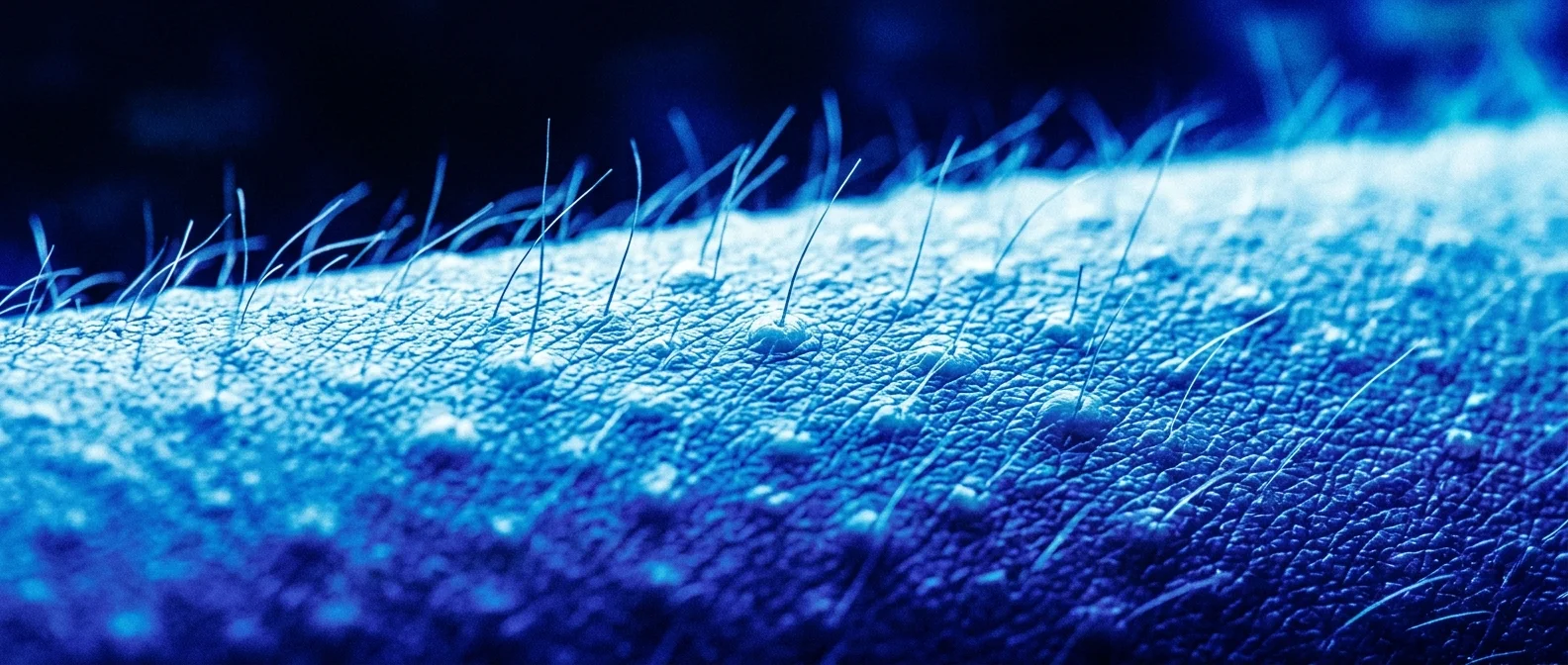
You hear a sudden noise in the dark. A chill runs up your spine — the hairs on your arms rise on their own, your skin erupts in tiny bumps. Goosebumps. Minutes later, you hear a piece of music and the exact same thing happens — but this time from beauty, not fear. Why does the same mechanism activate from both terror and emotion? The answer lies in a 65-million-year-old reflex.
📖 Read more: Why 503 Snake Species Turn Cannibal: Evolution's Dark Secret
What Happens Beneath the Skin
Goosebumps are an involuntary reflex called the pilomotor reflex (piloerection). Under each hair lies a microscopic arrector pili muscle — a smooth muscle 1-2 millimeters long. When this muscle contracts, it pulls the hair root and raises it perpendicular to the skin. Simultaneously, a small bump forms around the follicle — the characteristic “goose flesh” (named after plucked goose skin, though each language uses different birds: chair de poule in French, Gänsehaut in German, piel de gallina in Spanish). Humans have approximately 5 million hair follicles on the body, but the hairs are so fine that goosebumps are mainly visible on arms, neck, legs — areas with sparser hair where the bumps stand out visually. Interestingly, palms and soles have no hair follicles, so they never get goosebumps — proving the phenomenon is purely muscular (arrector pili) rather than nervous trembling.

The Role of the Sympathetic Nervous System
The command doesn't start consciously from the brain — it's autonomous. The sympathetic nervous system sends adrenergic signals via noradrenaline to the arrector pili muscles. The pathway: hypothalamus → spinal cord → sympathetic ganglia → postganglionic fibers → arrector pili. The entire circuit completes in less than 300 milliseconds — faster than conscious perception, which is why goosebumps “hit” before you can think. Simultaneously with the arrector muscles, the adrenal glands activate — releasing adrenaline (epinephrine) into the bloodstream. This is why goosebumps often accompany increased heart rate, alertness, and pupil dilation. It's part of the fight-or-flight response — Walter Cannon first described it in 1915 in Bodily Changes in Pain, Hunger, Fear and Rage. Cannon himself proved that adrenaline accelerates the heart, dilates bronchi, mobilizes glucose from the liver, and prepares the entire body for action within seconds — goosebumps are simply one piece of this package.
Evolutionary Origins: 65 Million Years Back
In furry mammals, piloerection serves two purposes. First: thermal insulation — raised hairs trap a layer of air close to the skin, creating insulation against cold. A cat or mouse can increase thermal insulation by 15-30% through piloerection alone — a significant advantage on cold nights. A grizzly bear uses piloerection for both thermal insulation (winter, before hibernation) and intimidation (raised neck fur during confrontations). Second: intimidation — a porcupine, cat, or chimpanzee appears larger with puffed-up fur. When a cat encounters a dog, piloerection can make its body appear up to 50% larger — enough to make the predator hesitate. Fear-induced goosebumps in prey serve exactly this purpose: a larger apparent silhouette, possibly enough to create uncertainty in the hunter — “maybe it's bigger than I thought?” The mechanism is ancient — appearing in the first mammals over 65 million years ago, before dinosaurs went extinct. In humans, body hair is now too fine for insulation or intimidation — but the mechanism didn't disappear because it costs no energy and because, as discovered in 2020, it serves a hidden tissue regeneration function.
Musical Chills: The Paradoxical Fever
A study by Jaak Panksepp (1995) — the same researcher who discovered that rats “laugh” when tickled — showed that musical chills occur mainly during unexpected harmonic changes: sudden solo entrances, crescendos after silence, key changes, or a voice “breaking” with emotion. In fMRI studies (Blood & Zatorre, PNAS, 2001), musical chills activate the nucleus accumbens — the same reward center activated by food, sex, social rewards, and addictive substances. Dopamine is released in quantities measurable by PET scan. This means chills “borrow” the same physiological mechanism (sympathetic nervous system, adrenaline) but activate it from a completely different source — pleasure instead of danger. It's as if the brain “confuses” extreme experiences: terror and beauty share the same engine. Interestingly, not everyone gets musical chills — research shows 55-86% of the population experiences it, and those who do score higher in “openness to experience” on the Big Five personality model.

📖 Read more: Why Humans Can't Regrow Limbs: The DNA Answer
Cold-Induced Chills: The Original Function
When skin temperature drops below 25°C, thermoreceptors (mainly TRPM8 channels — the same ones that detect menthol) send signals to the hypothalamus. The response includes: shivering (rapid trembling of skeletal muscles), vasoconstriction (less blood to skin, more to internal organs), and piloerection. In animals this works: raised hairs create an airtight “blanket.” In us? The fine vellus hairs trap no air — just goose flesh with no thermal benefit. A 2020 Harvard study (Ya-Chieh Hsu, Cell) revealed something remarkable: the sympathetic nerves controlling arrector pili muscles simultaneously regulate hair follicle stem cells. Piloerection isn't just a cold response — it's a hair renewal signal. Cold literally makes hair grow faster — explaining why animals develop thicker coats in winter. The nerve-stem cell-muscle connection represents a new model of “sensory regeneration” — a trinity that could revolutionize baldness treatment.
Fear, Awe, and Social Chills
Fear-induced chills start in the amygdala — detecting threat, activating hypothalamus, initiating fight-or-flight. But there are also “awe chills” — watching a sunset from a high mountain, hearing a massive choir, reading something deeply true — and getting goosebumps. Psychologist Dacher Keltner (UC Berkeley) argues that awe is a distinct emotion — activating the central nucleus of the amygdala but with serotonin involvement, creating a mixture of fear and pleasure. “Social chills” — getting goosebumps watching someone do something heroic — may serve social cohesion: signaling “this is important, pay attention.”
Anatomy of Chills: Nerves, Nicotine, ASMR
The arrector pili muscle is innervated exclusively by adrenergic fibers (noradrenaline) — there's no cholinergic innervation, which is why you can't voluntarily trigger goosebumps. Experiment: phentanyl injection (opioid) blocks musical chills — proof that endogenous opioids (endorphins) are involved in emotional chills. Nicotine — a nicotinic receptor agonist — can trigger chills through sympathetic activation. The ASMR phenomenon (Autonomous Sensory Meridian Response) — tingling in the head/neck from gentle sounds (whispers, tapping, rustling) — shares mechanisms but is opposite: relaxing instead of alerting, activating parasympathetic, lowering heart rate. Some researchers believe the capacity for musical chills is partially hereditary — identical twins share it more often than fraternal twins. Also, ASMR isn't universal — only about 20% of the population experiences it intensely, showing that sensory stimulus responses have a clear genetic component.
Why It Didn't Disappear
A reflex without visible function should disappear evolutionarily — unless it costs nothing or serves something hidden. Piloerection costs minimal energy: 1-millimeter smooth muscles with no metabolic burden. Hsu's 2020 discovery that it controls hair stem cells shows the mechanism serves tissue regeneration — an invisible but critical function. Simultaneously, “co-option” into emotional circuits — music, awe, social identification — shows evolution recycled an old thermal reflex into a communication tool. Goosebumps aren't an evolutionary fossil. They're a multi-tool — just with a changed field of action in each era. From thermal survival in early mammals, to predator intimidation, to emotional signaling in social Homo sapiens, to cellular regeneration via stem cells. Next time you get goosebumps, remember: what you're feeling is 65 million years of evolution in less than 300 milliseconds.
Sources:
- Cannon, W.B. (1915). Bodily Changes in Pain, Hunger, Fear and Rage. D. Appleton and Company.
- Hsu, Y.-C. et al. (2020). "Sympathetic nerves control hair follicle stem cell activity via arrector pili muscle niche." Cell, 182(3), 574-588.