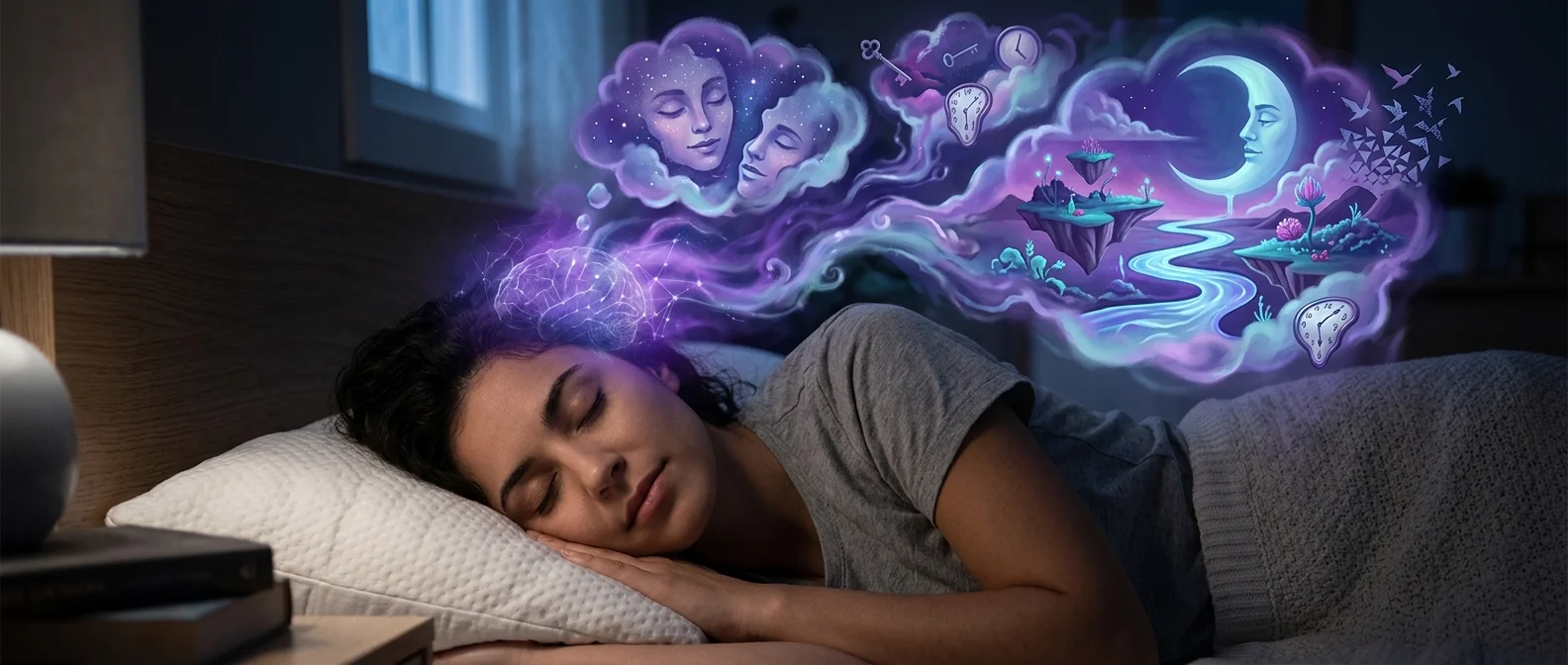
Three in the morning. You jolt awake — running down an endless corridor, something chasing you, your legs sinking into melting floor. You wake with a racing heart, relieved it was “just a dream.” But why does the brain spend ~2 hours every night creating scenarios you never asked for? The question seems simple. The answer has occupied neuroscience for over 70 years — from the discovery of REM sleep to today, and each new study reveals deeper complexity.
📖 Read more: Oxytocin: The Chemistry Behind Love and Trust
The Discovery That Changed Everything: REM Sleep
In 1953, Eugene Aserinsky — a graduate student in Chicago — noticed something odd about his sleeping son: the eyes moved rapidly beneath closed eyelids. Together with his advisor Nathaniel Kleitman, they published in Science (1953) the discovery of Rapid Eye Movement sleep — REM. They woke volunteers during REM: 80% reported vivid, narrative dreams with plot, characters, emotion. During non-REM? Only 7% — and these were vague, fragmentary, like snapshots rather than movies. REM proved to be a completely separate sleep stage — the brain shows electrical activity nearly identical to wakefulness, heart rate increases, breathing becomes irregular, while skeletal muscles become completely paralyzed (atonia — you're “locked” to prevent physically acting out dreams). GABA and glycine from the brainstem inhibit motor neurons in the spinal cord. When this mechanism fails, REM Sleep Behavior Disorder appears — people literally act out their dreams: punching, kicking, jumping from bed. Sleep paralysis is the opposite: you wake but REM atonia continues — you can't move for 1-2 minutes, often with hallucinations of presence in the room.

What Your Brain Does When You Dream
During REM, the visual cortex (V1, V2) activates as if you're actually seeing images — but receives no data from the eyes. The amygdala (fear/emotion center) becomes hyperactive — which is why dreams are often emotionally charged, featuring themes of anxiety, falling, being chased. Simultaneously, the prefrontal cortex (logic, critical thinking, self-control) nearly shuts down — which is why you don't question the most absurd scenarios during the dream. Flying over a city? Normal. Talking to a dead relative? Not surprising. The deactivation of the prefrontal cortex explains why only in lucid dreams do you recognize you're dreaming — there the prefrontal cortex partially reactivates.
📖 Read more: We Don't Have 5 Senses But 33: What Are the Hidden Ones?
Threat Simulation Theory (Revonsuo)
Finnish neuroscientist Antti Revonsuo (2000) proposed that dreams are an evolutionary threat simulator. The brain “runs scenarios” of danger in a safe environment — falling, being chased, predators — so if you encounter something similar in reality, you react faster. Evidence: studies of 1,000+ dream reports from 15 countries show that 70% have negative emotional content — threat, fear, failure, shame. Children exposed to traumatic experiences dream threatening scenarios much more frequently — the simulator “intensifies.” The theory explains why the five most common dream themes across all cultures are: falling, being chased, paralysis, exam failure, public nudity — all scenarios of social or physical threat. Critics note the theory doesn't explain pleasant dreams (flying, romantic) — but Revonsuo responds these are “side effects” of the system, not its primary function.
Memory Consolidation: Nighttime Filing
The most documented function of sleep is memory consolidation. During slow-wave sleep (deep sleep), the hippocampus “replays” the day's experiences to the neocortex — transferring information from short-term to long-term storage. “Sharp-wave ripples” (100-200 Hz, hippocampal micro-bursts) appear precisely during this transfer. Rats that run mazes reproduce the same neural patterns during sleep — as if “running” the maze again mentally. The REM phase appears to integrate new memories into existing networks — “connecting dots,” creating associations. That's why after sleep you solve problems more easily — “sleep on it” has a neurobiological basis. Robert Stickgold (Harvard, 2005) showed that volunteers who slept after a difficult puzzle solved it 33% more often than those who stayed awake for the same period — and many reported the solution “appeared in the dream.” One explanation: during slow-wave sleep, the hippocampus “replays” the day's experiences in compressed form (time-compression replay), while during REM new memories integrate into older networks.

📖 Read more: Why You Can't Tickle Yourself: The Brain's Prediction System
Emotional Processing: Overnight Therapy
Matthew Walker (UC Berkeley) called REM “overnight therapy.” During REM, the brain replays emotional experiences without noradrenaline — the only stage when the locus coeruleus (source of noradrenaline) completely silences. Result: you relive the difficult experience without the chemical signature of stress. Each time the emotional charge “washes away” a bit — the memory content remains, but the emotion gradually disconnects. That's why traumatic memories become more bearable after good sleep. PTSD patients have disrupted REM — noradrenaline doesn't drop, nightmares relive with full stress. Prazosin — a drug that blocks noradrenaline — dramatically reduces PTSD nightmares, confirming Walker's theory.
Creativity and Dreams
Kekulé “saw” the benzene ring in a dream. Paul McCartney woke with the melody of “Yesterday” in his head. Coincidence? Probably not. During REM, the brain creates unpredictable connections between memories that would never connect during wakefulness — the prefrontal “logic filter” is offline. Experiment by Sara Mednick (UC San Diego, 2009): volunteers who woke from REM solved anagrams 40% faster than those who woke from non-REM. REM appears to “shuffle” information in random combinations — exactly what creative thinking needs. Even Thomas Edison held spheres in his hands when falling asleep — when they dropped, he'd wake with the “idea” from sleep. New research (Lacaux et al., Science Advances, 2021) confirmed: N1 stage (drowsiness) is ideal for creative eureka moments.
📖 Read more: Your Nose Recognizes 1 Trillion Scents: How?
Nightmares: The Simulator in Overdrive
Nightmares aren't a “bug” but an extreme version of the simulation system. They occur mainly in the last third of sleep — when REM becomes longer and more intense. Chronic nightmares (4+ times/week) affect 2-5% of adults and are linked to psychological distress, insomnia, reduced daytime functioning. In children, nightmares are much more common (25-50%) and decrease with age — possibly because the developing mind needs more “threat simulation” for a world it doesn't yet understand. Imagery Rehearsal Therapy (IRT) asks patients to consciously rewrite the nightmare's ending while awake — “treating” the brain with a new scenario. Up to 70% reduction in nightmares, without drugs — proof that the brain can be “reprogrammed” even in the deepest layers of sleep. The brain learns new scenarios — even for dreams.
What We Still Don't Know
Despite decades of research, fundamental questions remain open. Do all animals dream? Most likely — dogs, cats, rats, even octopi show REM or REM-like phases (octopi change color during sleep — perhaps “dreaming” camouflage). But fish, reptiles, insects? Controversial — REM appears to have evolved independently in birds and mammals, meaning evolution “invented” dreams at least twice. Why do we forget 95% of dreams? Noradrenaline (essential for memory encoding) is absent during REM — dreams aren't “stored” unless you wake immediately after and noradrenaline returns. For the same reason, those who keep dream journals start remembering more. What do recurring dreams mean? Revonsuo's theory says: “unsolved threat” — the simulator runs again and again until it finds a solution or the stressor disappears. What we know for certain: without dreams, the brain doesn't complete its restoration cycle. Dreams aren't a side effect of sleep — they're the reason we sleep. Tonight, when you close your eyes, your brain will begin the most important night shift of its life — and you won't even remember it.
Sources:
- Aserinsky, E. & Kleitman, N. (1953). "Regularly occurring periods of eye motility, and concomitant phenomena, during sleep." Science, 118(3062), 273-274.
- Revonsuo, A. (2000). "The reinterpretation of dreams: An evolutionary hypothesis of the function of dreaming." Behavioral and Brain Sciences, 23(6), 877-901.