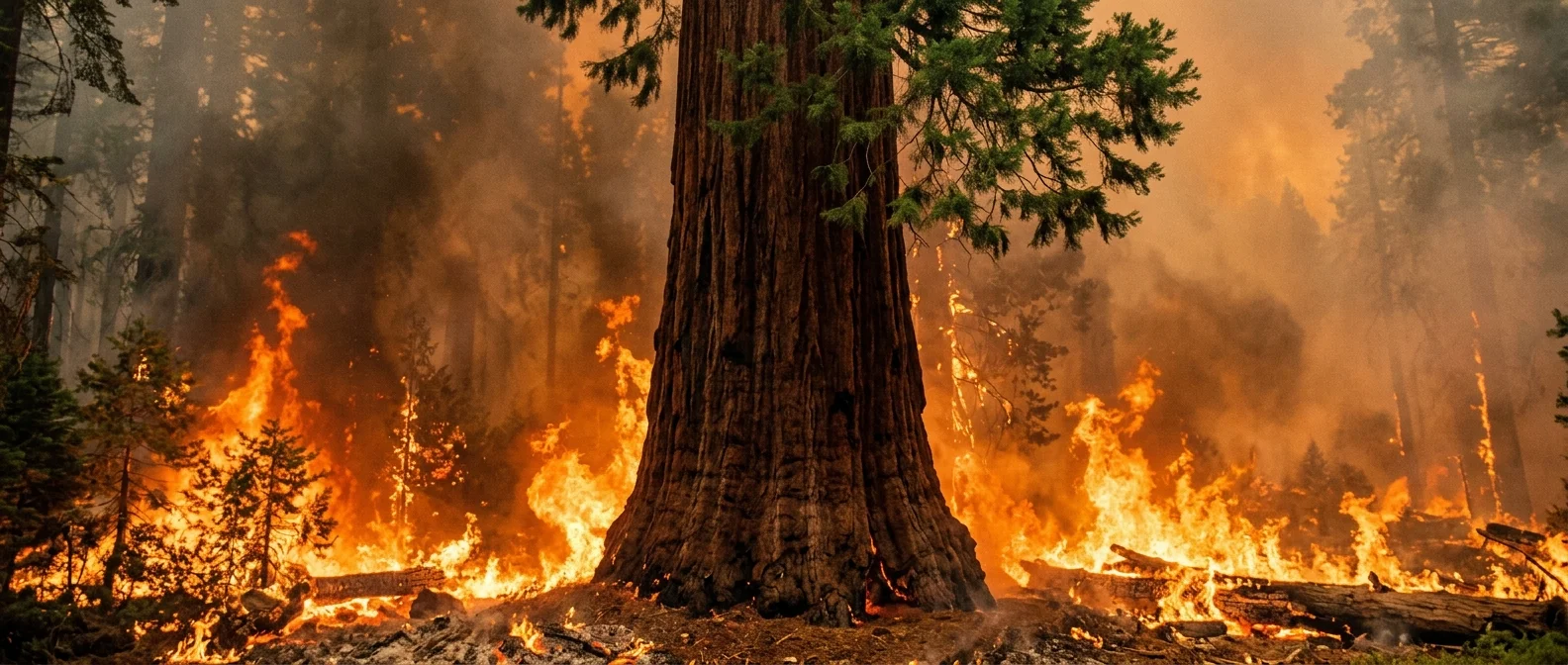
On September 19, 2021, firefighters wrapped General Sherman — the largest tree on Earth — in aluminum blankets. The KNP Complex megafire was approaching the giant sequoia groves of the Sierra Nevada. When the flames passed, most trees still stood upright — blackened but alive, as they had for thousands of years. Giant sequoias don't just survive fire — they need it to reproduce, in a co-evolutionary relationship that began 100 million years ago, when dinosaurs still walked the Earth and the first flowering plants were just emerging.
📖 Read more: 5,000-Year-Old Tree: Methuselah Still Stands Strong
Bark Like Armor: 24-Inch Shield
The bark of the giant sequoia (Sequoiadendron giganteum) is the primary line of defense. At up to 24 inches thick — the thickest of any tree species worldwide — it consists of fibrous layers of cork saturated with tannins. Unlike pines that contain flammable resin, sequoia bark is nearly resin-free — containing minimal volatile oils and terpenes, which in pines act as flame catalysts. Its structure resembles asbestos: cellulose fibers densely woven with air pockets that act as thermal insulation layers. Experiments at the USDA Forest Products Laboratory showed the bark withstands temperatures up to 1,500°F for over 20 minutes before carbonization begins — enough to survive most ground fires, which typically last 5-15 minutes at any given point. Beneath the bark, the cambium (the living growth layer) remains protected, allowing the tree to heal even massive “fire scars” within a few decades.

Anatomy of a Giant: The Largest Living Structure
General Sherman in Sequoia National Park is the largest living organism by volume: 52,500 cubic feet, 275 feet tall, 102-foot base circumference, approximately 2,200 years old. The Stephenson et al. study (Nature, 2014) revealed something remarkable: the largest trees increase their carbon sequestration rate with age — Sherman adds 1 ton of wood annually, more than an entire medium-sized young tree. This overturns the traditional notion that aging trees slow down — in sequoias, the opposite holds true. Lower branches begin at 130-160 feet — a strategy that prevents ground fires from reaching the crown (crown fire). The root system extends horizontally in a 100-foot radius, but only 3-6 feet deep — surprisingly shallow for such a giant, but its stability comes from the massive volume and wide base that functions as a gravity anchor. The root system intertwines with those of neighboring trees, creating an underground network of mutual support.
Cones That Open Only with Fire
The reproductive strategy of sequoias depends directly on fire. The cones — small, just 2-3 inches — remain sealed with resin on the tree for 15-20 years (serotiny). Only the heat of fire (120-140°F at crown level) melts the resin, releasing 200-300 tiny seeds per cone. A mature tree carries approximately 30,000-40,000 cones — potentially 10 million seeds. Fire serves a triple purpose: opens the cones, clears the forest floor (understory) of competing plants and shrubs, and creates bare mineral soil rich in nutrients (ash) ideal for germination. Without fire, sequoias essentially cannot reproduce — the seeds cannot compete with the dense understory of shade-tolerant plants.
📖 Read more: Carnivorous Plants That Devour Insects: Nature's Predators
Chemical Defense: Tannins and Phenols
The bark contains 11-17% tannins by weight — among the highest concentrations in the plant kingdom. These polyphenolic compounds are fungicidal, insect-repellent, and antimicrobial. Douglas fir bark (Pseudotsuga menziesii) contains only 6-8% tannins — and is far less fire-resistant. Tannins form complexes with proteins that prevent fungal infections — critical for trees that live millennia. Additionally, flavonoids and stilbenoids in the bark function as antioxidants, protecting cells from thermal oxidative damage during fire. The chemical composition of bark changes with age: young trees (under 100 years) have thinner bark and lower tannin content — explaining why young trees are vulnerable while mature ones resist — an evolutionary strategy that selects the most robust individuals through natural fire selection. Thus, fire functions as an evolutionary filter that strengthens the population's genome.

100-Million-Year Evolutionary History
The Cupressaceae family (to which sequoias belong) appeared in the Cretaceous period — approximately 100 million years ago, when dinosaurs dominated. Fossilized Metasequoia (dawn redwood) have been found in the Arctic, Europe, Asia, and even Antarctica — proving their distribution was once global. Giant sequoias today constitute a relict population: just 75 natural groves in a 260-mile zone on the western slope of the Sierra Nevada, at elevations of 5,000-7,000 feet. This narrow refuge requires specific conditions: winter snow cover, dry summers (fires), granitic soil, and annual precipitation of 35-60 inches. The Ice Age dramatically restricted them — from 6 continents to one narrow strip. The discovery of the “living fossil” Metasequoia glyptostroboides in China (1944) proved this ancient lineage survives in refugia worldwide, with Metasequoia now cultivated in botanical gardens in 50+ countries.
📖 Read more: Spiders Mimic Ants: The Perfect Disguise
Fire as Ally: The Ecology of Flame
Tree-ring analysis (dendrochronology) by Thomas Swetnam (Science, 1993) revealed that sequoias experienced fire every 6-35 years over the past 2,000 years — nearly every generation. These low-intensity surface fires cleared the understory without killing the giants. Fire scars on trunks record dozens of fires — some trees bear over 60 scars in 2,000 years. Fire removes young white firs (Abies concolor) that shade sequoia seedlings. Without fire, firs dominate and sequoias fail to regenerate — a condition called “regeneration deficit.” Fire suppression policy (1890-1970) removed this critical ecological ally, creating impenetrable understory that accumulated massive amounts of dead wood and dry vegetation — ideal fuel for megafires. This paradox — protection became destruction — is known as the fire deficit paradox.
Modern Threats: Climate Change
The Castle Fire (2020) killed 7,500-10,600 mature sequoias — approximately 10-14% of the global population in a single fire. It was the first recorded crown fire megafire to destroy sequoias — something that hadn't happened in millennia. The cause: 130 years of fire suppression created massive fuel loads in the understory, while California's 2012-2016 drought weakened the trees. Bark beetles (Phloeosinus spp.) attack weakened trees — rare in healthy sequoias, where bark typically repels insects chemically. Climate change increases fire frequency and intensity: instead of low-intensity ground fires, megafires reach the crown — exceeding the evolutionary limits of even these armored giants. Projections show that by 2100, the climatically suitable range for sequoias will shift 1,600 feet higher in elevation.
Protection and Conservation
The National Park Service (NPS) has implemented prescribed burns since the 1970s — one of the first times science recognized fire as a management tool, not an enemy. Approximately 15-20 prescribed burns are conducted annually in Sequoia-Kings Canyon NP, simulating the natural fire regime. In 2021, firefighters wrapped key trees (General Sherman, General Grant) in fire-resistant aluminum foil — a last-resort tactic. Current strategy includes “fuel reduction” in a 1,000-foot zone around each grove. However, with only ~75,000 mature trees globally, giant sequoias remain vulnerable — each megafire can remove a significant percentage of a population that took millennia to create. Reforestation programs using genetically selected seeds from the most resistant genetic lines are underway, while the Save the Redwoods League has protected 500,000 acres of sequoia forest since 1918. The history of sequoias teaches us that protection from fire doesn't always mean absence of fire — sometimes, salvation lies within the flames.
Sources:
- Swetnam, T.W. (1993). “Fire history and climate change in giant sequoia groves.” Science, 262(5135), 885-889.
- Stephenson, N.L., Das, A.J., Condit, R., et al. (2014). “Rate of tree carbon accumulation increases continuously with tree size.” Nature, 507, 90-93.