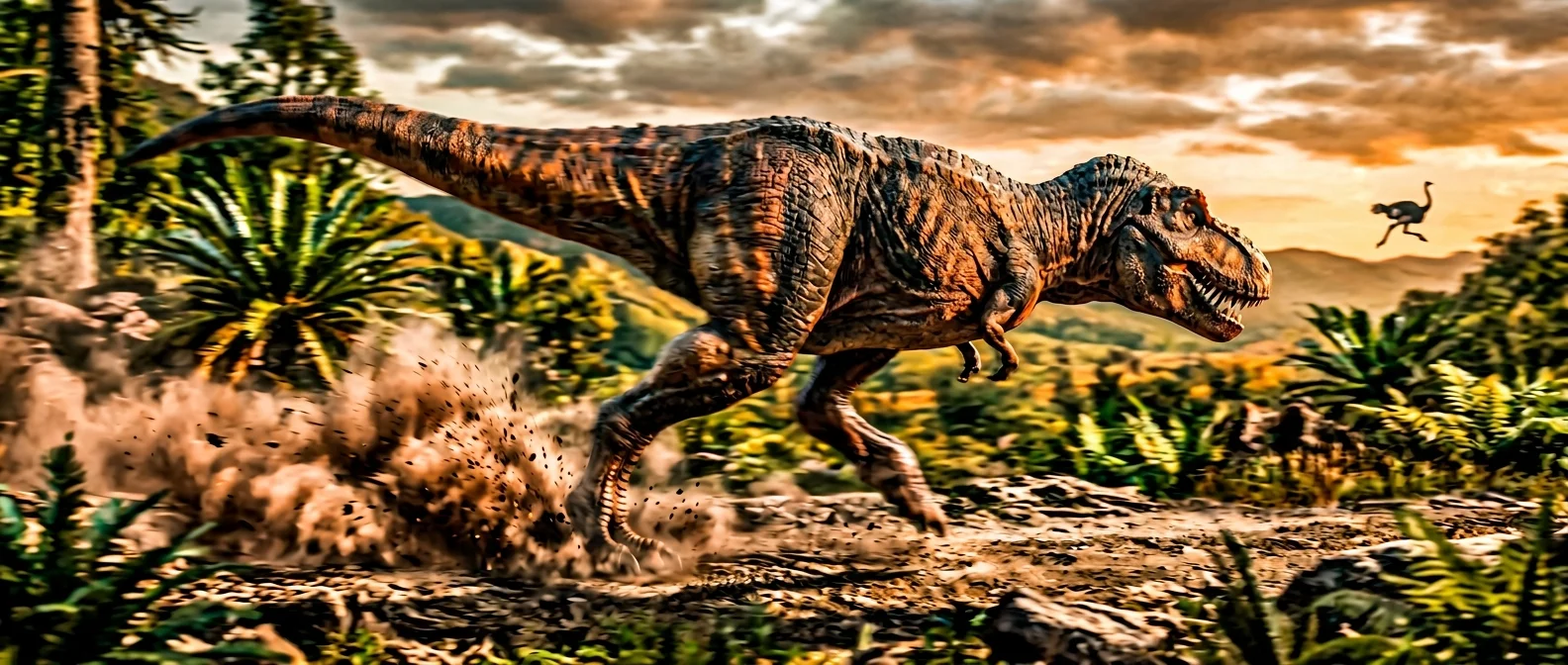
In a biomechanics lab in London, a computer simulates the mechanical movement of a creature that vanished 66 million years ago. Every muscle, every tendon, every bone is digitally recreated — and the result reveals something extraordinary: certain dinosaurs ran at speeds exceeding 60 kilometers per hour. How did they manage it? The answer lies in their anatomy, the tracks they left behind, and some evolutionary “inventions” unlike anything in the modern animal kingdom.
📖 Read more: Archaeopteryx: The First Bird That Ever Flew
The Fundamental Innovation: Upright Stance
When Richard Owen first described dinosaurs in 1842, he observed something crucial: unlike lizards and crocodiles, which sprawl their legs to the side, dinosaurs held their limbs directly beneath their bodies — in a “columnar” position, like elephants. This wasn't just a detail of form. It was a biomechanical revolution.
Upright stance means the entire body weight transfers vertically through the bones, rather than being distributed laterally through muscles. The result? Less energy wasted on support, more freed up for movement. Think of the difference between a runner sprinting upright versus someone trying to run while crouched — physics is unforgiving.
Why Stance Changes Everything
Modern reptiles (lizards, crocodiles) tire quickly because they expend energy just keeping their bodies elevated. Dinosaurs, with legs beneath their bodies, had “free” support — and their entire muscular power available for speed.
Bipedal Runners: The Power of Two Legs
Nearly all theropods — the group that includes carnivorous dinosaurs and, ultimately, birds — were obligate bipeds. This meant their hind legs exclusively handled support and locomotion, while the front limbs were freed for grasping and manipulation. This specialization — two legs solely for running — created an extremely efficient locomotion system.
The ankle joint of ornithodiran archosaurs — dinosaurs and pterosaurs — moved in only one plane: forward-backward. Like a door hinge. This forced them to walk upright, placing one foot directly in front of the other, exactly like modern birds. This stability translates to one thing: maximum power transfer with every step.
The “Ostriches” of the Cretaceous
If you want to see the fastest dinosaurs, look at the ornithomimids — a family of theropods that resemble ostriches so closely their names reflect it. Struthiomimus means “ostrich mimic.” Ornithomimus means “bird mimic.” Gallimimus means “chicken mimic.” And it wasn't just the names — their entire bodies were designed for one function: speed.
Struthiomimus, about 2.5 meters long and dating from 99 to 65 million years ago, was literally built for speed. Its three-toed feet were so bird-like that the metatarsals (foot bones) didn't even touch the ground — it walked on its toe tips, in digitigrade stance, exactly like today's ostrich. This stance increases the effective leg length without additional weight, lengthening every stride.
The skull was small, light, toothless — covered with a horny beak. The neck was slender and flexible. The entire body had been optimized: less weight in front, greater power behind. Like a race car shedding every ounce for a few milliseconds of speed.
The Alexander Formula: Tracks Tell the Story
How do you calculate the speed of an animal that died tens of millions of years ago? R. McNeill Alexander, a biomechanist from the University of Leeds, provided a solution in 1976 that changed the field. Studying running animals — from dogs to hippos — he discovered a consistent relationship between three variables: stride length, hip height, and speed.
The Alexander Formula
When the formula was applied to dinosaur trackways, the results were revealing. Small theropods like Compsognathus — a chicken-sized dinosaur — showed strides corresponding to speeds over 60 km/h. Larger theropods, like Allosaurus, ranged around 30-35 km/h. Even massive sauropods, despite their enormous bulk, moved at steady 5-10 km/h — enough to cover vast distances without stopping.
The Secrets of Speed Anatomy
If we could virtually dissect the leg of a fast dinosaur, we'd find a series of anatomical “inventions” that, if you didn't know better, you'd think were designed on purpose.
1. The Tibia-Femur Ratio
In fast runners — dinosaurs and modern mammals — the tibia (shin bone) is longer than the femur (thigh bone). This seems counterintuitive: wouldn't you expect more muscle mass in the upper portion? But physics explains: a long lower leg segment acts as a lever — and muscular force is multiplied with every step. Ornithomimids had this ratio to an extreme degree.
2. Hollow Bones
The bones of many theropods were pneumatic — hollow, filled with air chambers, like modern birds. Coelophysis, one of the first dinosaurs of North America (Late Triassic), lived in large herds and had hollow limbs. This dramatically reduced weight without sacrificing strength — like carbon fiber tubing instead of steel.
3. The Caudofemoralis Muscle
Perhaps the greatest speed secret was a muscle that modern mammals lack: the caudofemoralis. This massive muscle, positioned at the base of the tail, connected to the femur and provided explosive power with every step. It was the “turbo engine” of dinosaurs — something no modern terrestrial animal possesses. The tail, therefore, wasn't just a counterbalance. It was an engine.
The Tail's Role in Speed
Imagine holding a massive elastic band attached behind you, and with every step it pushes you forward. This was, roughly, the function of the caudofemoralis — each contraction pulled the femur backward with force exceeding that of several modern mammals.
Digital Simulations: T-Rex in the Computer
In 2002, John Hutchinson from the Royal Veterinary College in London used digital models to answer a question that had tormented paleontologists: how much muscle mass would T-Rex need to actually run fast? The answer was shocking. To reach 40 km/h, T-Rex would need leg muscles equivalent to 86% of total body weight — something physically impossible.
This study showed that the “king of dinosaurs,” while terrifying, probably didn't exceed 20-29 km/h. Conversely, smaller theropods — with less weight and better muscle-to-mass ratios — could reach much higher speeds. Physics is harsh: resistance increases with the cube of size, while muscular strength increases only with the square.
Dinosaur Speed Comparison
The Evolutionary Arms Race
Why did such high speeds develop in dinosaurs? The answer lies in what biologists call an “arms race” — an endless evolutionary battle between predator and prey. As herbivores became faster, carnivores were forced to follow. And vice versa.
This pressure created impressive adaptations in two directions. On one hand, dinosaurs like Ornithomimus — which, though a theropod (the carnivore group), was actually omnivorous — developed extreme speed as an escape mechanism. On the other hand, large carnivores like Allosaurus developed alternative hunting strategies — ambushes, pack hunting, targeting elderly or injured prey.
Feathers and Speed: An Unexpected Connection
Recent discoveries of feathered dinosaurs opened a new chapter in speed studies. Ornithomimus, for example, had feathered covering resembling that of an ostrich — and this wasn't coincidental. These feathers functioned as thermoregulators: they maintained stable body temperature, allowing prolonged muscular activity. A cold reptile tires quickly. A “warm” dinosaur can run for hours.
This discovery connects directly to the greatest puzzle of dinosaur physiology: were they warm-blooded or cold-blooded? The most accepted current theory says “something in between” — mesothermic — but warm enough to produce high speeds for extended periods.
The Tracks That Prove Everything
Ichnofossils — dinosaur footprint impressions in ancient sediments — provide the only direct evidence of movement. It's not skeleton, not speculation: it's the moment an animal actually moved, frozen in stone.
These tracks reveal much more than speed. They show foot shape, weight distribution, stride angle, even whether the animal was alone or in a herd. At Bernissart, Belgium, an entire herd of Iguanodon was discovered in a coal mine in 1878 — the first evidence that some dinosaurs traveled in groups. The image of a solitary hunter was replaced by that of organized migration — and herd speed is never the speed of the fastest, but of the slowest member.
"Every footprint is a window into a moment of life. Speed, direction, weight — all encoded in a few centimeters of mud, now stone."
What This Means for the Modern World
The study of dinosaur biomechanics isn't merely academic. The models Hutchinson developed for T-Rex are used today in robotics — for designing robotic legs. The Alexander formula is applied in orthopedic and sports biomechanics. The principles discovered in hollow dinosaur bones inspire lightweight construction materials.
Dinosaurs ran so fast because evolution, over 180 million years, optimized every aspect of their bodies for efficient movement. Upright stance, hollow bones, the caudofemoralis muscle, digitigrade posture, feather-thermoregulators — each was a puzzle piece. Together, they created the most efficient runners Earth has ever known.
And some of those runners never went extinct. They simply learned to fly. The ostrich — the fastest bipedal runner today, at 70 km/h — is living proof that the locomotion “technology” dinosaurs developed millions of years ago still works.