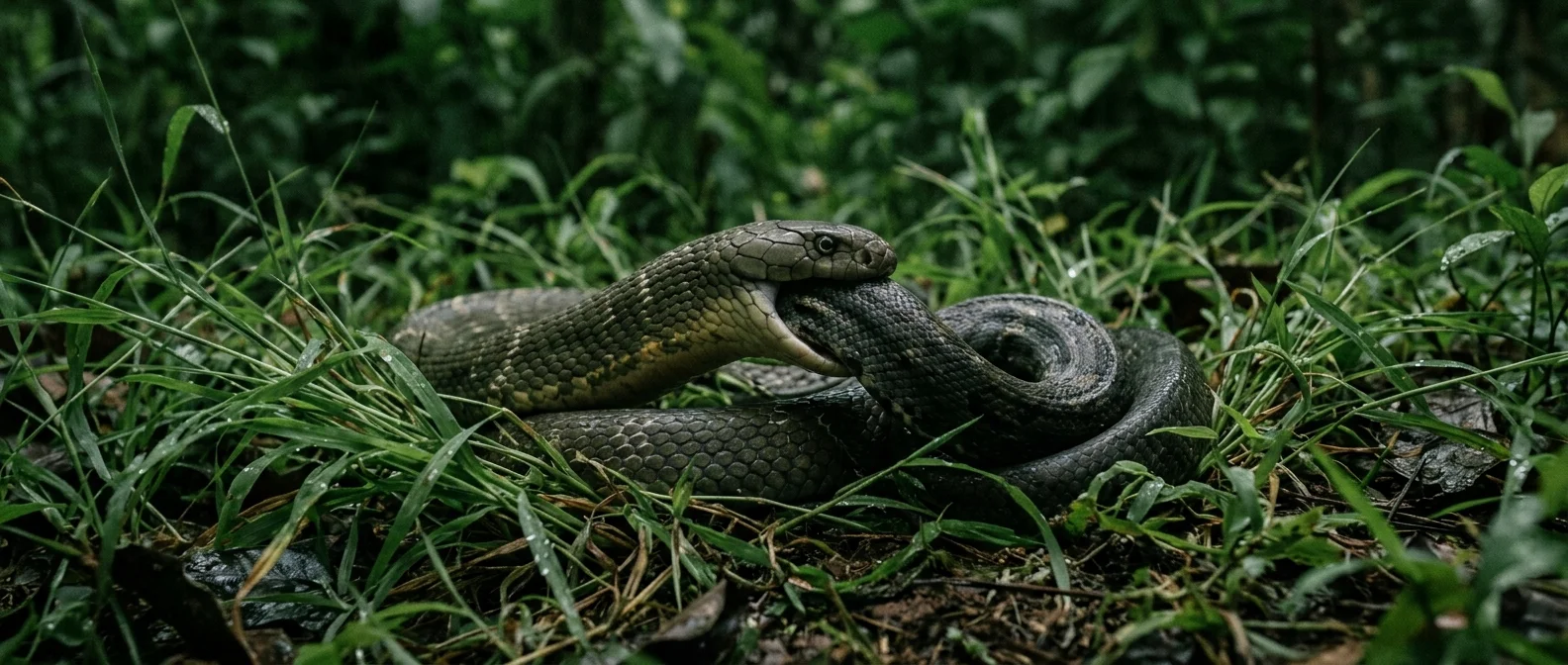
Picture yourself as a snake. Food is scarce, winter approaches, and beside you coils a smaller snake — perhaps even of your own species. What do you do? If you belong to one of the 207 species documented in a recent study, the answer is clear: you eat it. Cannibalism in snakes isn't an anomaly — it's a survival strategy that evolved again and again.
📖 Read more: Bonobos Play Pretend: No Longer Just a Human Thing
The Largest Snake Cannibalism Study Ever
Bruna Falcão, a graduate researcher at the University of São Paulo, and her team compiled 503 reports of cannibalism across 207 different snake species — the most extensive review ever conducted on the topic. The reports spanned every continent where snakes live, covering both wild and captive environments.
"None of us expected that snakes could be so cannibalistic," Falcão told LiveScience. “The more we searched, the more cases we found.” The study was published November 2, 2025, in the journal Biological Reviews — and its findings overturn the older assumption that snake cannibalism is rare and abnormal.
Key Findings
- 503 reports of cannibalism across 207 species
- Evolved independently at least 11 times
- On every continent except Antarctica
- Published: Biological Reviews, November 2025
Which Snakes Are the Worst Cannibals
Not all snakes are equally cannibalistic. The Colubridae family — the largest snake family — represented 29% of all reports. However, this family isn't known as snake-eating specialists, so researchers hypothesized that cannibalism in these species is primarily triggered by stressors like food scarcity.
The Viperidae family (vipers) covered 21% of reports — but most involved captive snakes, suggesting that pressures like confined space trigger the behavior. The Elapidae family (cobras) covered 19% — which didn't surprise researchers, since cobras are already known as hunters of other snakes.

📖 Read more: Four-Eyed Prehistoric Creature: The Ancestor We All Share
11 Independent Evolutions
The most striking finding was that cannibalism didn't evolve once and spread — it evolved independently at least 11 times across different snake lineages. "It's really amazing that cannibalism evolved independently 11 times in snake lineages," Falcão commented.
This means nature “discovered” the same solution multiple times — in different parts of the world, at different time periods, in snakes with no phylogenetic relationship to each other. In evolutionary biology, this is called convergence: when two independent organisms arrive at the same strategy because it works.
Why a Snake Eats Snake
"For us humans, we don't think of cannibalism as something common — it's something weird and disgusting," Falcão admitted. "But for snakes, it's good for them. It's good for their ecological fitness. It's strategic." The reasons vary: population size control, addressing food scarcity, even competition between males for access to females.
Xavier Glaudas, a biologist and National Geographic explorer, noted that “cannibalism is widespread throughout the animal kingdom” — but in snakes it appears particularly systematic. His team had documented male Montpellier snakes (Malpolon monspessulanus) eating females in France, a behavior believed to stem from food scarcity outside mating season.
📖 Read more: Mitochondria: Ancient Aliens Living Inside Every Cell
The Cape Cobra Case
A separate study by Bryan Maritz from the University of the Western Cape in South Africa had already highlighted the significance of cannibalism. His team discovered a large male Cape cobra (Naja nivea) devouring a smaller male of the same species in the Kalahari Desert.
The research that followed revealed that 5 out of 6 cobra species exhibit cannibalistic behavior. Snakes represent 13-43% of cobra diets — and for cannibalistic Cape cobras, the only prey they ate more frequently than their own kind was... vipers. Interestingly, only males appeared as both predators and prey in these cannibalistic encounters.

Jaw Structure Makes the Difference
A key finding was the role of anatomy. Cannibalistic behavior correlates directly with jaw structure: if a snake has jaws that can open wide enough to swallow another snake, then cannibalism becomes feasible. The research data was clear: no species without this structural capability exhibited cannibalism.
This explains why certain snakes — like kingsnakes (Lampropeltis) or king cobras (Ophiophagus hannah, literally “snake-eater”) — have evolved jaws specifically designed for swallowing large, cylindrical prey. Their morphology isn't simply the result of chance — it's evolutionary adaptation to cannibalism.
Two Classic Snake-Eaters
King Cobra
Ophiophagus hannah — the world's largest venomous snake, feeds almost exclusively on other snakes, including pythons
📖 Read more: Parasaurolophus: The Singing Dinosaur That Played Music
Kingsnake
Lampropeltis spp. — immune to rattlesnake venom, eats rattlesnakes and other snakes as primary diet
Climate Change and Cannibalism
If food scarcity drives cannibalism, what happens as ecosystems warm? Maritz posed the question directly: "If their ecosystem heats up dramatically and food becomes scarcer, will snakes engage in cannibalism more frequently?" The answer, based on the evidence, is likely yes.
If cannibalism pushes snakes to evolve larger sizes — since bigger snakes eat smaller ones — then this will affect entire food webs. Larger snakes mean larger prey, different pressure on rodent populations, changes in the dynamics of every habitat. Cannibalism isn't just a “disgusting” habit — it's a mechanism that can reshape entire ecosystems.
What This Teaches Us
Snakes are found on every continent except Antarctica and have adapted to nearly every ecological niche. Their cannibalistic behavior reflects exactly this adaptability: when opportunity or necessity demands it, they eat whatever they can — even their own species. “For snakes, it's good for them,” Falcão reiterated. “It's strategic.”
The study couldn't include all reports — many are found in older books and archives that aren't easily accessible. This means snake cannibalism is likely even more widespread than current data shows. Nature, once again, proves to be far more brutal — and far more inventive — than we imagine.