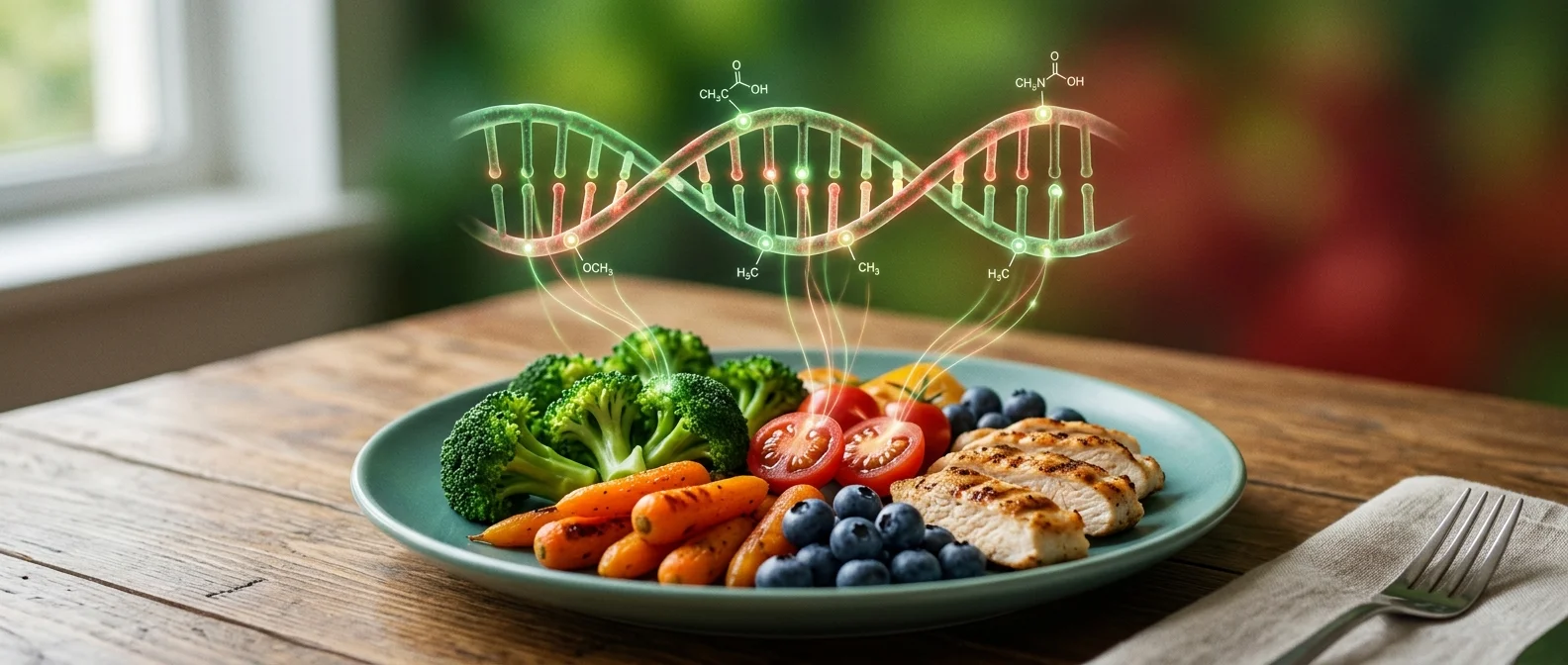
You grew up believing your genes were your destiny — a fixed blueprint written at conception, unchangeable until death. Your father had diabetes, so you'll get it too. Your mother had depression, so it's just a matter of time. But what if I told you that what you ate last night changed how your genes express themselves today? Epigenetics has overturned everything — it doesn't change your DNA, but it changes which genes turn on and which stay off.
📖 Read more: Trauma Gets Inherited: How Stress Rewrites Your DNA
Same Book, Different Reading
Think of DNA as a massive library — 20,000 books (genes) on its shelves. Epigenetics doesn't write new books or erase existing ones. Instead, it places bookmarks in some and locks others inside display cases that only specific signals can open. Some genes are read constantly, others never — and this is largely determined by your experiences, your diet, even your emotions.
The mechanism works through chemical modifications on top of DNA or on the proteins that wrap it — histones. The most well-known modification is methylation: a tiny methyl group (CH3) is added to cytosines in DNA, silencing the gene located there. Removing the methyl group reopens the silenced gene. Simple mechanism, massive implications — because methylation doesn't affect just one gene, but thousands simultaneously, creating a complex pattern that determines who you are biologically.
Diet as a Genetic Switch
Food isn't just calories — it's information that changes gene expression. Folic acid, vitamin B12, methionine, and choline are methyl donors — without them, the methylation machinery malfunctions. The classic 2003 Agouti mouse experiment proved this dramatically: identical genome, but mice whose mothers received folic acid were born lean and brown, while those without folic acid were born obese and yellow.
Polyphenols from green tea, resveratrol from red wine, sulforaphane from broccoli — all affect epigenetic mechanisms. They don't change the sequence of letters in your DNA, but they change which chapters you open. The Mediterranean diet, rich in plant foods and olive oil, appears to protect through epigenetic mechanisms — keeping protective genes open and dangerous ones closed. This explains why fruits and vegetables do far more than simply provide vitamins — they influence how your DNA is read.

The Dutch Hunger Winter: Children Who Remember
During the winter of 1944-45, Nazi occupation in the Netherlands caused a massive famine — the Hongerwinter. Women pregnant during this period suffered from extreme malnutrition. Their children, decades later, showed increased rates of obesity, cardiovascular disease, and schizophrenia — as if their bodies “remembered” the famine and stored every calorie as survival supplies, as if preparing for a famine that never came.
The shocking part: the effects didn't stop with the children. The grandchildren — second generation after the famine — also showed metabolic abnormalities. Grandmother's hunger had left a chemical imprint on DNA that passed to the eggs, to the children, and to the grandchildren. The traumatic experience wasn't inherited genetically — it was inherited epigenetically, through modified methylation in the IGF2 gene. Grandmother's hunger became biological memory in the grandchildren.
Stress, Trauma, and Genetic Memory
Epigenetics isn't just about diet. Chronic stress, trauma, childhood abuse — all leave epigenetic imprints. Studies on Holocaust survivors by Rachel Yehuda's team at Mount Sinai found altered methylation patterns in the crucial FKBP5 gene, which regulates stress response — and their children had similar changes, without experiencing trauma themselves — as if they “remembered” something they never lived through.
In mice, fear can be "inherited": male mice were trained to fear a specific scent (acetophenone) through electric shock. Their offspring — never exposed to shock — reacted with intense fear and anxiety to the same scent, as if they had experienced the shock themselves. The change was found in methylation of the Olfr151 receptor in the father's sperm. Experience was written into germ cells — a discovery that shook biology, because it meant experiences could be inherited without mutation.
Histones: The DNA Spools
DNA doesn't float freely in the nucleus — it wraps around proteins called histones, forming complex structures that look like beads on a string. Histone acetylation “loosens” the wrapping, leaving genes accessible for reading. Deacetylation “tightens” them and silences them. The foods you eat affect this mechanism — butyric acid from plant fibers is a histone deacetylase inhibitor.
This means every time you eat a fiber-rich salad, your gut bacteria produce butyric acid that modifies histones in your intestinal cells — activating genes related to anti-inflammatory responses. Food doesn't end in your stomach or intestines — its information reaches the cell nucleus, where your fate is written.

Reversible Changes
The greatest hope of epigenetics lies in the fact that changes are reversible — unlike DNA mutations. If poor diet silenced a protective gene through methylation, it can theoretically reopen with the right intervention. This is already reality in oncology: drugs like azacitidine remove methylation in cancer cells, reactivating tumor suppressor genes that cancer had silenced — an approach already used clinically in myelodysplastic syndromes and acute myeloid leukemia.
The idea that you can “unlock” genes through lifestyle isn't alternative medicine — it's molecular biology. Regular exercise changes methylation patterns in hundreds of genes within weeks. Meditation reduces methylation in inflammatory genes, proving that even mental calm leaves a molecular imprint. Sleep directly affects histone modifications. Every decision you make is written in your genes — not metaphorically, but literally through chemical signals.
The Twin Paradox
Identical twins start with identical DNA — but by age 50, their epigenetic patterns differ dramatically. One may develop cancer or autoimmune disease, the other won't. The difference isn't in the genes — it's in the experiences, diet, stress, pollution that exposed each to different epigenetic modifications throughout an entire lifetime.
The 2005 study of identical twins by Mario Fraga and colleague Manel Esteller was a landmark: young twins had nearly identical epigenetic patterns, but elderly twins who had lived in different environments showed massive deviations in hundreds of genes. Life is written on top of genes — literally.
Writing the Future in DNA
Epigenetics has overturned genetic determinism. You're not a slave to your DNA — you're its co-creator. Every meal, every night's sleep, every walk in nature, every stressful day writes another line in your epigenetic map. And this map doesn't just affect you — it may affect your children, even your grandchildren.
The thought that your habits today might shape the health of generations not yet born is simultaneously terrifying and hopeful. Terrifying because responsibility extends beyond yourself to people not yet born. Hopeful because it means your fate wasn't written at conception — it's written every day, with every choice you make, and the pen is in your hands.
Sources:
- Waterland, R.A. & Jirtle, R.L. "Transposable elements: targets for early nutritional effects on epigenetic gene regulation." Molecular and Cellular Biology, 23(15), 5293-5300, 2003
- Heijmans, B.T. et al. "Persistent epigenetic differences associated with prenatal exposure to famine in humans." Proceedings of the National Academy of Sciences, 105(44), 17046-17049, 2008