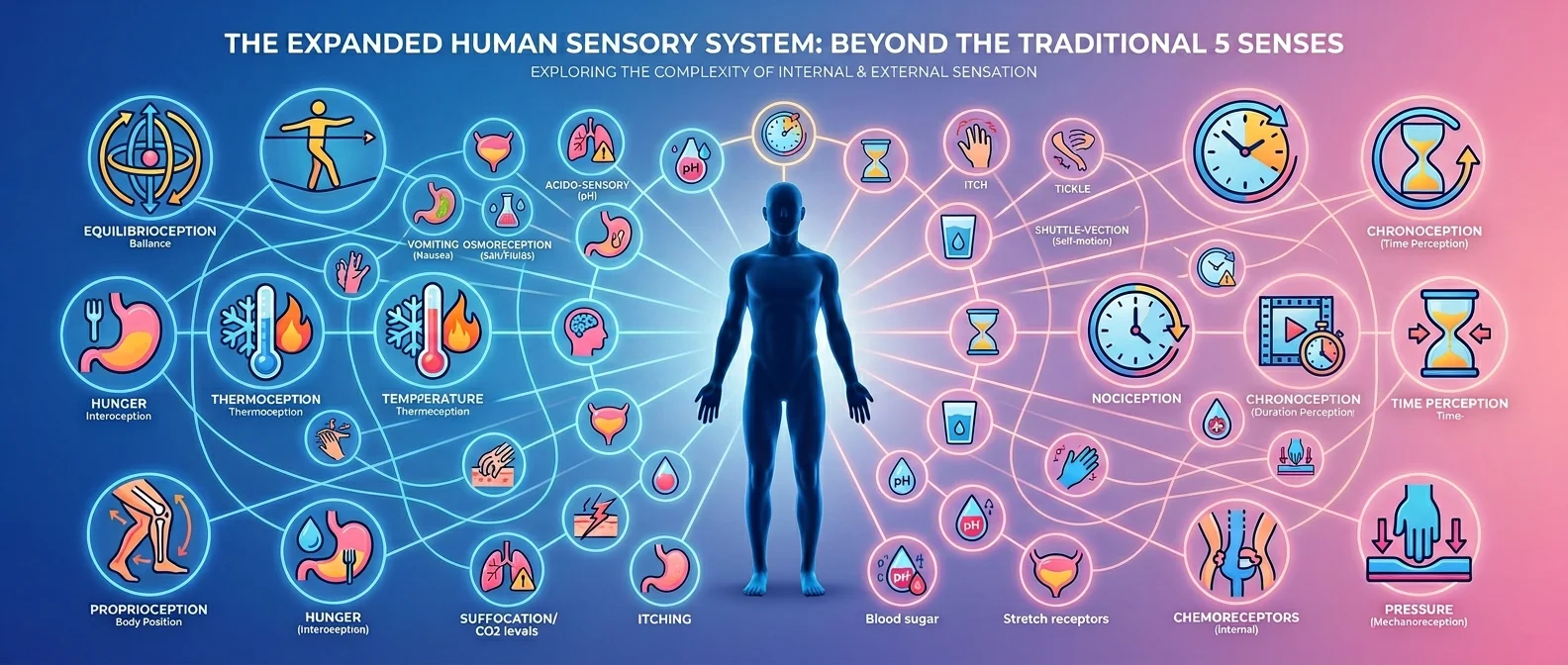
Close your eyes. Raise your hand. You know exactly where it is — without seeing it, hearing it, or touching it. Which sense informed you? None of the “five” classical ones. What you just used is called proprioception — and it's not on Aristotle's list. The philosopher who defined our senses 2,400 years ago created history's most successful oversimplification. The reality? You possess at least 33 distinct senses.
📖 Read more: Your Nose Recognizes 1 Trillion Scents: How?
The Myth of 5 Senses
Aristotle in De Anima (~350 BCE) defined five senses: sight, hearing, taste, smell, touch. His reasoning? He matched each sense to a specific “medium” — light, air, liquid, vapor, flesh. The model was elegant, symmetrical, easy to teach. Five senses for five fingers — perfect mnemonic device. That's why it survived 24 centuries. Ask anyone on the street how many senses they have — they'll say five without hesitation. School textbooks still present them as a complete set. The truth is that Aristotle himself recognized a “common sense” (koine aisthesis) beyond the five — a meta-ability that combined information, something like today's multisensory integration. But this detail was forgotten. The first to systematically challenge the 5 senses was Charles Sherrington (The Integrative Action of the Nervous System, 1906) — discovering proprioception and winning the Nobel Prize in Medicine in 1932.

Proprioception: The Sense of Body Position
Proprioception informs you of every limb's position in space — without looking. The receptors are located in muscles (muscle spindles), tendons (Golgi tendon organs), and joints. Without it: you couldn't walk in the dark, write without watching your hand, or put a key in a lock behind your back. The case of Ian Waterman (1971) revealed what losing proprioception means in tragic fashion: after a rare viral infection at 19, he lost all sense of his body below the neck — though his muscles remained functional. He can walk only by constantly watching his feet, consciously planning every movement — if he closes his eyes, he falls immediately. In 50 years, he hasn't adapted to the loss. Oliver Sacks called it the “dark sense” — we use it every second without ever thinking about it. Elite athletes, ballet dancers, surgeons — all rely on refined proprioception. A ballet instructor trains muscle spindles for thousands of hours so every movement executes automatically in three-dimensional space.
Vestibular Sense: Balance and Gravity
In the inner ear, three semicircular canals filled with endolymph detect rotation in three dimensions — one for each axis (yaw, pitch, roll). Two otoliths (utricle, saccule) detect linear acceleration and gravity through tiny calcite crystals on hair cells. This isn't “hearing” — it's a completely separate sense with its own nerves (vestibular nerve), its own receptors, and its own brain center (vestibular nuclei in the brainstem). Benign Paroxysmal Positional Vertigo (BPPV) — the most common cause of dizziness — occurs when otoliths move into the wrong canal. Astronauts on the ISS develop “space motion sickness” for the first 72 hours — the vestibular system receives no gravity signal and gets confused. The brain receives conflicting information: eyes see movement, vestibular says “stationary.” Result: nausea, disorientation, inability to judge up from down. After a few days, the brain recalibrates — real-time sensory adaptation learning.
📖 Read more: Dolphins Sleep with Half Their Brain Awake
Thermoception: Two Senses, Not One
The “sense of temperature” isn't one but two: thermoreception (heat) and cold reception — with completely different receptors. TRPV1 channels detect temperatures above 43°C (discovered by David Julius & Ardem Patapoutian — Nobel 2021). TRPM8 channels detect cold below 26°C — these are also activated by menthol (why mint “cools”). Interesting: TRPV1 is also activated by capsaicin (chili) — the brain can't distinguish “capsaicin” from “burning.” Capsaicin patches for chronic pain exploit this confusion — they overstimulate TRPV1 until they desensitize. TRP temperature channels are found in all animals — even bacteria. Overall, humans have at least 6 different TRP channels just for temperature, each sensitive to a specific range. From freezing (TRPA1, below 17°C) to scorching (TRPV2, above 52°C) — a complete thermometer built into your skin.

Nociception: Three Types of Pain
Pain isn't a subcategory of touch — it's a separate sense (nociception) with its own receptors (nociceptors), its own fibers (Aδ and C), its own pathway (spinothalamic tract). Three types: mechanical pain (pressure/trauma — Aδ fibers, speed 5-30 m/s, the “first pain”), thermal pain (burning/freezing — also activates TRP), chemical pain (inflammation, bradykinin, prostaglandins — C fibers 0.5-2 m/s, the slow “deep pain”). The existence of people with CIP (Congenital Insensitivity to Pain) — a rare genetic mutation in the SCN9A gene encoding a sodium channel — proves that pain can be completely removed without losing touch. They feel pressure, texture, temperature — but no pain. Paradoxically, life without pain is extremely dangerous: undetected broken bones, third-degree burns, tongue self-injury while chewing. Most children with CIP don't reach adulthood without serious complications. Pain isn't an enemy — it's a survival ally, so vital that evolution kept it intact for millions of years.
📖 Read more: Dream Recording Technology: Neuroscience Breakthrough 2026
Interoception: The Sense of the Interior
A.D. (Bud) Craig (Nature Reviews Neuroscience, 2002) showed that interoception — the sense of internal states — constitutes a separate sensory category. It includes: hunger (ghrelin/leptin), thirst (hypothalamic osmotic receptors), fatigue (brain adenosine), full bladder (stretch receptors), heartbeat (aortic arch baroreceptors), breathing (CO₂ chemoreceptors in the medulla). Studies show that interoceptive accuracy (how well you feel your heartbeat) correlates positively with emotional intelligence, empathy, and negatively with alexithymia. The brain's insula is the interoception center — a complete “map” of the internal body. Damage to the insula can lead to alexithymia — inability to recognize emotions. Why? Because emotions aren't abstract: they're bodily signals interpreted by the insula. “I feel stressed” literally means: knot in stomach, rapid heartbeat, shallow breathing — interoceptive data.
Touch: Four Senses in One Word
Aristotle's “touch” is actually four separate senses: pressure (Merkel discs, sustained), vibration (Pacinian corpuscles, 40-400 Hz — detect mechanical vibration), light touch (Meissner corpuscles, rapid adaptation), skin stretch (Ruffini endings). Fingertips contain 2,500 receptors per cm² — more than any other area. The discovery of Piezo2 (Patapoutian, Nobel 2021) as a mechanoreceptor revealed the molecular basis of touch. People with Piezo2 mutations don't feel vibration, have severe proprioception problems, but pressure through other mechanisms remains — proving that “touch” isn't one thing but a complex of senses. Even more impressive: lips and tongue have such dense receptors they can distinguish textures at micrometer scale — finer than human hair.
Chronoception and Other “Invisible” Senses
The suprachiasmatic nucleus (SCN) in the hypothalamus is the biological clock — regulating 24.2-hour circadian rhythms without external signals. Chronoception doesn't have one receptor but is distributed across multiple brain regions — basal ganglia, cerebellum, prefrontal cortex. Beyond these exist even more: kinesthesia (sense of movement — separate from proprioception because it concerns dynamic position change), stretch sense (stretch receptors in lungs, stomach, bladder), magnetic field sense (retinal cryptochromes — proven in birds, controversial in humans), spatial sense (grid cells, place cells — Nobel O'Keefe/Moser 2014). The work of Sherrington and Craig together created the modern framework: exteroception (external world), proprioception (body), interoception (internal organs) — three major categories, dozens of senses. The body you think you know surprises you every time you examine it carefully. Close your eyes again. Touch your nose. What you just used? It's none of Aristotle's five.
Sources:
- Sherrington, C.S. (1906). The Integrative Action of the Nervous System. Yale University Press.
- Craig, A.D. (2002). "How do you feel? Interoception: the sense of the physiological condition of the body." Nature Reviews Neuroscience, 3(8), 655-666.