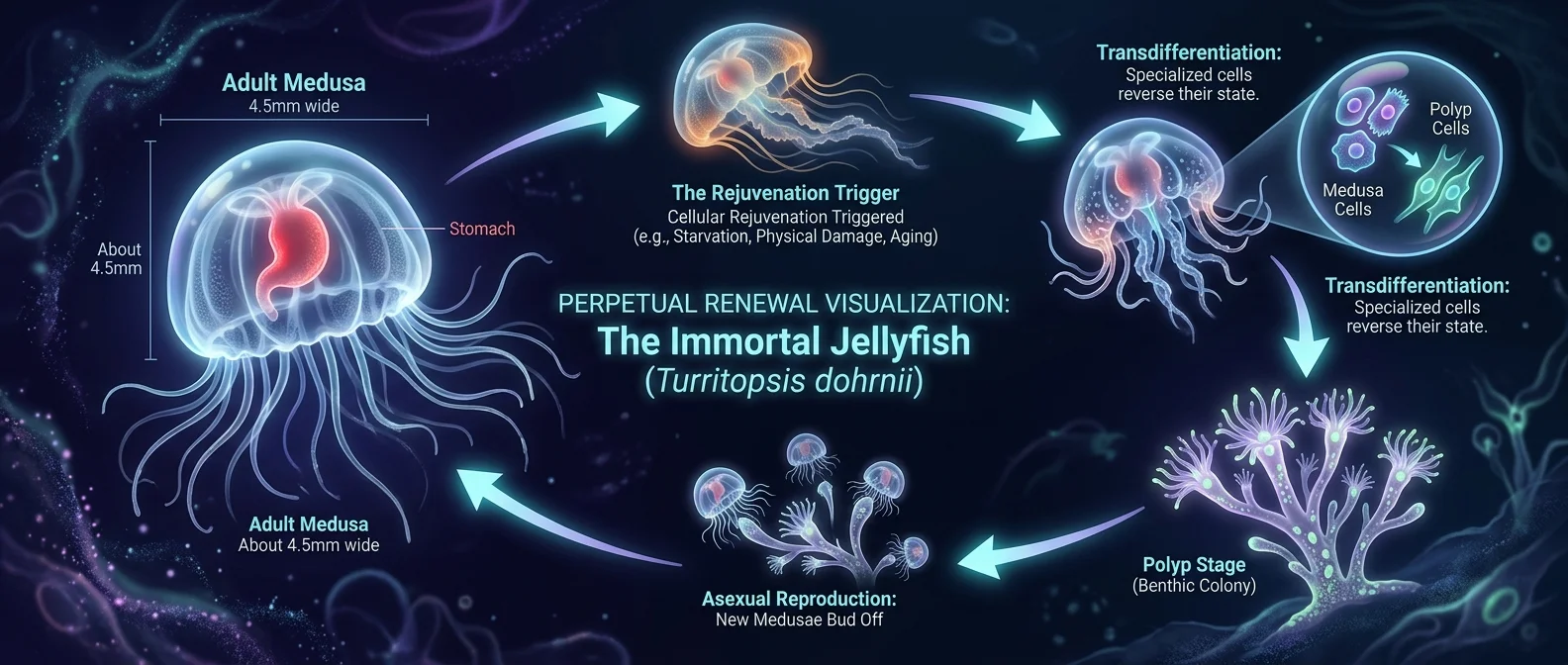
A laboratory at the University of Salento, southern Italy. Biologist Stefano Piraino watches a jellyfish that just suffered injury in a test tube. Instead of dying, the animal begins shrinking, losing its tentacles, and within 24 hours transforms into something resembling a baby. This isn't science fiction—it's Turritopsis dohrnii, the only known animal on Earth that can reset its biological clock to zero.
🔬 The Discovery That Shocked Biologists
Turritopsis dohrnii was discovered in the Mediterranean Sea in 1883, but it took over a century for its most astonishing property to be revealed. In the 1990s, Italian researchers observed something unthinkable: when the adult animal faced stress—starvation, injury, or disease—it didn't die. It transformed.
The jellyfish became a blob, the blob became a polyp, and the polyp produced new adult jellyfish. Genetically identical to the original. The cycle could theoretically repeat indefinitely—something no other animal does in nature.
🧬 How It "Rewinds the Clock"—Transdifferentiation
The mechanism behind this regeneration is called transdifferentiation. In most animals, a cell that has specialized—muscle, nerve, digestive—remains locked in its role until death. In T. dohrnii, this rule doesn't apply.
When the jellyfish activates reversal, its cells “turn off” certain genes and “open” others that were active at an earlier life stage. A muscle cell can transform into a nerve cell. A nerve cell into a reproductive one. According to Stefano Piraino of the University of Salento, this ability resembles how cancer cells function—except here it leads to regeneration, not destruction.
💡 What Is Transdifferentiation?
The conversion of one specialized cell type into a completely different cell type. In humans, this happens extremely rarely. In T. dohrnii, it's the primary survival strategy.

🔄 A Life Cycle with a Reset Button
The life of T. dohrnii begins like any jellyfish. Fertilized eggs become planulae—microscopic larvae that swim freely. The planula settles on the seafloor and forms a colony of polyps, cylindrical structures attached to hard surfaces. From this colony, free-swimming jellyfish are released—the mature animals we recognize.
Here's where it gets interesting. If an adult jellyfish is injured or starved, instead of following the natural path to death, it hits “reset.” It literally shrinks, tentacles are absorbed, and the body transforms into a blob that starts a new polyp colony. From these polyps emerge hundreds of genetically identical jellyfish.
Like rewinding a movie to the beginning—except the movie never ends.
📊 The Immortal Jellyfish by the Numbers
The size is surprising. The entire jellyfish fits on your pinky nail—4.5 millimeters at full development, according to the American Museum of Natural History. At the center of the transparent body sits a bright red stomach, while white tentacles vary dramatically: 8 in tropical waters, up to 90 in temperate regions. The reason for this difference remains a mystery.
🧪 What Its Genome Revealed
In 2022, researchers from the University of Oviedo in Spain published a landmark study in PNAS. The team, led by Pascual-Torner and Diouf, sequenced the entire genome of T. dohrnii and compared it with that of a close relative—Turritopsis rubra, which ages and dies normally.
The comparison was revealing. The “immortal” jellyfish possesses multiple copies of genes related to four critical functions:
DNA Repair
Enhanced mechanisms for correcting genetic damage that accumulates with aging
Telomeres
Improved maintenance of telomeres—the “caps” at chromosome ends
Oxidative Stress
Increased resistance to free radicals that destroy cells
Stem Cells
Enhanced stem cell renewal capacity at every life stage
In other words, T. dohrnii doesn't do anything magical. It simply has “enhanced versions” of mechanisms that exist in every living organism—just on a much larger scale. The research team noted that the mortal relative T. rubra lacks these multiple copies, clearly indicating the genetic basis of biological immortality.

🚢 Global Invasion Through Shipping Routes
Maria Pia Miglietta from Penn State University and Harilaos Lessios from the Smithsonian Tropical Research Institute in Panama discovered something even more concerning. When they analyzed DNA from T. dohrnii samples from the Mediterranean, Japan, Florida, Panama, and elsewhere, the genes were identical.
How did genetically identical animals end up in oceans thousands of miles apart? Ocean currents don't explain this. The answer lies in cargo ships.
🆚 How T. dohrnii Spreads
Through Ballast Water
Ships pump seawater for stability in one port and discharge it in another—transporting live jellyfish
Through Hull Attachment
Polyps attach to ship hulls and travel as “stowaways” on intercontinental routes
Marine biologist James Carlton of Williams College characterized Turritopsis as part of a “growing fleet” of invisible marine invaders. The problem? No one yet knows the implications of this silent spread on local ecosystems.
🏥 Lessons for Human Medicine
The idea that a jellyfish will give us the secret to eternal youth belongs to science fiction—something Miglietta herself explicitly emphasized. “Nobody is looking for anti-aging drugs in these creatures,” she stated.
But there's something much more realistic. The way the jellyfish's cells “turn off” death genes and “activate” regeneration genes resembles how cancer cells function in the human body. Understanding this mechanism could offer tools in cancer research.
Meanwhile, studying transdifferentiation opens pathways in regenerative medicine. If we understand how an adult cell can transform into a different type without passing through the stem cell stage, the applications would be enormous—from treating degenerative diseases to restoring damaged tissues.
❓ Does It Really Live Forever?
The short answer: no. The title “immortal jellyfish” is appealing but misleading. In nature, T. dohrnii dies constantly—eaten by sea turtles, fish, and other cnidarians. Attacked by diseases. Destroyed by extreme temperatures.
Age reversal isn't automatic—it's activated only under extreme conditions, as a last survival option. And even if a specimen manages to revert to the polyp stage, it doesn't guarantee survival. Shin Kubota, a biologist at Kyoto University, managed to keep specimens alive in the lab through multiple reversal cycles—but this required daily care and ideal conditions.
"You're not going to find secrets of eternal youth in these creatures. But that doesn't mean they have nothing to teach us."
— Maria Pia Miglietta, Penn State UniversityThe real value of T. dohrnii doesn't lie in the promise of immortality. It lies in the fact that a creature smaller than a fingernail managed to evolve mechanisms that modern biology is just beginning to understand—mechanisms that might one day change how we approach aging, cancer, and degenerative diseases.
Sources: