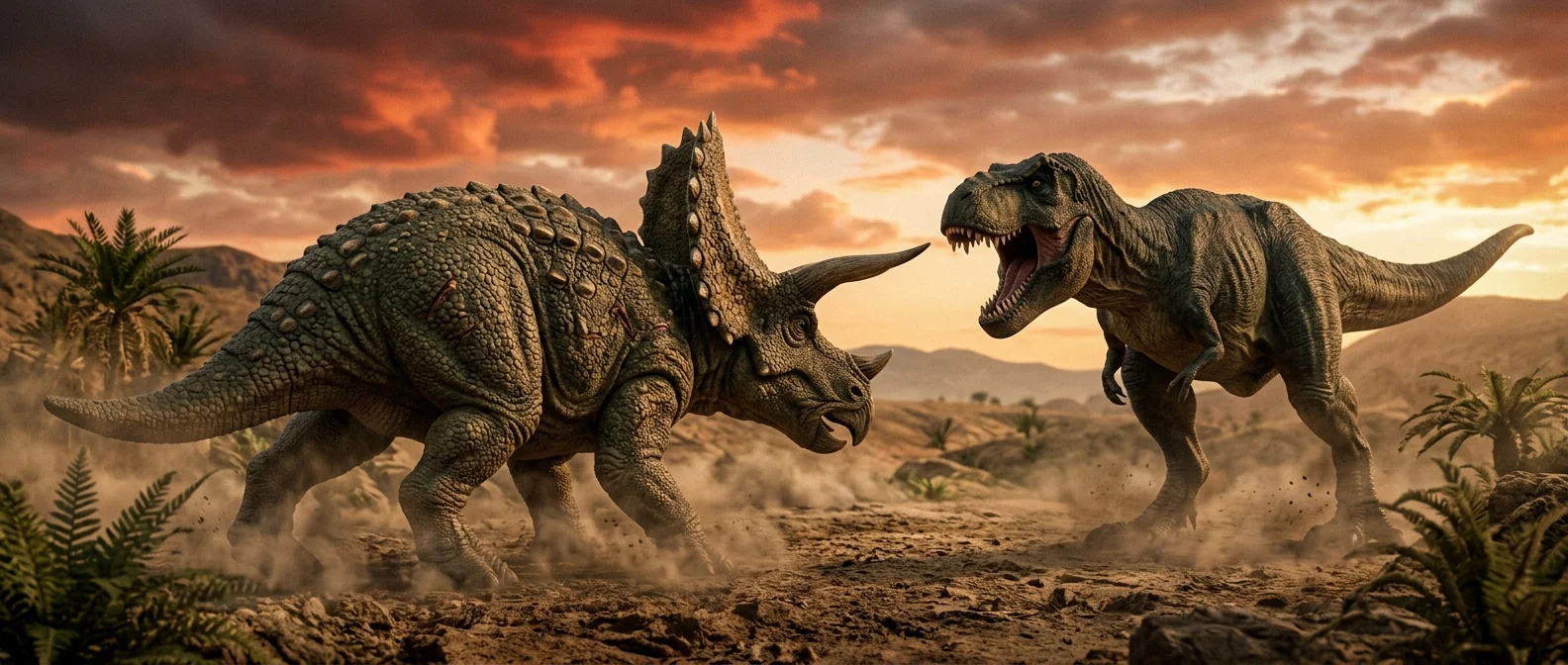
Picture a creature the size of an African elephant, armored with three horns and a massive bony collar. This was Triceratops — one of the last and most impressive dinosaurs to ever walk the Earth. Its head could reach 2.5 meters in length, taking up nearly one-third of its entire body. Like a living tank, it roamed the plains of North America just before the final catastrophe — facing off against Tyrannosaurus rex itself.
📖 Read more: Pachycephalosaurus: Head-Butting Terror That Scared T-Rex
A Name That Says It All
The word Triceratops comes from Greek: tri- (three), keras (horn), and ops (face). “Three-horned face.” Two massive horns above the eyes — reaching up to 1 meter in length — and a smaller horn on the nose. During youth, the horns started as small projections pointing backward. As the dinosaur matured, they gradually straightened. Only when it reached sexual maturity did the horns curve forward and acquire their final, legendary shape.
Behind the horns extended the “frill” — a massive bony collar that covered the neck. Initially, scientists believed it functioned exclusively as a shield, but specimens with T. rex bite marks prove it wasn't always enough. It likely also served for individual recognition, sexual display, and dominance contests between males.
Weaponry and Body: Built for Resistance
Triceratops was a colossal animal. Length up to 9 meters, weight reaching 7,150 kilograms in the largest specimens, and four sturdy legs like columns. Contrary to older reconstructions, a 2012 study in Proceedings of the Royal Society B showed it stood upright like an elephant, not like a lizard with splayed elbows. The front feet had three hooves, the rear four.
📖 Read more: Velociraptor: Hollywood Myths vs Scientific Reality
Its mouth resembles a parrot's beak — designed for grasping, not biting. Behind the beak hid up to 800 teeth(!) that were continuously replaced. They were arranged in groups called "batteries": 36-40 columns of teeth on each side of each jaw, with 3-5 teeth per column. This system allowed it to grind tough palms, cycads, and ferns without problem.
Even more interesting, skin impressions show Triceratops wasn't smooth — it had large, pebbly scales. In the tail region, it may have even had hair-like structures, similar to the primitive ceratopsian Psittacosaurus.
A Nose-Air Conditioner: The 2026 Discovery
🦎 Normal Reptiles
- Nerves and blood vessels reach the nose through the jaw
- Simple nasal cavities
- No respiratory turbinates
🦕 Triceratops
- Jaw pathway blocked — nerves and vessels pass through the nose
- Massive, complex nasal cavity
- Evidence of respiratory turbinate
In February 2026, researchers led by Seishiro Tada from the University of Tokyo published a striking study in The Anatomical Record. Using CT scans on fossilized Triceratops skulls, they revealed a surprisingly complex nasal anatomy.
In most reptiles, nerves and blood vessels reach the nostrils through the jaw. But in Triceratops, the skull shape blocks this route. Instead, nerves and vessels followed an alternative path through the nasal space. “Triceratops had unusual 'wiring' in its nose,” Tada explained. “I realized this while assembling 3D-printed skull pieces like a puzzle.”
📖 Read more: T-Rex: 10 Shocking Facts About the King of Dinosaurs
The team also identified traces of a structure known as a respiratory turbinate — thin, spiral bones inside the nasal cavity that increase the air-blood contact surface. These structures exist in birds and mammals but rarely appear in dinosaurs. Triceratops likely used its giant nose not just for smell — but as a built-in air conditioner, regulating the temperature and humidity inside its skull.
"Ceratopsian dinosaurs were the last group in which the soft tissues of the head were studied. Our research completed the final piece of this dinosaur-shaped puzzle."— Seishiro Tada, University of Tokyo
The Great Debate: Triceratops or Torosaurus?
For decades, paleontologists faced a puzzle. Torosaurus — a similar ceratopsian creature — differs mainly because it has a larger frill with two large holes. Is it a separate species or simply an elderly Triceratops?
In 2010, John Scannella and Jack Horner argued in the Journal of Vertebrate Paleontology that Torosaurus was actually the aged Triceratops. They found evidence that the frill expands slowly during development. The microstructure of Torosaurus bones shows greater age even than the most massive Triceratops specimens. In a 2011 PLOS ONE study, they proposed that Nedoceratops hatcheri also represents a transitional stage between young Triceratops and mature Torosaurus — the holes in the frill gradually enlarge with age.
But the story didn't end there. Other researchers challenged this theory — they found Torosaurus bones that weren't fully ossified, meaning they belonged to immature animals (and therefore couldn't be the final form of aged Triceratops). The solution? More fossils of young Torosaurus are needed to definitively solve the mystery.
📖 Read more: Why Dinosaurs Ran So Fast: The Biomechanical Secrets
Social Animal or Solitary Warrior?
Most ceratopsian dinosaurs are found in mass fossil deposits — a sign of herds. Triceratops, conversely, was found almost always alone. This made it unique among its relatives.
Until 2009, when the first Triceratops “bonebed” was revealed in the Hell Creek Formation, with three juveniles together. And then, the real surprise: in 2013, in Wyoming, researchers searching for Tyrannosaurus stumbled upon a group of Triceratops that had lived and died together. After a decade of excavations, over 1,200 bones from at least five individuals were discovered.
Tooth analysis showed these animals were migratory — they traveled together over long distances. “This naturally opens new questions,” said Jimmy de Rooij, paleontologist at Utrecht University. “How complex was this social behavior?”
📖 Read more: Largest Dinosaur That Ever Walked the Earth Revealed
Discoveries and Legacy
The first Triceratops bones were discovered in Denver in 1887 and sent to Othniel Charles Marsh. Initially, Marsh believed they belonged to bison — he named them Bison alticornis. Only in 1888, with new finds, did he recognize they belonged to a three-horned dinosaur. To date, according to Scannella's study (PNAS, 2014), over 50 Triceratops skulls have been found in the Hell Creek Formation alone.
Although no complete skeleton has been discovered, skulls and partial skeletons — including baby dinosaurs — have been found in Montana, South Dakota, North Dakota, Colorado, Wyoming, and in Canada (Saskatchewan, Alberta). Triceratops was exclusively North American: the continent had already separated from Europe before this species appeared.
Two species are considered valid today — T. horridus and T. prorsus. According to a 2014 study, the first evolved into the second over 1-2 million years. "We began to observe that specimens from lower strata are different from those in upper ones," Scannella explained.
Triceratops lived exactly the last 2 million years before the mass extinction — one of the most common fossils in the Hell Creek Formation. The tank of the Cretaceous held its position as the most recognizable ceratopsian dinosaur until the very last second of its era.