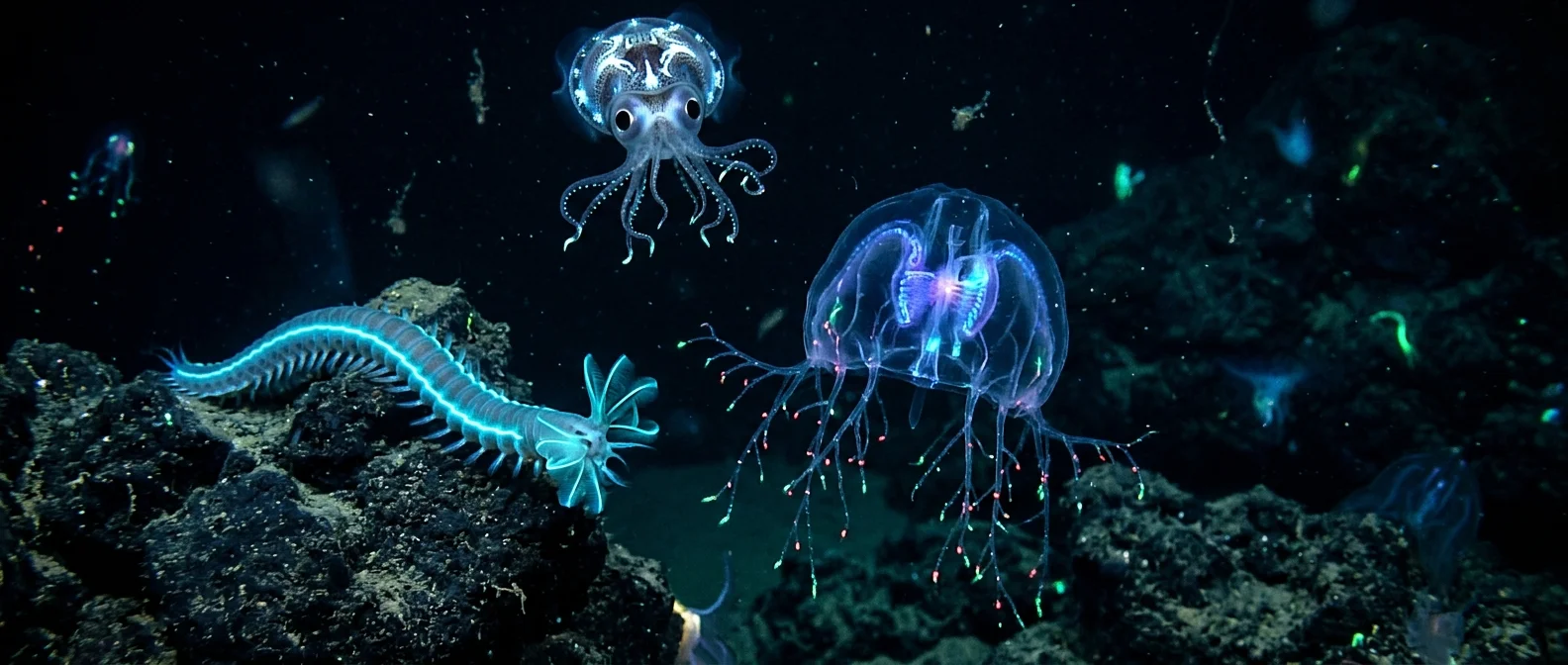
Imagine descending in a deep-sea submersible. You pass 3,000 feet — absolute darkness. You pass 13,000 feet — the metal hull creaks under pressure. At 23,000 feet, where logic says nothing can survive, something moves in the darkness. Something alive. Welcome to the hadal zone — the last unexplored frontier on our planet.
🌊 The Hadal Zone — Beyond the Abyss
The hadal zone begins at 20,000 feet (6,000 meters) and plunges to 36,000 feet (10,994 meters) in the Mariana Trench, the deepest point in Earth's oceans. Named after Hades — the Greek god of the underworld — the etymology isn't coincidental. At these depths, pressure reaches 1,100 atmospheres, temperatures hover around 34-39°F (1-4°C), and not a trace of sunlight penetrates.
Despite impossible conditions, over 45 oceanic trenches harbor unique life. Each trench functions like an isolated island — with endemic species found nowhere else on Earth. Amphipods, sea cucumbers, giant single-celled amoebas known as xenophyophores, and ghost fish dominate this hidden world. Contrary to decades of belief, the seafloor isn't dead — it's a theater of slow but relentless evolution.
🐟 The Snailfish — King of the Deep
Snailfish (family Liparidae) are the only vertebrates inhabiting the hadal zone. They live in at least five separate oceanic trenches, and their anatomy represents a masterpiece of evolutionary engineering — a creature designed entirely for pressure.
In 2021, researchers from Fujian Agriculture and Forestry University and the BGI Academy of Marine Sciences published the complete genome of the Yap Trench snailfish. The fish was captured at approximately 23,000 feet (7,000 meters) in the western Pacific Ocean, and its genetic analysis revealed stunning adaptations.
5 Copies of fmo3
Five copies of the fmo3 gene convert trimethylamine (TMA) from gut bacteria into TMAO — a molecule that stabilizes proteins under massive hydrostatic pressure.
DNA Repair
Extra DNA repair genes maintain genome integrity — the crushing pressure constantly breaks genetic material structure.
Lost Senses
Vision, taste, and smell genes have been evolutionarily lost — they're simply unnecessary in absolute darkness with minimal food.
TMAO — Molecular Shield
TMAO (trimethylamine N-oxide) acts like a molecular panic room — protecting every protein from collapse under pressure.
Bacterial Symbiosis
Gut bacteria produce TMA — the raw material for TMAO. Without these microbes, the fish's proteins would collapse.
Gelatinous Body
Bones are partially decalcified and the body semi-transparent — an adaptation that balances internal and external pressure.

Molecular Discovery
The analysis was published in PLOS Genetics (2021) by Xinhua Chen and Qiong Shi. Positive evolutionary selection actively operates on DNA repair genes, indicating that hydrostatic pressure is the primary evolutionary driver in the hadal zone.
🦐 Dulcibella camanchaca — The Darkness Hunter
In the Atacama Trench, off northern Chile's coast, the story becomes even more dramatic. There, at a depth of 25,900 feet (7,902 meters), scientists from the Woods Hole Oceanographic Institution (WHOI) and the Instituto Milenio de Oceanografía (IMO) discovered a creature that rewrites the rules of the deep sea.
Dulcibella camanchaca is the first large, active predatory amphipod ever found at hadal depths. Its name means "darkness" in Andean languages — a reference to the frozen, eternal abyss it inhabits. With specialized raptorial appendages and lightning-fast swimming ability, it hunts smaller amphipods in the lightless kingdom.
Four specimens were collected during the IDOOS 2023 expedition aboard the R/V Abate Molina, using a lander — an autonomous platform equipped with baited traps that free-falls to the seafloor and returns to the surface. The samples were immediately frozen and subjected to detailed morphological and genetic analysis at the University of Concepción.
Discovery Identity
The study was published in Systematics and Biodiversity (2024) by Dr. Johanna Weston (WHOI) and Dr. Carolina González (IMO). DNA and morphological analysis revealed this is an entirely new genus — not just a new species — making the Atacama Trench a hotspot of endemism.
The Atacama Trench extends along the eastern South Pacific, plunging to depths over 26,000 feet (8,000 meters) and lies beneath exceptionally rich surface waters. This geographic isolation — far from other hadal environments — means its species have been evolving independently for millions of years, creating a unique ecosystem of endemic organisms.

💎 How to Survive at 7 Miles Down
Life in the hadal zone requires solutions that resemble science fiction. Every cell, every protein, every enzyme must function under conditions that would crush a military submarine. The pressure at 36,000 feet is equivalent to the weight of 50 jumbo jets concentrated on a postage stamp.
Pressure
At 36,000 ft, pressure reaches 1,100 atmospheres. Every square inch of skin receives over a ton of weight. Bodies must be nearly incompressible.
Cold
Constant 34-39°F. Metabolism slows dramatically — creatures live at slow speeds, conserving every calorie and energy molecule.
Deep creatures tackle these challenges with an impressive arsenal of adaptations:
- TMAO in every cell — the molecular stabilizer concentration increases linearly with depth
- Gelatinous bodies — no swim bladder, no hard bones, pressure equalization through elastic tissues
- Scavenging — most feed on “marine snow,” dead organic matter slowly sinking from the surface
- Genomic armor — multiple copies of DNA repair genes compensate for continuous damage
- Evolutionary blindness — eyes atrophy, replaced by mechanoreceptors and chemoreceptors
🔬 Why the Deep Matters to Us
The food chain in the hadal zone begins with so-called marine snow — a continuous stream of dead organisms, feces, and organic particles slowly sinking from the surface. This “rain” feeds seafloor bacteria, bacteria feed amphipods, and amphipods feed snailfish — a chain built on decomposition.
Each trench functions as a unique evolutionary laboratory. The Atacama Trench, Yap Trench, Mariana Trench — each hosts species that exist nowhere else on Earth. The geographic isolation of these depressions creates evolutionary laboratories similar to the Galápagos Islands, except instead of ocean, they're separated by incomprehensible pressure.
"Many genes related to DNA repair show signs of positive selection and increased copy numbers in the snailfish genome — reflecting the difficulty of maintaining DNA integrity under high hydrostatic pressure."
— Xinhua Chen, PLOS Genetics (2021)Despite their isolation, not even trenches escape human influence. Toxic substances like PCBs (polychlorinated biphenyls) have been detected even in the hadal zone — proving that industrial pollution reaches the most inaccessible points on the planet. This discovery gives new urgent dimension to protecting the deep oceans.
Meanwhile, the molecular solutions of these creatures open pathways in biotechnology. Enzymes that function at 1,100 atm, proteins with built-in stability through TMAO, and DNA repair mechanisms could inspire new biomaterials, pharmaceutical applications, and biological sample preservation technologies.
As Dr. Johanna Weston of WHOI emphasized: "Each species discovered there adds a critical piece to the puzzle of how life evolved and still thrives in one of Earth's most extreme environments." As exploration technology advances — with autonomous landers, remotely operated ROVs, and next-generation submersibles — more species are expected to be revealed, each illuminating a new aspect of life at the extremes.