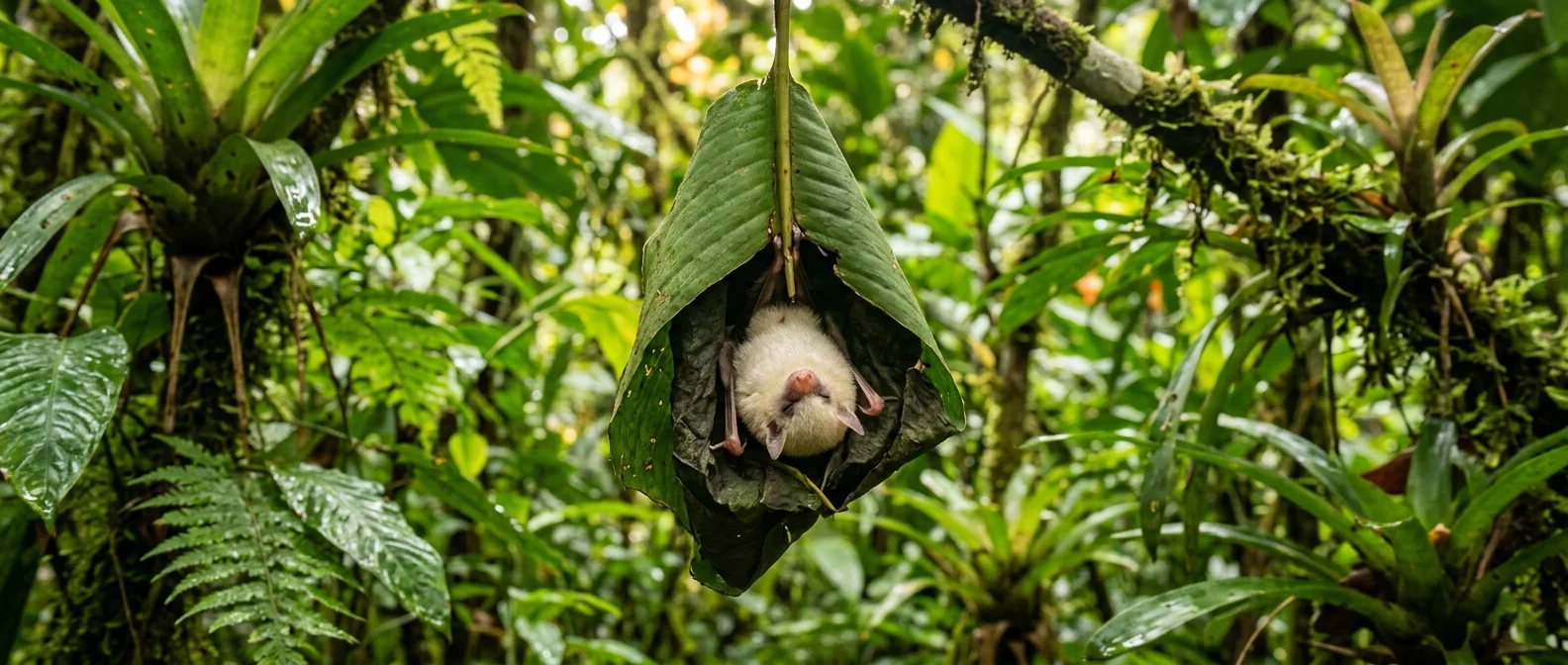
In the tropical rainforests of Central America, a tiny white creature hangs upside down inside what looks like a folded leaf. This isn't random damage. The bat itself systematically bit along the leaf's midrib, causing the sides to droop downward and form a V-shaped shelter that protects it from rain, sun, and predators. Welcome to the world of tent-making bats.
📖 Read more: How Many Creatures Live on You Right Now? The Answer Shocks
🏕️ What Makes a Bat a “Tent-Maker”
Of the world's 1,400+ bat species, only 22 construct leaf tents. They belong primarily to the Phyllostomidae family (leaf-nosed bats) and live exclusively in tropical forests of Central and South America. The term “tent-making bats” covers a spectrum of species — from the iconic Ectophylla alba (Honduran white bat) to Uroderma bilobatum (Peters' tent-making bat), extensively studied in Panama.
Construction isn't random. Each species uses specific plants, specific cutting techniques, and produces specific tent shapes. There are at least 6 different architectural tent types — conical, boat-shaped, inverted umbrellas, bifid, and pteropodial constructions. Each type serves different needs depending on group size and environment.
🦇 The Honduran White Bat
Imagine a thumb-sized bat, pure white, with a yellow leaf-shaped nose and yellow ears. Ectophylla alba looks more like an exotic flower than a mammal. It weighs just 5–6 grams and measures around 4 centimeters.
Its favorite raw material? Massive Heliconia leaves — plants that reach 2 meters in length. The bat methodically bites along the central vein, causing the leaf's two halves to drop and form a V-tent. Inside this green cocoon, groups of 4 to 12 individuals hang in a row, side by side. The green light filtering through the leaf gives their white fur a greenish tint — natural camouflage.

🔬 Peters' Tent-Making Bat: The Panama Study
In Gamboa, Panama, a team of researchers from the Smithsonian Tropical Research Institute (STRI) monitored Uroderma bilobatum colonies for nearly a year. Jenna Kohles, then a student at the University of Konstanz under Dina Dechmann's supervision, recorded births on camera and tracked changes in mother-pup interactions.
What she discovered was something never before documented in bats: mothers push their pups with their forearms, gradually encouraging them to fly and wean. Unlike many mammals that show aggression to drive offspring away, tent-making bats do it without violence — only gentle nudging.
"It's in the pups' interest to continue nursing as long as possible. But this is a huge burden for mothers," Kohles explained. “That's why we were excited to observe this new behavior.”
📖 Read more: Mariana Trench: What Lives at 36,000 Feet Deep?
🏗️ Tent Architecture
Not all bats build the same tents. The variety would make even human architects envious.
Conical Tent
The most common — a large palm leaf becomes a cone. Used by larger groups, up to 50 individuals.
V-tent (Boat)
Sides fall on either side of the midrib — like an inverted boat. The classic technique of Ectophylla alba on Heliconia leaves.
Inverted Umbrella
The leaf forms a concave dome. Suitable for solitary individuals or pairs on banana leaves.
Pteropodial
Multiple cuts create folds. Rarer, appears on palmate leaves of tropical plants.
Leaf selection isn't random. Bats prefer young, flexible leaves — old ones don't bend properly, while very small ones don't provide adequate coverage. A tent can last weeks before being destroyed by wind or wear, so construction of a new one begins from scratch.
👶 Raising Young in a Green Dome
Bats typically give birth to just one pup at a time — a constraint stemming from the fact that mothers must fly while carrying the embryo's weight. Tent-making bat pups develop rapidly. According to Kohles' research, pups' arms grow faster than the rest of their body — an evolutionary advantage that allows them to fly within just a few nights.
Mothers don't abandon their young. Kohles' team found evidence that mothers retrieve pups that fail their first flights and carry them back to the tent. Meanwhile, tents function as "information centers": members learn from others where to find their favorite food — ripe figs.

📖 Read more: Pelican Eel: The Living Mouth-Bag of the Deep
🛡️ Why Tents Instead of Caves
Most bats roost in caves, mines, or building roofs. Why did some choose leaves?
The answer lies in geography. In dense tropical forests, caves are rare. Simultaneously, leaves offer advantages: they're elevated above ground, away from terrestrial predators. The tent hides the bat from aerial predators thanks to the leaf's visual cover. And if a snake or predator lands on the leaf, vibration immediately reveals the intruder — the tent functions as an alarm system.
Leaf Tent vs Cave
🌿 Tent
- Small groups (2–50 individuals)
- Temporary (weeks)
- High in vegetation
- Predator detection via vibration
- Natural camouflage
🪨 Cave
- Massive colonies (hundreds of thousands)
- Permanent
- At or below ground level
- Stable temperature
- Vulnerable to white-nose syndrome
🌡️ Climate Change and Threats
Deforestation is the worst enemy. Without massive Heliconia, palm, or banana leaves, there are no tents. Every hectare of tropical forest lost means fewer resources for bats that depend exclusively on vegetation. Ectophylla alba is already classified as “Near Threatened” on the IUCN Red List — one step before vulnerability.
Climate change adds pressure: changes in rainfall cycles affect host plants, while increased temperatures can raise the energy needs of these microscopic mammals. A 5-gram bat without fat reserves has little margin for error. Every thermal fluctuation translates to calories that must be found within a shrinking forest.
💡 Did you know...
Uroderma bilobatum in Panama doesn't just make tents in leaves — it also colonizes the slightly sloped roofs of tropical bungalows. Rachel Page's team (STRI) monitored tents under the eaves of over 30 houses in Gamboa for nearly a year.
🧬 Evolutionary Mystery
How did tent construction evolve? This remains an open question. The 22 tent-making species don't belong to a single branch — the behavior appeared independently at least four times during evolution. This means selection pressure was strong enough for different lineages to “discover” the same solution independently.
"Our study highlights how little we still know about the secret lives of these amazing creatures," Kohles observed. And she's right. For every new discovery — like forearm nudging — dozens of questions remain unanswered. How does a young bat learn to make a tent? Is it instinct or learned? Nobody knows yet.
What we do know is that somewhere in a tropical forest, a 5-gram creature gets up every night, checks if its tent is holding up, and if needed, starts building a new one. Without blueprints, without tools. Just teeth and instinct.