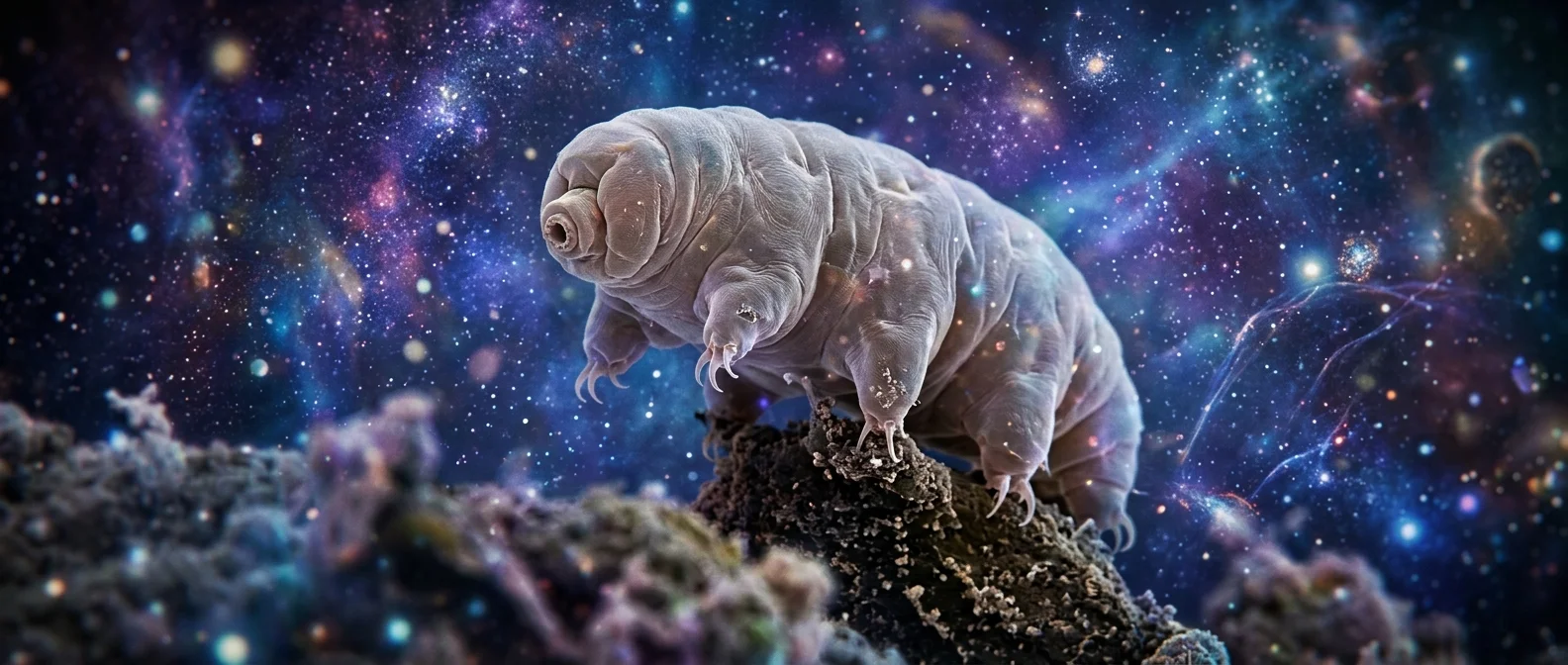
Imagine a creature smaller than the period at the end of this sentence that can survive in the vacuum of space, withstand radiation 1,000 times more lethal than what kills humans, and endure dehydration lasting over a decade. This isn't science fiction — it's walking through the moss in your backyard right now on eight clumsy legs, and scientists are just beginning to understand how it pulls off these impossible feats.
📖 Read more: Life 4km Underground: Bacteria Thrive in Earth's Deep Crust
Meet the "Water Bears": What Are Tardigrades?
Tardigrades, known as “water bears” or “moss piglets,” are microscopic invertebrates measuring 0.1 to 1.5 millimeters. With over 1,300 known species, they form an entire phylum (Tardigrada) that emerged roughly 500 million years ago — before fish even developed jaws. Their pudgy bodies sport four pairs of legs ending in microscopic claws, resembling something between a bear and a cartoon character. Dutch microscopist Johann August Ephraim Goeze dubbed them “little water bears” in 1773, while Italian Lazzaro Spallanzani gave them their scientific name Tardigrada (slow walkers) in 1776 — inspired by their sluggish, awkward gait.

Cryptobiosis: Life's Ultimate Pause Button
The secret behind their immortality is called cryptobiosis — a state where metabolism drops below 0.01% of normal levels. When conditions turn hostile, tardigrades retract their legs, expel nearly all their water (about 85% of their body mass), and transform into a dry, glassy sphere called a “tun.” In this form, they can withstand temperatures from -272°C (near absolute zero) to 150°C, pressure 6,000 times atmospheric — six times greater than the deepest ocean trenches — and decades of complete dehydration. In one Japanese laboratory experiment, tardigrades frozen for 30 years at -20°C revived within hours of being brought to room temperature.
The Mysterious TDP Proteins: Glass Instead of Sugar
For decades, scientists believed a sugar called trehalose — the same one used by brine shrimp and certain nematodes — explained how tardigrades survive dehydration. But biochemical analyses revealed trehalose exists at very low levels or is completely absent. “If tardigrades don't rely on trehalose, what do they use?” wondered Thomas Boothby from the University of North Carolina.
The answer came in 2017, published in Molecular Cell: a group of unique proteins called TDPs (tardigrade-specific intrinsically disordered proteins). These proteins lack stable three-dimensional structure — they're “disordered” — but when the animal begins drying out, the genes encoding them activate at maximum levels. TDPs form glassy solids, just like trehalose, creating a protective shell around sensitive cellular components.
Boothby's team did something remarkably clever: they inserted TDP genes into bacteria and yeast, proving these organisms gained new desiccation tolerance abilities. A tardigrade species with permanently activated TDP genes could survive sudden dehydration much faster — “it didn't need time to manufacture them,” he explained.
📖 Read more: 12-Meter Crystal Cave: Life Thrives in Extreme Heat
1,000x More Radiation: The DNA Repair Surprise
Sixty years ago, researchers discovered tardigrades withstand radiation roughly 1,000 times more intense than what humans can survive. But nobody knew how. The answer came in April 2024 from Bob Goldstein's lab at the University of North Carolina, which has studied tardigrades for 25 years. Researcher Courtney Clark-Hachtel studied the species Hypsibius exemplaris and discovered something unexpected: radiation does indeed destroy their DNA — they're not invulnerable.
What makes the difference is their response: tardigrades dramatically increase production of DNA repair genes to such an extent that these become “some of the most abundant gene products in the animal kingdom,” according to the Current Biology publication. Simultaneously, independent experiments at the Paris Natural History Museum discovered a new tardigrade protein that directly protects DNA — results published in eLife.

In Space Without a Suit
In 2007, the European FOTON-M3 mission exposed tardigrades directly to the vacuum of space for 10 days. Without oxygen, without moisture, in temperatures ranging from -270°C in shadow to 100°C in sunlight, bombarded by ultraviolet and cosmic radiation. When they returned to Earth and were rehydrated, many revived and reproduced normally. No other animal has achieved this without protective equipment. In 2019, the Israeli Beresheet mission crashed on the Moon carrying dehydrated tardigrades — and many scientists speculate they remain viable, waiting for water that may never come.
The Dsup Protein: DNA's Shield
Beyond the dramatic repair mechanisms Goldstein revealed, tardigrades possess yet another unique weapon: a protein called Dsup (Damage Suppressor). Discovered in Japanese laboratories, it functions like natural armor — wrapping around DNA and preventing radiation and free radicals from breaking the genetic code. When researchers introduced the Dsup gene into human cells, they showed 40% less DNA damage after X-ray exposure. This dual strategy — prevention (Dsup) and repair (DNA repair genes) — explains why no other animal approaches their endurance records.
📖 Read more: Russian Scientists Starved to Death to Save the World
From Moss to Medicine: Applications for Humans
The tardigrade “superpower suite” doesn't just fascinate biologists. TDP proteins could stabilize drugs without refrigeration — a revolution for regions lacking cold storage chains. "The ability to stabilize sensitive drugs in a dry state is something very important to me — I grew up in Africa, where lack of refrigeration in remote areas is a huge problem," Boothby explained.
In February 2025, researchers presented tardigrade proteins that could help cancer patients tolerate radiation therapy — literally transferring the abilities of these microscopic creatures to human medicine. In agriculture, TDP genes are being tested in crops to withstand prolonged drought — vital in an era of climate crisis.
Where They Live and Why We Don't See Them
Despite their reputation as “alien” creatures, tardigrades live everywhere around us — in wet moss, in lichens on rocks, in lake sediments, even in apartment building gutters. Their ideal environment is a thin film of water on plant surfaces, where they feed by absorbing cellular fluids from mosses, algae, and microscopic invertebrates. They're so small you need a microscope with at least 40x magnification to see them — but if you take a piece of moss from a sidewalk stone and wet it, you'll almost certainly find several. Studies estimate an average square meter of moss hosts thousands of individuals.
These invisible bears aren't just biological curiosities — they're living manuals of evolutionary engineering. Every protein revealed in their bodies opens new pathways in pharmacology, space biology, and agriculture. Evolution needed half a billion years to perfect this design — we've barely begun deciphering it.
Sources:
- Clark-Hachtel, C. M. et al. «The tardigrade Hypsibius exemplaris dramatically upregulates DNA repair pathway genes in response to ionizing radiation.» Current Biology, 2024 — ScienceDaily / University of North Carolina
- Boothby, T. et al. «Tardigrades Use Intrinsically Disordered Proteins to Survive Desiccation.» Molecular Cell, 2017 — ScienceDaily / Cell Press