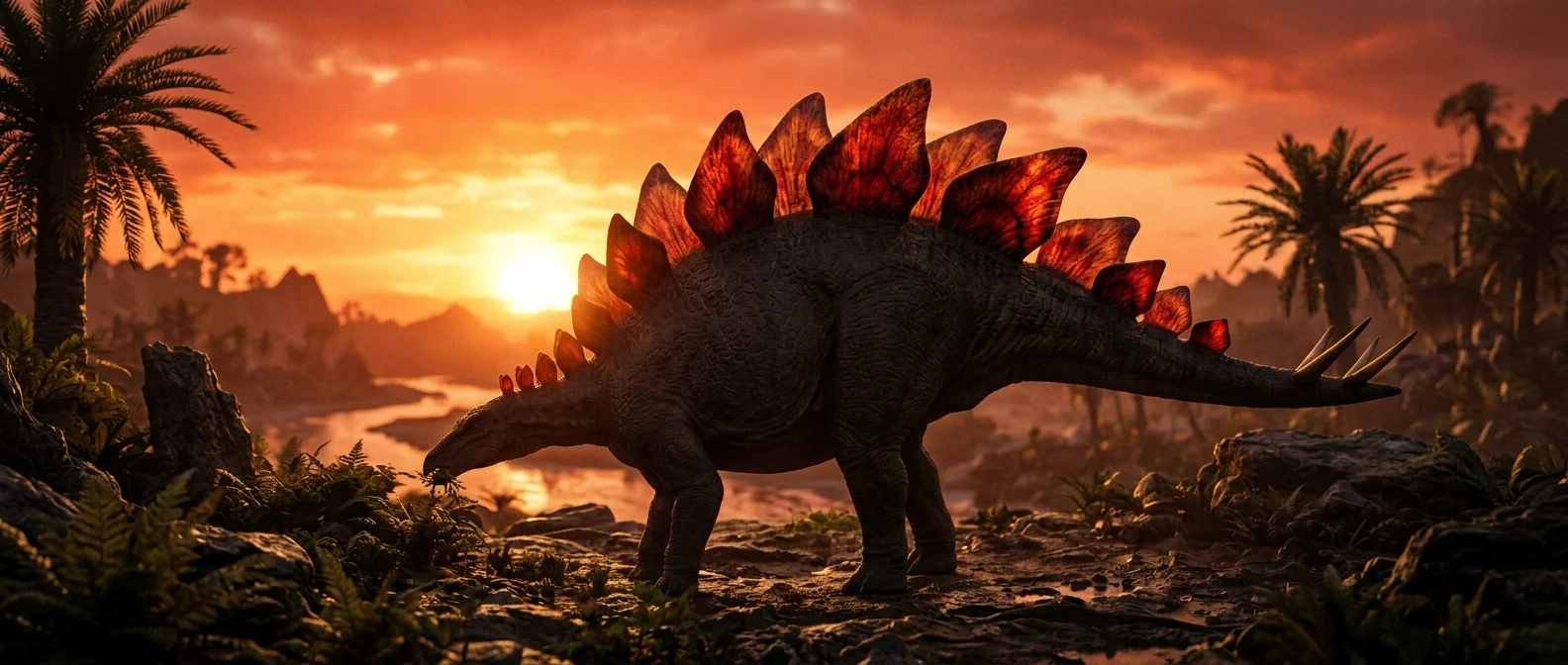
Nearly 150 years after its discovery, Stegosaurus remains one of prehistory's most recognizable yet mysterious creatures. Those massive bony plates running down its back — what exactly were they? Armor plating? Solar collectors? Mating displays? The answer turned out far more complex than anyone imagined.
📖 Read more: Pterosaurs: Ancient Sky Kings That Ruled Before Birds
The Case File: Vital Statistics
Stegosaurus lived during the Late Jurassic period, when western North America was covered in dense forests and rivers. About the size of a bus — 30 feet long — but moving slowly. Its front legs were significantly shorter than its back legs, giving it a characteristic head-down posture. This leg inequality meant its gait was sluggish — the back legs would “catch up” to the front ones if it tried running fast.
Evidence #1: The Plates Aren't What They Seem
Let's clear something up: Stegosaurus's 17 plates weren't attached to its skeleton. They were embedded in the skin, like a type of osteoderms. That's why in almost every fossil, the plates are found separated from the rest of the body — mud and time moved them around.
These plates, called scutes, weren't solid. They had an internal honeycomb structure and blood vessels running through them. This was the first major clue: a defensive wall doesn't need blood vessels. Something else was happening.
Evidence #2: Temperature Control or Show-Off Display?
The microscopic grooves on the plate surfaces — traces of blood vessels — led many scientists to conclude they functioned as thermoregulators. Like car radiators: blood passed through the plates, shed heat, and returned cooler to the body.
But a 2005 study in Paleobiology challenged this scenario. The plates' microstructure didn't match that of an efficient thermoregulator. A later 2010 study in the Swiss Journal of Geosciences found a middle ground: the plates probably helped passively with thermoregulation due to their size — just like a toucan's massive beak radiates heat — but this wasn't their primary purpose.
Evidence #3: The Tail Tells All
If the plates were for show, then how did Stegosaurus defend itself? The answer lies in its tail — and it's devastating. At the tip of its flexible tail were four large, sharp spikes projecting sideways. The name of these spikes? Thagomizer — and the story behind this name is unique.
In 1982, cartoonist Gary Larson published a “Far Side” comic showing a group of cavemen naming the spikes “thagomizer — after the late Thag Simmons.” The unofficial term was adopted by paleontologists and is still used in scientific literature today. A cartoon gave permanent naming to an anatomical feature.
Defense Evidence
- ~10% of spikes found damaged at the tip
- Allosaurus fossils with spike-sized holes
- Flexible tail = precise targeting
Opponents
- Allosaurus: primary predator
- Ceratosaurus: secondary predator
- Morrison Formation: packed with predators
The evidence is ironclad. About one in ten fossilized spikes show damage at the tip — signs of repeated use. Even more revealing: Allosaurus fossils, Stegosaurus's main predator, have been found with holes that match exactly with thagomizer spikes. Stegosaurus wasn't easy prey.
Evidence #4: The Brain Mystery
"Stegosaurus's brain was thought to be walnut-sized," says Carpenter. “But actually, it was the size and shape of a bent hot dog.” It still remains one of the lowest brain-to-body ratios in the dinosaur kingdom.
Scientists once believed Stegosaurus had a second “brain” — a nerve cluster above its hind legs that helped control movement. The idea arose because the spinal column in the hip area had an unusually large cavity. This theory has now been debunked. The cavity probably housed a glycogen body — a structure found in modern birds related to energy storage, according to a 1990 study in Paleobiology.
Evidence #5: What It Ate — And How Weakly
Stegosaurus was herbivorous, but not a typical one. Unlike Triceratops or hadrosaurs, it lacked powerful jaws or grinding teeth. Its teeth were small, rounded, like clothespins. The jaws moved only up-down — no sideways motion for grinding.
A 2010 modeling study in the Swiss Journal of Geosciences revealed something startling: Stegosaurus's bite was weaker than a human's. It could only break branches smaller than 1.3 centimeters in diameter. It fed on low vegetation: ferns, mosses, cycads, conifers, and fallen fruit. The short neck and small head meant it couldn't reach high — though some researchers argue it reared up on its hind legs.
It had one advantage though: cheeks. Stegosaurus's cheeks allowed it to store more food in its mouth while chewing, something many other dinosaurs couldn't do.
The Discovery: From Colorado to Portugal
The first Stegosaurus fossils were discovered in 1876 in Colorado by M.P. Felch and named by Othniel C. Marsh in 1877. Stegosaurus is so important to Colorado that it became the state's official fossil.
The vast majority of finds — fossils from about 80 individuals — come from the Morrison Formation, a geological unit extending mainly through Wyoming and Colorado but reaching Montana, Nebraska, Texas, New Mexico, Arizona, and Idaho. The fossils show that Stegosaurus traveled in mixed-age herds.
Another significant discovery came from an entirely different continent: in 2007, researchers found a Stegosaurus fossil in Portugal. The discovery, published in the German scientific journal Naturwissenschaften, proved that Stegosaurus also lived in Europe — supporting the theory that the two continents were connected by temporary land bridges during tidal periods.
How Many Species? The Final Evidence
Even today, paleontologists disagree on how many Stegosaurus species existed. The type species S. armatus was the largest, reaching 30 feet. But S. stenops — the most studied species thanks to its nearly complete fossils — might deserve the title of representative species. Some researchers believe three or four different species existed, based on anatomical differences. Others argue they all belong to a single species with great variation — just like all dog breeds belong to Canis lupus familiaris.
This is perhaps Stegosaurus's final mystery: an animal so iconic, so recognizable, yet full of questions. Its plates may never have been shields — but they were something more interesting: a communication tool in a world 150 million years old. And the tail? That was purely about survival.