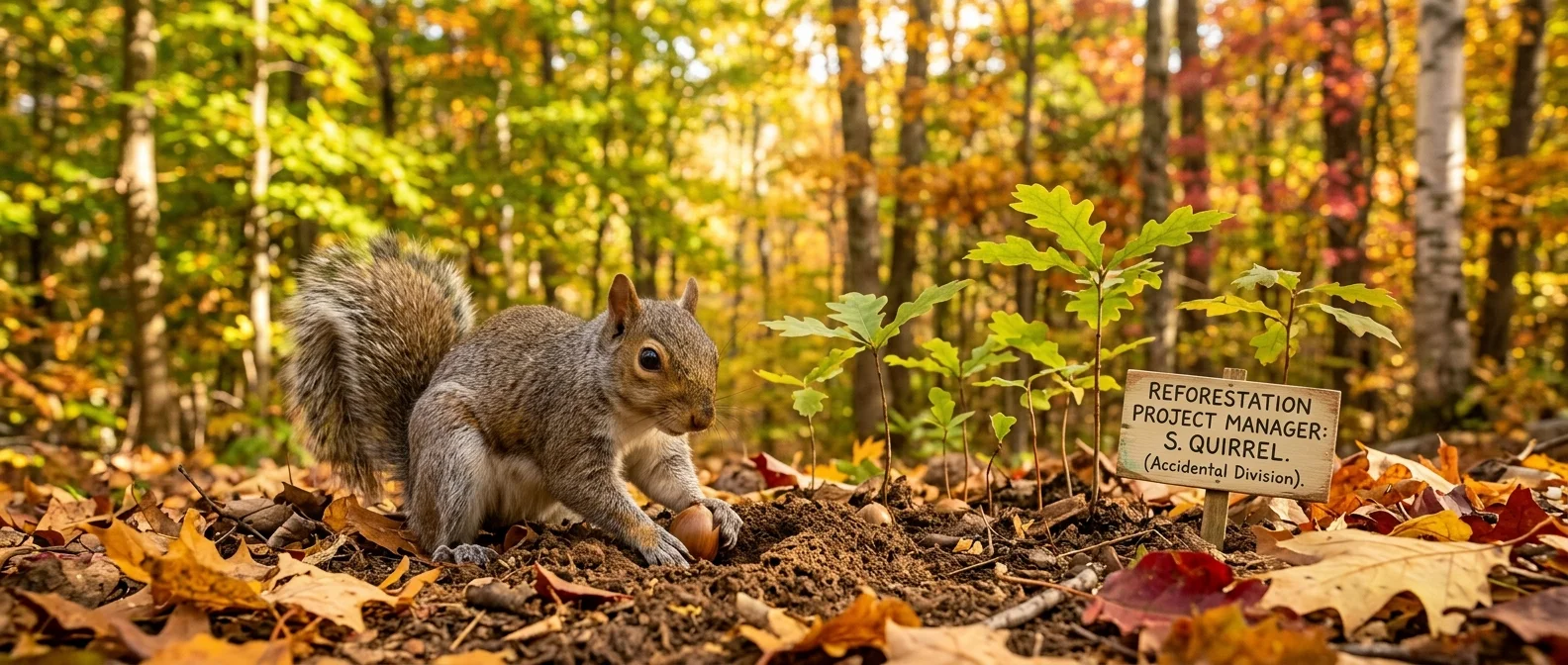
Every autumn, millions of squirrels dig small holes in the ground and bury acorns for winter. But they never find them all. The forgotten acorns sprout — and become trees. Without knowing it, these small rodents are responsible for regenerating entire oak forests across North America. It's one of nature's most paradoxical partnerships: the squirrel eats the acorns, but simultaneously plants the trees.
📖 Read more: Kazakhstan Plants 37,000 Trees to Restore Tigers After 70 Years
The Accidental Foresters
"Tree squirrels are among the most important animals for oak dispersal because they cache acorns in the soil — essentially planting baby oak trees," explains Peter Smallwood, a biology professor at the University of Richmond. His research with Michael Steele from Wilkes University revealed something remarkable: gray squirrels fail to retrieve up to 74% of the acorns they bury. This isn't loss — it's reforestation.
Evidence is mounting that squirrels, along with blue jays and a few other small animals, are critical to maintaining and regenerating secondary oak forests — and were likely responsible for spreading the massive oak forests across all of North America. The relationship between squirrel and oak is a balance between seed destruction and seed dispersal.

Red vs White Acorns: The Big Difference
Not all acorns are created equal — and squirrels know it well. In over 1,500 feeding trials, Steele and Smallwood recorded a clear pattern: 85% of white oak acorns were eaten immediately, while about 60% of red oak acorns were cached for later. The explanation lies in chemistry.
Red oak acorns are rich in fats but loaded with tannins — the bitter compounds used in leather tanning. White acorns have less fat and fewer tannins. Critical difference: red acorns remain dormant through winter and sprout in spring, while white acorns germinate almost immediately after falling to the ground in autumn — making them useless if stored. That's why squirrels consume them on the spot.
Half-Eaten Acorns That Still Sprout
Researchers observed a remarkable behavior: squirrels often ate only the top half of a red oak acorn — the part furthest from the embryo — and discarded the rest. Moments later, they'd grab a fresh acorn and repeat. The explanation? Higher tannin concentrations are found near the bottom of the acorn, where the embryo sits. “This factor may influence squirrel choices,” Steele explains.
The result? Half-eaten acorns continued to germinate, since the embryo remained intact. Even if a squirrel rediscovered a cached acorn after it had begun sprouting, up to half the stored energy had already gone to the seedling. Nature designed a system where even the squirrel's “failure” becomes success for the forest.
Bankers with Fur
"Think of them as little bankers depositing money and spreading it across different accounts," says Mikel Delgado, a psychology PhD candidate at UC Berkeley who leads a squirrel research team in Lucia Jacobs' lab. The team uses GPS technology to track the caching behavior of up to 70 fox squirrels on campus, and has recorded over 1,000 locations of buried nuts.
📖 Read more: World's Largest Organism Is a Fungus Covering 965 Hectares
Squirrels don't bury blindly. They grab a nut with teeth and claws, rotate it, shake their heads two or three times — a “head-flicking” behavior that increases when they plan to cache rather than eat it — then leap up to 100 meters away to find a suitable hiding spot. Jacobs was the first to discover that squirrels remember their own caches better than other squirrels' caches — suggesting true spatial memory, not just scent.

Memory, Scent, or Both?
How do squirrels find their buried acorns three months later? Some scientists hypothesized they use smell, but Jacobs' research shows something more complex. "They may use a combination of landmarks and memory to narrow their search, then use their nose for final location," Delgado explains. The team replicates experiments with students burying Easter eggs in the park — "we use humans as a model for squirrel behavior so we can ask questions we can't ask squirrels," she says.
Jacobs, a leading expert on squirrel cognitive ability, describes what's needed: "You want a species that faces big cognitive problems — like making decisions about thousands of acorns and then remembering where they hid them three months later — while also dealing with regular challenges, like escaping predators and outsmarting competitors."
How Forests Regenerate
The importance of squirrels to oak forests becomes clear in metal tag experiments. Steele and Smallwood tagged thousands of red and white oak acorns with tiny metal labels, and after animals dispersed them, used metal detectors to locate them. Results were clear: red oak seedlings were more widely scattered throughout forests, while white oak seedlings clustered near the parent tree.
This means squirrels don't just plant trees — they determine which species will dominate. Red oak will likely be first into new forests, thanks to greater dispersal by squirrels. This relationship has shaped forest structure for millions of years — an unwitting forester working quietly, one acorn at a time.
Red vs White Acorns
Red: Rich in fats + tannins. Dormant through winter. 60% cached. Wide dispersal. First into new forests.
White: Less fat + tannins. Germinate immediately. 85% eaten on-site. Stay near parent tree.
📖 Read more: Rainbow Eucalyptus: The Tree That Paints Itself
Problem-Solving Squirrels
Squirrel intelligence extends beyond memory. In a Berkeley experiment, squirrels were trained to open boxes with their noses. When given locked boxes, they didn't give up — they pushed, pulled, bit them, displaying the building blocks of intelligence. “They're smart and extremely persistent at problem-solving,” Delgado states.
Berkeley's fox squirrels (Sciurus niger) — non-native, with reddish fur and bushy tails — face multiple daily threats: foxes, coyotes, hawks, eagles, and owls. They don't hibernate, are solitary animals, and their reproductive life involves “brief chases with lots of chattering and tree-climbing.” Every day, every decision — bury or eat, here or there — is part of a complex cognitive system that keeps both the squirrel and entire forests alive.
The Paradoxical Alliance
"Are squirrels dispersers and planters of oak forests or troublesome seed predators? The answer isn't simple," Steele admits. The truth lies in between: squirrels destroy millions of seeds, but simultaneously cache, transport, and “plant” enough to ensure the continuity of entire ecosystems. This relationship isn't accidental — oaks have evolved acorns to “exploit” caching behavior: tannins protect the embryo, dormancy ensures transport, and acorn size makes burying rather than consumption more likely.
The story of squirrels and acorns reminds us that in nature, forgetting can be more creative than remembering. Every lost acorn is gained as a tree, and every tree will feed generations of squirrels who won't remember who planted them. “They're saving for the future,” Delgado says, “and they're really smart about it” — even if they don't know it.
74% Forgotten
Nearly 3 out of 4 acorns are never retrieved
Reforestation
Squirrels accidentally plant millions of trees
1,000+ Caches
Mapped with GPS at Berkeley
Sources:
- University of Richmond. “Researchers Tackle The Nutty Truth On Acorns And Squirrels.” ScienceDaily, 26 November 1998. Steele & Smallwood, Wilkes University/University of Richmond.
- University of California - Berkeley. “Fox squirrels show long-term investment savvy when hoarding nuts.” ScienceDaily, 4 October 2012. Delgado & Jacobs, UC Berkeley Psychology.