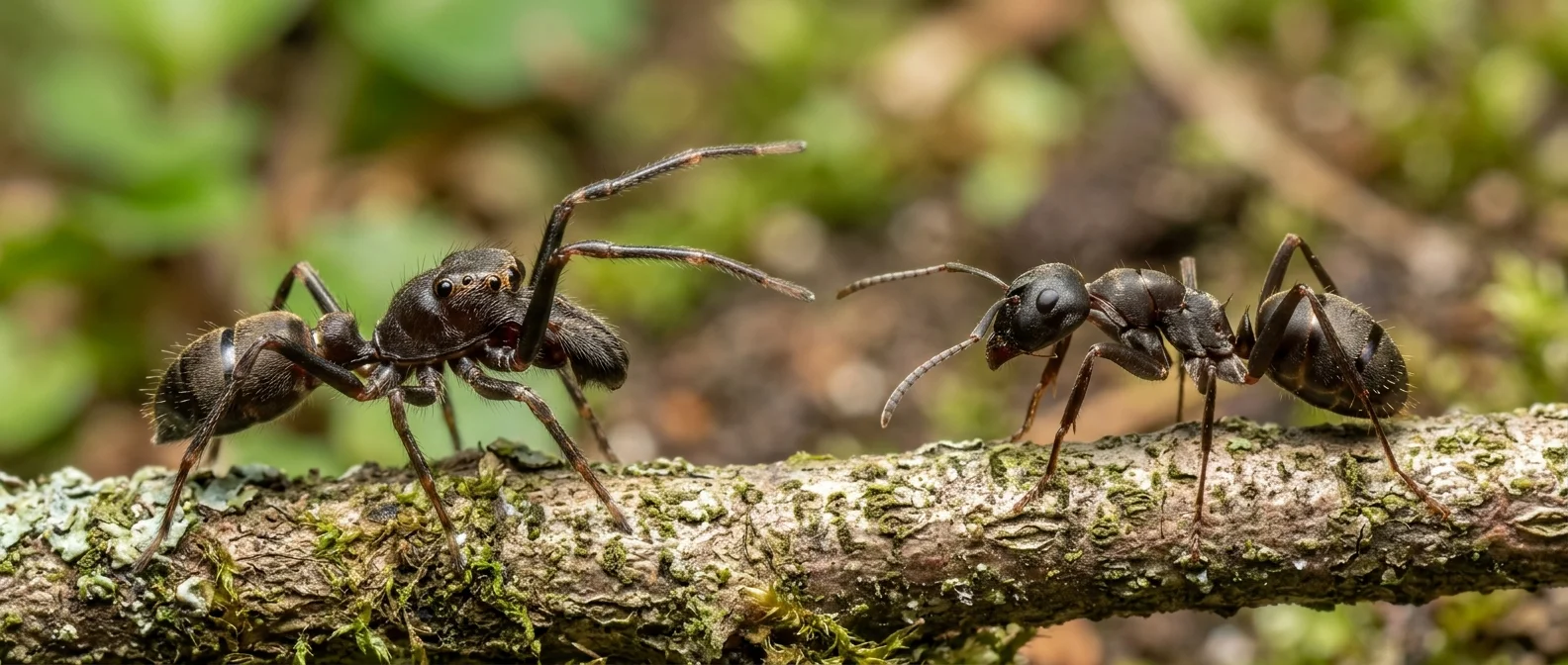
A spider crawls across a leaf, waving its front legs like antennae. To a bird's eye, it looks exactly like an ant — and that distinction means the difference between life and death. Over 300 spider species worldwide have evolved bodies, movements, and behaviors that mimic ants with stunning precision. This is the most sophisticated theater that natural selection has ever staged.
📖 Read more: Oxytocin: The Chemistry Behind Love and Trust
Why Ants and Not Something Else?
Ants are among the most well-armed insects in nature. They possess mandibles, stingers, formic acid, and — most importantly — always appear in large numbers. “Try to eat one ant and ten others will bite you,” explains Nathan Morehouse, associate professor of biological sciences at the University of Cincinnati. Most birds and lizards avoid ants entirely — "unless you're a specialized predator like an anteater, they're simply not worth the meal." That's why nearly every insect family, from beetles to ladybugs, includes species that mimic ants. But spiders do it better than anyone.
Spiders, unlike ants, are nutritious and tasty — easy targets without particular chemical defenses. Disguising as an ant transforms an easy meal into something no predator wants to approach. This strategy, known as myrmecomorphy, has evolved independently dozens of times across different spider families.

Eight Legs That Look Like Six
Ants have six legs and two antennae. Spiders have eight legs and zero antennae. How is this problem solved? Myrmarachne formicaria, a jumping spider found throughout eastern North America, raises its two front legs in the air and waves them rhythmically — exactly like an ant's antennae. Researchers from Cornell University used high-speed cameras and discovered that these spiders walk in helical trajectories 5 to 10 body lengths long, mimicking ants following chemical pheromone trails.
The results published in Proceedings of the Royal Society B revealed something even more impressive: while researchers could see the difference in slow motion, most predators have slower visual systems — in real time, the spider truly looks like an ant. The study emphasized “the importance of dynamic behaviors and observer perception in mimicry.”
Changing Roles as You Grow
An even more impressive strategy was discovered in the species Synemosyna formica, which lives in Ohio and throughout eastern North America. This spider doesn't mimic one ant — it mimics two different species during its lifetime. Young spiders mimic small black Crematogaster ants, while adults switch models and mimic larger Camponotus — carpenter ants.
📖 Read more: Palau's Jellyfish Lake: 5 Million Golden Medusae in Paradise
"I think this is the most amazing finding," said David Outomuro, a postdoctoral researcher at the University of Cincinnati. “It makes sense to mimic something that matches your size.” Researchers used elliptical Fourier analysis — a mathematical method for comparing complex shapes — to measure how closely spiders resemble their ant models. The results were presented at the Society for Integrative and Comparative Biology conference.
The Mimicry Map
Young S. formica → mimics Crematogaster (small black ant). Adult S. formica → mimics Camponotus (large carpenter ant). From above: looks like ant (to predators). From the side: looks like spider (to mates).
Spiders That Forgot How to Jump
Jumping spiders (Salticidae) are famous for their spectacular leaps — some can jump over 50 times their body length. But ants don't jump. Neither do the spiders that mimic them. S. formica appears to have completely lost the ability to jump, sacrificing one of its family's most characteristic traits on the altar of disguise.
"Something has to do with biomechanics — they're constrained by the weight loading of their body," explains Morehouse. “They just stumble around. They become like ants in every way.” This loss isn't just behavioral — the ant body copy, with its narrow segments and fake “waists,” doesn't allow the mechanics of jumping. Evolution granted protection but took something essential back.

Courtship Among Ants (That Aren't)
The disguise creates a paradoxical problem: how do you find a mate when you look like an ant? Jumping spiders are renowned for their spectacular courtship rituals — colorful dances, iridescent colors, intricate movements. But such a dance would immediately reveal the disguise. The solution? S. formica maintains an ant appearance from above (for birds viewing dorsally), but from the side reveals a more spider-like silhouette — enough to be recognized by potential mates.
📖 Read more: Pineapple Eats You Back: How Its Enzymes Digest Your Mouth
Alexis Dodson, a PhD candidate at UC, observed a unique "handshake" between mimic spiders — as if one says “hi, I'm not an ant” and the other “I'm not an ant either.” "There's definitely something there. It's different from just walking. And it's not something I've seen an ant do," she said. Some spiders take their dates underground — where disguise isn't needed.
Viewing Angle Matters
A critical element in mimicry is the predator's viewing angle. Spiders live in a three-dimensional world — on the ground, on branches, on leaves. But birds see them mainly from above. That's why evolution “designed” mimic bodies so the dorsal view is perfect — three distinct body segments (head, thorax, abdomen) that look exactly like an ant's three segments. Dark bands create the illusion of a narrow “waist” — the characteristic node of ants.
From the sides, however, the story changes. Young S. formica look very much like ants from every angle. Adults, though, deviate from the ant profile — displaying a more “full” spider-like appearance that seems to help with recognition by potential mates. This unique compromise between protection and reproduction had never been documented before — “Alexis was the first to recognize that adults look like spiders from the side,” said Morehouse.
Mimicry Beyond Appearance
Myrmecomorphy isn't limited to body shape. Mimic spiders copy the entire behavioral repertoire of their ant models. M. formicaria performs impressive helical head movements — exactly like ants searching for chemical pheromone traces on the ground. "Amazingly, spiders perform this swaying behavior even though it has no functional significance for them," noted Morehouse. “They're trying to be convincing actors.”
Ant vs Spider-Mimic
Body: Ant — 3 segments, narrow waist. Spider — 2 segments, but color tricks create fake “waist” for third segment.
📖 Read more: Praying Mantis Strikes in 0.025s — Faster Than Blinking
Legs/Antennae: Ant — 6 legs + 2 antennae. Spider — uses 6 legs + raises 2 as fake antennae.
Movement: Ant — helical pheromone trail path. Spider — mimics exactly the same helical trajectory without chemical reason.
A Global Phenomenon
Myrmecomorphy isn't a rare phenomenon — it's one of the most widespread forms of protective mimicry in the animal kingdom. Beyond spiders, beetles, mantises, grasshoppers, and even plants have developed relationships with ants or mimic their appearance. Some plants have evolved mutually beneficial relationships with aggressive ants to deter herbivores. The strategy's success is proven by the fact that it evolved dozens of times independently — a sign that natural selection discovers the same solution again and again.
Research on spider-ant mimicry underscores how complex evolutionary mechanisms can become. It's not enough to look right — you must move, walk, stop, and wave your legs exactly correctly. And simultaneously you must solve a second problem: find a mate without being exposed. "We need to understand how these animals are visible to each other but invisible to other species," said Morehouse. Myrmecomorphy is a reminder that in nature, the best defense isn't always strength — sometimes it's the art of acting.
Perfect Disguise
Body, movement, speed — everything mimics ants
Double Mimicry
Switch ant models as they grow
3D Deception
Ant from above, spider from the side
Sources:
- Cornell University. “Walking like ants gives spiders a chance.” ScienceDaily, 14 July 2017. Shamble, Hoy, Cohen & Beatus, Proc. Royal Society B (2017). DOI: 10.1098/rspb.2017.0308
- University of Cincinnati. “Jumping spider mimics two kinds of ants as it grows.” ScienceDaily, 27 February 2019. Dodson, Outomuro & Morehouse, SICB Conference 2019.