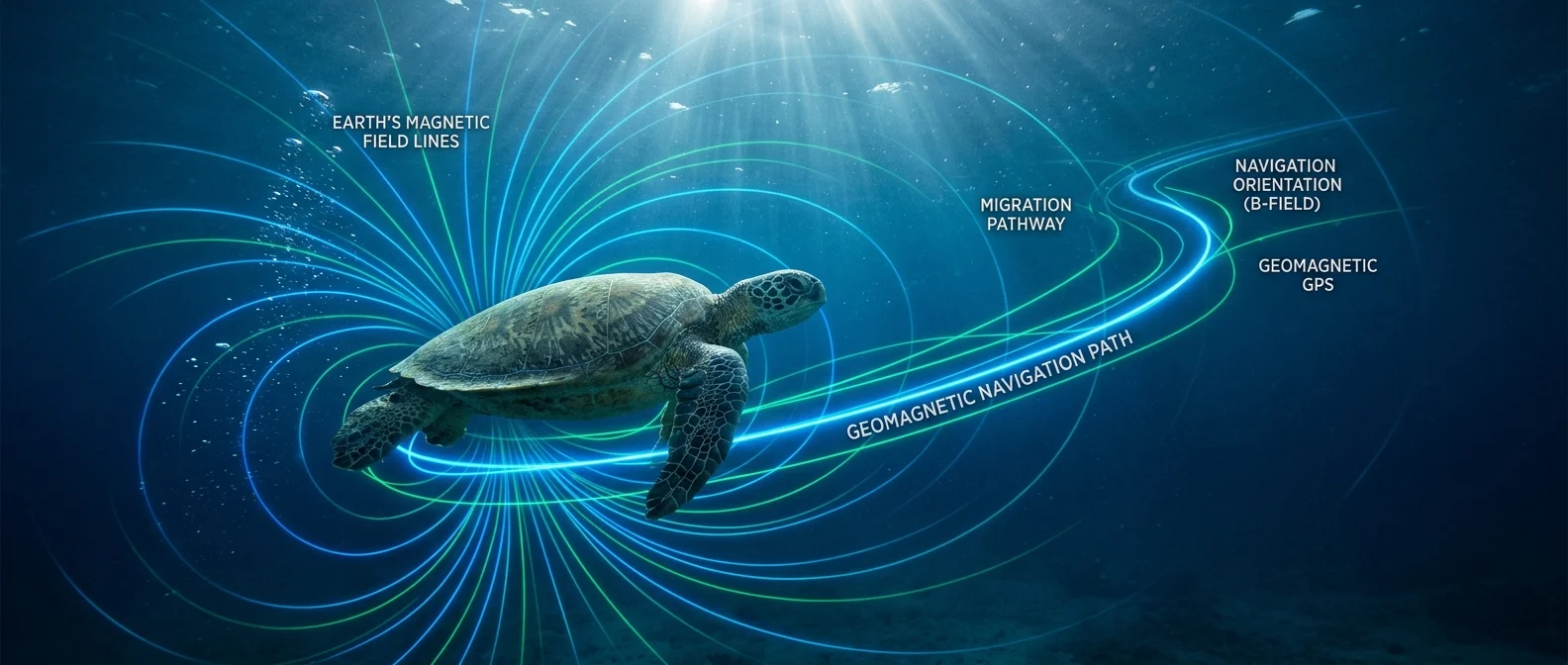
Every summer, a female Caretta caretta crawls onto the same beach where she hatched 30 years ago — after crossing thousands of miles of open ocean without any visible landmarks. How does she find this exact strip of sand among millions of similar coastlines? The answer lies in a biological GPS of stunning precision that uses Earth's magnetic field as a map.
📖 Read more: Galápagos Tortoises Return Home After 175 Years
The Magnetic Field as a Map
Earth functions like a giant magnet. The geomagnetic field isn't uniform — intensity (25-65 microtesla) and inclination (angle to surface, 0° at equator, 90° at poles) create a unique “magnetic fingerprint” at every point on the planet. Kenneth Lohmann at the University of North Carolina proved that sea turtles use these two parameters as a two-dimensional coordinate system — equivalent to geographic latitude and longitude. In experiments inside artificial magnetic fields (Helmholtz coils), Caretta caretta hatchlings changed swimming direction based on the simulated “location.” The precision was remarkable: hatchlings that “thought” they were in the North Atlantic swam south, while those in the South Atlantic swam north — as if reading a map they'd never seen. The magnetic field shifts slowly (westward drift) — averaging 0.2° per year — meaning the “map” must be updated each generation.
Magnetic Imprinting at Hatching
How does a turtle know where it was born? The theory of geomagnetic imprinting suggests that hatchlings record the magnetic “signature” of their natal beach — intensity, inclination, and possibly declination — within the first hours of life. Brothers & Lohmann (2015, Current Biology) analyzed 19 years of nesting data from Florida beaches and found that when the magnetic field shifted (due to secular variation), turtles followed — nesting at new locations that matched their original magnetic imprint. The precision was impressively high: magnetic isoline shifts of just a few kilometers led to corresponding shifts in nesting sites. This explains an old puzzle: why sister turtles nest at nearby but not identical locations — the slight magnetic change between generations shifts the “target” slightly. Imprinting appears to occur within the first 48-72 hours after hatching, possibly through cryptochrome proteins in the brain.
The North Atlantic Gyre Circuit
Caretta caretta hatchlings from Florida execute one of nature's most impressive journeys. Upon entering the ocean, they're initially swept by the Gulf Stream and then actively navigate through the North Atlantic Gyre — a circular current spanning 12,000+ kilometers. Lohmann et al. (2001) experiments showed that hatchlings exposed to magnetic fields corresponding to northern Portugal swam southwest, while those in Caribbean-equivalent fields swam northeast — exactly the directions needed to stay within the safe gyre and avoid frigid waters. This journey lasts 5-12 years — the so-called “lost years” — during which juvenile turtles mature feeding on pelagic jellyfish and sargassum. Only 1 in 1,000-10,000 hatchlings reaches maturity.
The Biology of Magnetic Sensing
The precise mechanism of magnetoreception remains under investigation. Two main models compete: magnetite crystals (Fe₃O₄) in nasal tissues, functioning as microscopic compasses, and cryptochrome radical pairs in the retina, where quantum reactions are influenced by magnetic field orientation. Putman et al. (2011) proposed that turtles might use both: magnetite for precise intensity measurement and cryptochrome for direction. In experiments with strong magnets near the head, turtles temporarily lost orientation — but recovered within minutes, suggesting multiple backup systems. Recent research (Natan & Bhatt, 2022) identified magnetite concentrations in Caretta caretta nasal cavities 10 times higher than surrounding tissue, strengthening the “magnetic nasal sensor” hypothesis. Neural signals appear to transmit through the trigeminal nerve (V1 branch) to the brain.
📖 Read more: 3 Billion Birds Lost Since 1970: The Silent Sky Crisis
Chemical Navigation and Multi-Sensory Integration
The magnetic GPS doesn't work alone. In the final kilometers before their natal beach, turtles likely use olfactory cues — chemical compounds carried by rivers into the sea, creating unique “aromatic fingerprints.” Experiments with Chelonia mydas (green turtles) at Ascension Island, in the middle of the Atlantic, show turtles locate this tiny island (88 km²) from 2,200 km away — using magnetic maps for coarse navigation first, then chemical signals for precise approach. Luschi et al. (2007) proved that turtles with blocked olfaction (petroleum jelly in nostrils) struggled significantly with final approach, confirming the dual system. This hierarchical multi-sensory strategy resembles a pilot using GPS first, then visual contact for landing.

Satellite Tracking and Big Data
GPS/Argos satellite transmitter technology (weighing 20-50 grams) enabled real-time tracking of thousands of sea turtles. The Movebank database contains trajectories of millions of data points. One Dermochelys coriacea (leatherback) was recorded crossing the Atlantic in 150 days — 15,000 km from Indonesia to the US. Analyses show turtles don't follow straight lines but sigmoid trajectories, continuously correcting their course — exactly as a navigator would repeatedly check position on a map. Hays et al. (2014) calculated that open-ocean navigation accuracy reaches 50-100 kilometers — sufficient for “coarse” positioning before local sensory systems activate. Remarkably, sea turtles transported to unknown waters returned to their feeding areas with only 8-15% deviation from optimal routes, confirming an internal “map” exists.
Threats to the Magnetic System
Modern human activity threatens this ancient ability. Coastal light pollution disorients hatchlings — instead of heading toward the dark ocean horizon, they're trapped by artificial lights from hotels and roads. In Florida, over 100,000 hatchlings are lost annually to light pollution — many end up on roads, hotel pools, and parking lots, where they die from dehydration or predators. Underwater electrical cables (wind farms, offshore interconnections) create local magnetic fields that might “blur” the magnetic map — though studies show effects are limited to within a few meters. Noise from seismic surveys (air guns) causes temporary navigation disruption within 5-10 km radius, particularly affecting hatchlings that haven't completed imprinting. Climate change poses a more insidious threat: rising sand temperatures feminize eggs (above 29°C → females), while sea level rise destroys nesting beaches.
Conservation and Future
Understanding magnetic navigation has practical conservation applications. NOAA's TurtleWatch program uses migration data to warn fishing vessels, reducing accidental captures by 60%. In the Mediterranean, Greece's ARCHELON program (Zakynthos, Crete, Peloponnese) protects over 3,000 nests annually — Zakynthos hosts the largest Caretta caretta colony in the Mediterranean. Globally, all 7 sea turtle species are threatened or critically endangered. Establishing “dark zones” without artificial lighting at critical beaches (Florida Fish and Wildlife, Oman, Costa Rica) has increased hatchling survival by 40%. Implementing amber-colored LED lighting (590+ nm wavelength) instead of white illumination has reduced hatchling disorientation by 70%. New questions emerge: how will turtles respond to the coming pole reversal (occurring every 200,000-300,000 years)? The paleontological record shows turtles survived multiple reversals over 100+ million years of evolution — likely thanks to their multi-sensory system's flexibility and ability to rapidly recalibrate to new magnetic conditions. Magnetic navigation isn't a precision timepiece — it's a robust, adaptive system proving that nature solves navigation problems more elegantly than any human technology.

Sources:
- Lohmann, K.J., Lohmann, C.M.F. & Putman, N.F. «Magnetic maps in animals: nature's GPS.» Journal of Experimental Biology, 210, 3697-3705, 2007.
- Brothers, J.R. & Lohmann, K.J. «Evidence for geomagnetic imprinting and magnetic navigation in the natal homing of sea turtles.» Current Biology, 25(3), 392-396, 2015.