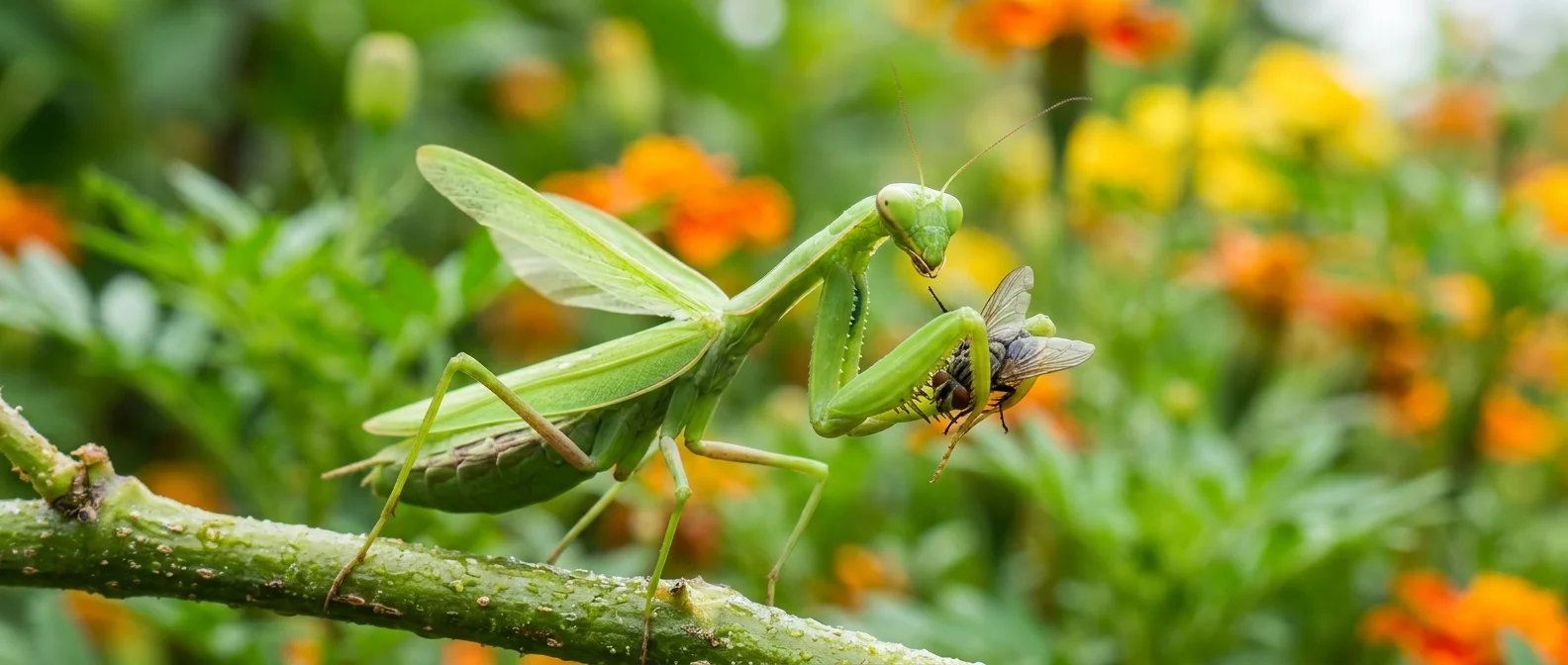
It sits motionless on a branch, front legs folded as if in prayer. Could be a garden ornament. But when a fly approaches striking distance, everything ends in 25 milliseconds — twelve times faster than a human blink. The praying mantis isn't praying. It's ambushing.
📖 Read more: Cuttlefish Wave Their Arms: Do They Actually Communicate?
⚡ 25 Milliseconds — The Fastest Strike in the Insect World
A human blink lasts about 300 milliseconds. The praying mantis completes a lethal capture in 25 — that's 12 times faster. The strike isn't a blind reflexive swipe. According to research published in the Proceedings of the Royal Society, the mantis calculates each attack individually, adjusting angle and velocity based on prey position and movement.
This real-time calculation happens in a brain smaller than a pinhead. No robot today can replicate this combination of speed, precision, and strategic thinking. This makes the praying mantis one of the most effective predators in the animal kingdom — proportional to its size.
👁️ 3D Vision in a Miniature Brain
The praying mantis is the only invertebrate that sees in three dimensions. This isn't theory — it was proven experimentally. In 2018, researchers at Newcastle University in England created microscopic 3D glasses and glued them to mantis eyes. Inside a specially designed “insect cinema,” the animals watched three-dimensional movies of simulated insects.
The results were surprising. Dr. Ronny Rosner identified four categories of neurons in the mantis brain, specialized exclusively for three-dimensional perception — stereoscopic vision, scientifically. It was the first time anyone had recognized such neurons in an invertebrate. Professor Jenny Read, who led the broader research program, noted that certain mechanisms resemble the visual cortex of primates — even though the two species evolved this solution completely independently.
Their stereoscopic vision works differently from ours. We compare static images between our two eyes. The mantis focuses exclusively on movement — ignoring stationary objects and reacting only to what moves. It can detect movement from 18 meters away, but stationary prey at centimeter distance would be invisible to it.
🧠 Why Does It Resemble Our Brain?
The mantis and primates independently evolved similar 3D vision solutions — a phenomenon known as convergent evolution. The team also found feedback loops in the 3D circuit that had never been reported in vertebrates.

🦵 Raptorial Legs — The Mechanics of the Trap
The mantis's front legs are called raptorial legs and function like spring-loaded switchblades. The second and third segments of each leg bear interlocking spikes — like the teeth of a zipper. When the legs close around prey, escape is impossible.
The thorax is long and slender, resembling a neck, and between head and thorax there's a flexible joint. This allows 180-degree head rotation — the mantis is the only insect in the world that turns its head to look behind itself. Two large compound eyes and three small optical cells (ocelli) complete the sensory equipment of a perfect hunter.
📖 Read more: Octopus: 3 Hearts, 9 Brains and Blue Blood
📊 The Mantis in Numbers
🎭 Camouflage: Flowers, Leaves, and Ghosts
If speed is half the equation, invisibility is the other half. Mantises have evolved some of the most impressive camouflage in nature. The European mantis (Mantis religiosa) is green or brown, to blend among plants. The orchid mantis of Southeast Asia is white with pink hues — it looks so much like a flower that butterflies land on it.
Dragon Mantis
Brazil — mimics rainforest leaves, even swaying in the breeze
Orchid Mantis
Southeast Asia — white with pink hues, females attract male butterflies
Cone-headed Mantis
Southern Europe, Turkey — spiny crown, body like tree branches
Ghost Mantis
Africa — resembles dead leaf, nearly invisible on branches
The largest species, reaching 15 centimeters, don't limit themselves to insects. They eat lizards, frogs, even hummingbirds. A photograph of a mantis devouring a hummingbird was published in National Geographic and went viral. The diversity of 2,500 species means every continent except Antarctica hosts its own versions of this perfect hunter — from tropical forests to Mediterranean scrublands.

💀 Sexual Cannibalism — A Deadly Marriage
Reproduction in mantises involves a shocking element: in about 30% of cases, the female bites and eats the male's head during — or immediately after — mating. The male, now headless, continues mating. Its nervous system functions autonomously for several minutes after decapitation.
📖 Read more: Identical Twins, Different Fates: What DNA Really Reveals
Why does this happen? The most accepted theory: the female needs extra protein for her eggs. After mating, she lays hundreds of eggs inside a protective structure called an ootheca — a foamy shell that hardens and functions as an incubator. The ootheca's shape differs by species: the European mantis creates a broader, textured one, while the Chinese mantis produces a rounder, puffed capsule. Nymphs hatch in spring, resembling miniature adults, and immediately begin hunting — sometimes their own siblings. They'll undergo several molts before reaching adult size during summer.
👂 One Ear Against Bats
Most mantises have only one ear — located between their middle and hind legs. Scientists call them “acoustic cyclops.” This single ear doesn't hear low frequencies — it doesn't need to. It hears exclusively the high-frequency echolocation calls emitted by bats, their greatest aerial predator. This acoustic specialization is a defensive adaptation that evolved over millions of years of predator-prey coevolution between mantises and bats.
🆚 Mantis vs Human Athlete
Mantis
Strike in 0.025 seconds. Motion detection at 18 meters. Stereoscopic 3D vision. One anti-bat ear.
Usain Bolt
Starting reaction 0.155 seconds. Human 3D vision based on different mechanism. Two ears, full spectrum.
When it detects a bat signal during nocturnal flight, the mantis performs impressive aerobatic maneuvers — spiral dives that take it out of sonar range. The reaction is lightning-fast and automatic. Even the most effective predator needs its own countermeasures.
🔬 What the Mantis Teaches Us Today
The mantis's closest relatives aren't butterflies or beetles — they're cockroaches and termites. This evolutionary neighborhood makes the mantis an even more interesting study subject: how did one branch of insects develop three-dimensional vision, raptorial legs, and hunting strategy, while its relatives remained garbage cleaners?
The Newcastle team plans to use their findings to develop simpler machine vision algorithms for robots. The human brain uses 86 billion neurons to process three-dimensional information. The mantis manages with fewer than one million. If this mechanism is fully decoded, it could revolutionize artificial vision — smaller, cheaper robots that “see” the world in depth.
One more thing: if you ever see a mantis “praying” in your garden, pay attention. 400 million years of evolution are looking back. And it definitely spotted you first.
Sources: