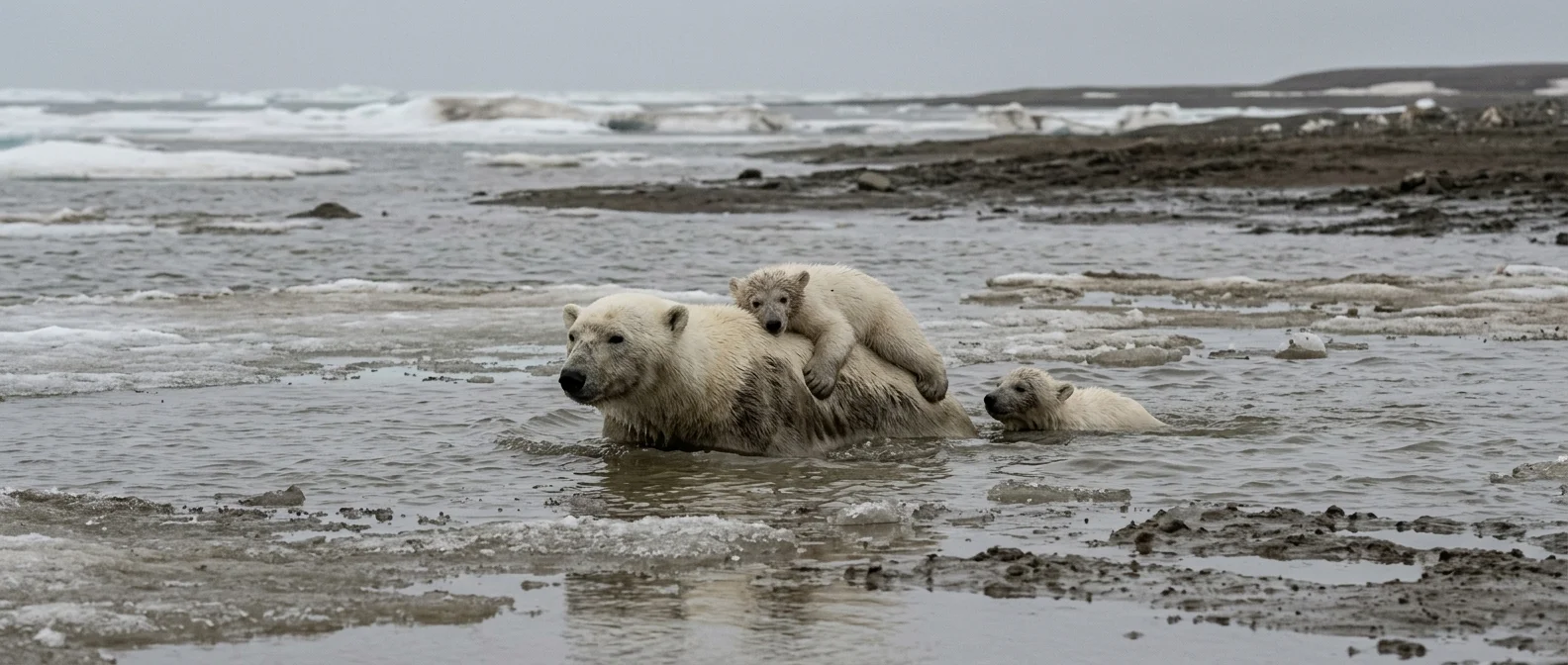
In February 2026, a photograph went viral across every media outlet on the planet. A polar bear mother with her three cubs, lying on bare ground and moss, their fur brown with mud. No trace of ice. No trace of the Arctic. Just a family trying to sleep in the heat. This image says more than any scientific study ever could.
📖 Read more: Antarctica Loses Ice Mass Equivalent to Two Countries
📸 The Photo That Shocked the World
Christopher Paetkau's photograph “Family Rest” was taken on the shores of Hudson Bay in Canada and made the shortlist for the Natural History Museum of London's Wildlife Photographer of the Year 2026 award. It shows a polar bear mother (Ursus maritimus) with her three cubs resting on bare, muddy ground during summer.
This image isn't isolated — it represents a new reality. Polar bears, which once spent their entire lives on ice hunting seals, are now forced to forage on land. The sea ice that sustained them for millennia shrinks year after year, leaving them exposed to an environment they weren't built to endure.
🧊 An Animal Built for Ice
The polar bear is a biological masterpiece of cold adaptation. It has a double-layer coat — a dense inner layer and a waterproof outer layer — over a thick layer of blubber. Even its paws are covered with fur, which functions as both insulation and anti-slip grip on ice. Beneath its white fur, the skin is black — perfect for absorbing solar radiation.
They're exceptional swimmers. Their large front paws, slightly flipper-like, allow them to swim hundreds of miles from shore. Some bears have been recorded swimming 687 kilometers without stopping — though they likely used ice floes along the way to rest.

🦭 Seal Hunters — No Ice Means No Hunt
The polar bear's primary food source is ringed seals (Pusa hispida) and bearded seals (Erignathus barbatus). The hunting technique is simple but requires patience — and ice: the bear waits beside cracks or breathing holes in the ice, motionless for hours, until a seal surfaces. Once it appears, one strike with powerful front paws is enough. Without ice, this technique becomes impossible and their entire survival strategy collapses.
Forced to seek alternative food on land, polar bears turn to caribou, birds, and even garbage near human settlements. But the energy they gain from these sources isn't enough. A single seal can provide enough blubber for weeks — something impossible with terrestrial prey. The metabolic equation doesn't add up.
The polar bear is the only bear species that doesn't hibernate. It remains active year-round — but now it doesn't always have ice to hunt on.
📖 Read more: Ocean Currents: How Invisible Rivers Control Our Planet
🌡️ The Ice Is Melting — The Numbers Don't Lie
Arctic sea ice is declining by approximately 13% per decade compared to the 1981-2010 average. The last ten years have seen September — the month with minimum ice coverage — consistently record historic lows. For polar bears, this means longer periods without access to seals, greater weight loss, and lower cub survival rates.
The IUCN classifies the polar bear as “Vulnerable” — one step before “Endangered.” The population trend? Unknown. This alone is alarming: it means we don't have enough data to know if bears are already declining or if the decline hasn't yet become apparent.
Reproduction
Females typically give birth to twins inside snow dens deep beneath the snow
Cub Development
Cubs stay with their mother for 28 months learning survival skills
Male Threat
Males may kill young cubs — mothers must protect them alone
🧬 Genes “Rewriting” Themselves for Survival
Perhaps the most surprising recent discovery involves polar bears in southern Greenland. According to recent research, these populations use “jumping genes” (transposons) to rapidly rewrite sections of their DNA — a process that could help them adapt to melting ice faster than classical evolution would allow.
This doesn't mean polar bears will simply “adapt” and everything will be fine. Evolutionary adaptation takes generations. Climate change runs on a timeline of decades. The race between biology and physics isn't fair — and unfortunately, physics is winning by a wide margin.

📖 Read more: Corpse Flower: Giant Bloom Smells Like Death Every 10 Years
🏔️ Life Without Ice
In areas where ice disappears earlier, polar bears are forced to spend months on land. During this period, they essentially live in starvation — relying on their fat reserves. An adult bear can lose over 1 kilogram per day during periods without food. For a nursing mother with twins, this can become fatal.
Even more concerning is increasing contact with humans. Hungry bears approach settlements looking for food in garbage — a situation dangerous for both parties. In Norway's Svalbard archipelago, a bear cub was shot after its mother was found dead near a human settlement. These tragedies multiply each year.
"I deliberately jump onto the beach, with a very hungry bear that missed the chance to leave with the ice. Now I am food. And I'm definitely not at the top of the food chain" — Cory Richards, National Geographic photographer
🛡️ What Can Be Done?
Protecting polar bears cannot happen without addressing climate change. Whatever we do locally — banning hunting, creating protected areas, reducing pollution — without reducing CO₂ emissions, the ice will continue to disappear. And without ice, there are no polar bears.
The photograph of the family in mud isn't just an image — it's a prediction. It shows life without ice, without seals, without the Arctic as we know it. Polar bears, symbols of strength and resilience, are becoming symbols of climate crisis. And the question isn't whether we'll save them — but whether we'll save the world they need.
Arctic Yesterday vs Arctic Today
Before Climate Change
- Year-round ice — stable access to seals
- Healthy fat reserves for mothers
- High cub survival rates
- Minimal human contact
Current Situation
- Months without ice — forced starvation
- Reduced weight and energy deficit
- Declining births and cub survival
- Increasing human-bear conflicts
🔮 An Arctic Without Bears?
Climate models predict that if warming continues at the current rate, the Arctic could experience completely ice-free summers by 2050. For polar bears, this means extinction of many local populations — particularly in the southern ranges of their distribution. Some populations will survive — likely in areas like northern Greenland and Arctic Canada, where ice will persist a bit longer. But even these will face a dramatically different environment.
The polar bear isn't just an animal — it's an indicator of an entire ecosystem's health. If it can't survive, it means the Arctic's entire food web is collapsing. And the image of the family in mud will become, instead of shocking, the new normal.