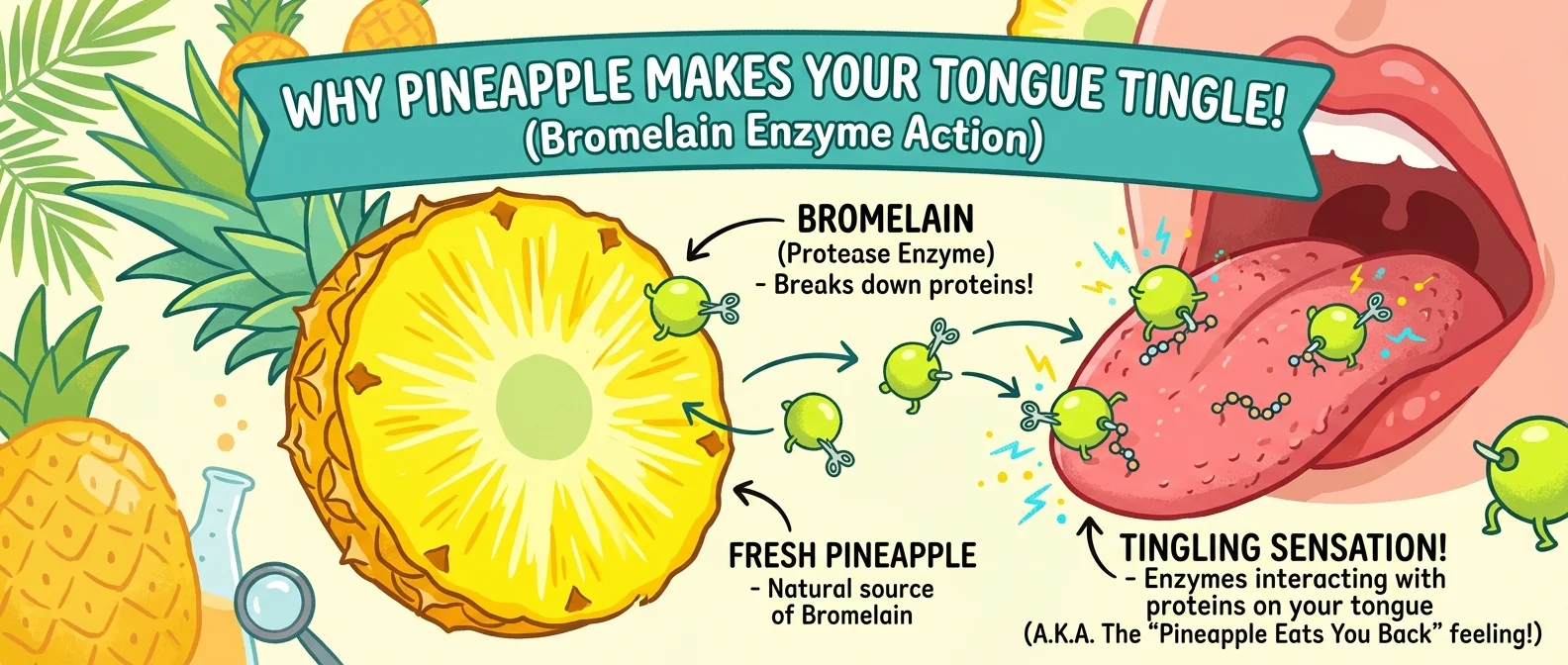
Bite into a fresh pineapple slice and you immediately feel that distinctive sting on your tongue — as if something is biting you back. It's not your imagination, not an allergic reaction, and not simple acidity. At that moment, a powerful enzyme is literally breaking down the proteins in your mouth, digesting your tissue while you digest the fruit. Pineapple is perhaps the only fruit in nature that eats you back — and the biochemistry behind this phenomenon is remarkably complex, rooted in millions of years of evolution.
📖 Read more: Giant 16-Inch Insect Discovered in Australia Sets New Record
What's Actually Happening in Your Mouth
The stinging, redness, and mild swelling you feel aren't caused by acidity or allergies. The culprit is bromelain, a mixture of proteolytic enzymes found throughout the pineapple plant (Ananas comosus). Once bromelain contacts your mouth's mucous membrane, it begins breaking down the proteins that protect your tongue, lips, and cheeks. Essentially, the pineapple digests small amounts of living tissue — a bidirectional relationship unique in the fruit world. The phenomenon is completely harmless: your body rapidly regenerates the damaged mucous membrane within hours.
Bromelain: The Cysteine Protease That Digests Proteins
Bromelain isn't a single molecule, but a mixture of at least eight cysteine proteases with different specializations. These enzymes use a cysteine amino acid in their active site to cut peptide bonds — the “knots” that hold a protein's amino acids together. Their action is non-selective, meaning they can break down almost any protein, from skin keratins to meat collagen and blood vessel elastins. In recent years, researchers discovered that the highest bromelain concentration is found in the plant's stem, not the fruit flesh — which is why bromelain supplements are primarily produced from stems. Stem bromelain can be up to ten times more concentrated than that in the flesh. According to Dr. Brent Bauer of the Mayo Clinic, bromelain ranks among the most popular over-the-counter enzyme supplements, with sales increasing rapidly in recent years.
📖 Read more: Giant Viruses So Large They Were Mistaken for Bacteria

How Bromelain Breaks Down Tissues
Bromelain works optimally at pH between 4.5 and 8 — precisely the range found in the mouth (pH 6.2-7.6). Once the enzymes are released from pineapple cell walls during chewing, they attach to mucous membrane proteins and begin hydrolysis. The result is the breakdown of mucin — the slimy protective layer covering the mouth's soft parts. Without this layer, nerve endings are directly exposed to the fruit's citric acid, multiplying the stinging sensation. Bromelain doesn't act immediately: it takes about 15-30 seconds of chewing for the enzymes to fully activate and penetrate protective saliva. Once the pineapple reaches the stomach, however, the game ends: the extremely low pH (around 2) and pepsin in gastric juice completely denature bromelain within seconds.
📖 Read more: How Babies Acquire Billions of Bacteria in 72 Hours
Why Pineapple Makes This Biochemical Weapon
Bromelain didn't evolve to annoy humans. It functions as a defense mechanism against insects, parasites, and fungi. The proteases dissolve insect exoskeleton proteins and destroy enzymes that pathogenic microorganisms use to invade the plant. Additionally, bromelain can serve as a grazing deterrent — animals that sample leaves or unripe fruit experience mouth irritation, discouraging further consumption. Pineapple belongs to the Bromeliaceae family, a tropical group of over 3,500 species, many of which produce similar proteases. Papaya's papain (Carica papaya), kiwi's actinidin (Actinidia deliciosa), and fig's ficin (Ficus carica) work the same way — but bromelain remains the strongest and most studied of these plant proteases.
From Cooking to Medicine: Bromelain Applications
Bromelain's protein-breaking ability has made it a valuable tool across multiple fields. In cooking, it's used as a natural meat tenderizer — a little pineapple juice marinates tough meat cuts in under an hour, breaking down collagen fibers. In the food industry, it's added to gelatin (which is why you can't make Jell-O with fresh pineapple — bromelain dissolves gelatin). In medicine, according to research in Mayo Clinic Proceedings (2014), Dr. Bauer explains that bromelain has anti-inflammatory properties and is used in some countries to reduce swelling after surgical procedures and injuries. There's also a long history of investigating bromelain as an anti-cancer agent, though evidence remains limited. Bromelain also shows antiplatelet activity, meaning people taking anticoagulant medications should be careful with bromelain supplements.

📖 Read more: How Elephants Pass Knowledge to Their Young
Pineapple Genome Reveals Surprises
In 2019, an international research team led by Ray Ming from the University of Illinois changed the data. Publishing in Nature Genetics, the researchers sequenced the red pineapple genome (Ananas comosus var. bracteatus) and analyzed 89 samples from different varieties. The study revealed something surprising: certain pineapple varieties were domesticated in a single step, through clonal reproduction and without years of selective agriculture. Large homozygous sequences were found at chromosome ends of the Singapore Spanish variety — indicative of thousands of years of exclusively clonal multiplication. Researchers also identified genes responsible for fruit sweetness, leaf fiber production, and self-fertilization ability — traits selected by humans for millennia.
How to Neutralize Bromelain
If you love pineapple but can't stand the sting, the solution is simple: heat. Bromelain, like all enzymes, is a protein — and permanently denatures at temperatures above 70°C. Grilled, cooked, or canned pineapple doesn't sting at all, since bromelain has already been destroyed. A second trick is combining with dairy: milk casein binds bromelain before it can attack the mucous membrane. An interesting detail is that ripening reduces bromelain concentration in the flesh — so riper pineapples sting less. Conversely, the core (the hard central axis) contains the highest enzyme concentration in the fruit, which is why it's avoided in consumption.
📖 Read more: Human Evolution: 7 Million Years from Ape to Homo sapiens
A Complex Fruit with Million-Year Secrets
Pineapple isn't a simple fruit. It's actually a compound infructescence: dozens of individual flowers, usually 100 to 200, fuse around the central axis, forming what we perceive as a single fruit. Each “eye” on the surface corresponds to a separate berry. Pineapple leaves contain extremely durable fibers, known as piña fibers, traditionally used in the Philippines for weaving luxury fabrics. Even more impressive, workers in pineapple processing plants report that chronic bromelain exposure can lead to fingerprint loss — the proteases literally dissolve keratin patterns in fingertips. Cultivated for at least 6,000 years in South America, Ananas comosus was a sacred plant of indigenous Tupi-Guarani long before Europeans discovered it. Christopher Columbus first encountered it in Guadeloupe in 1493 and brought it to Europe, where it immediately became a symbol of wealth and hospitality. Today, over 28 million tons of pineapple are produced annually worldwide, with the Philippines, Costa Rica, and Brazil leading production. And every time you bite a slice, bromelain reminds you that this fruit doesn't surrender without a fight.
Sources:
- Varayil, J.E., Bauer, B.A. & Hurt, R.T. «Over-the-Counter Enzyme Supplements: What a Clinician Needs to Know.» Mayo Clinic Proceedings, 2014 — ScienceDaily
- Chen, L.Y., Ming, R. et al. «The bracteatus pineapple genome and domestication of clonally propagated crops.» Nature Genetics, 2019 — ScienceDaily