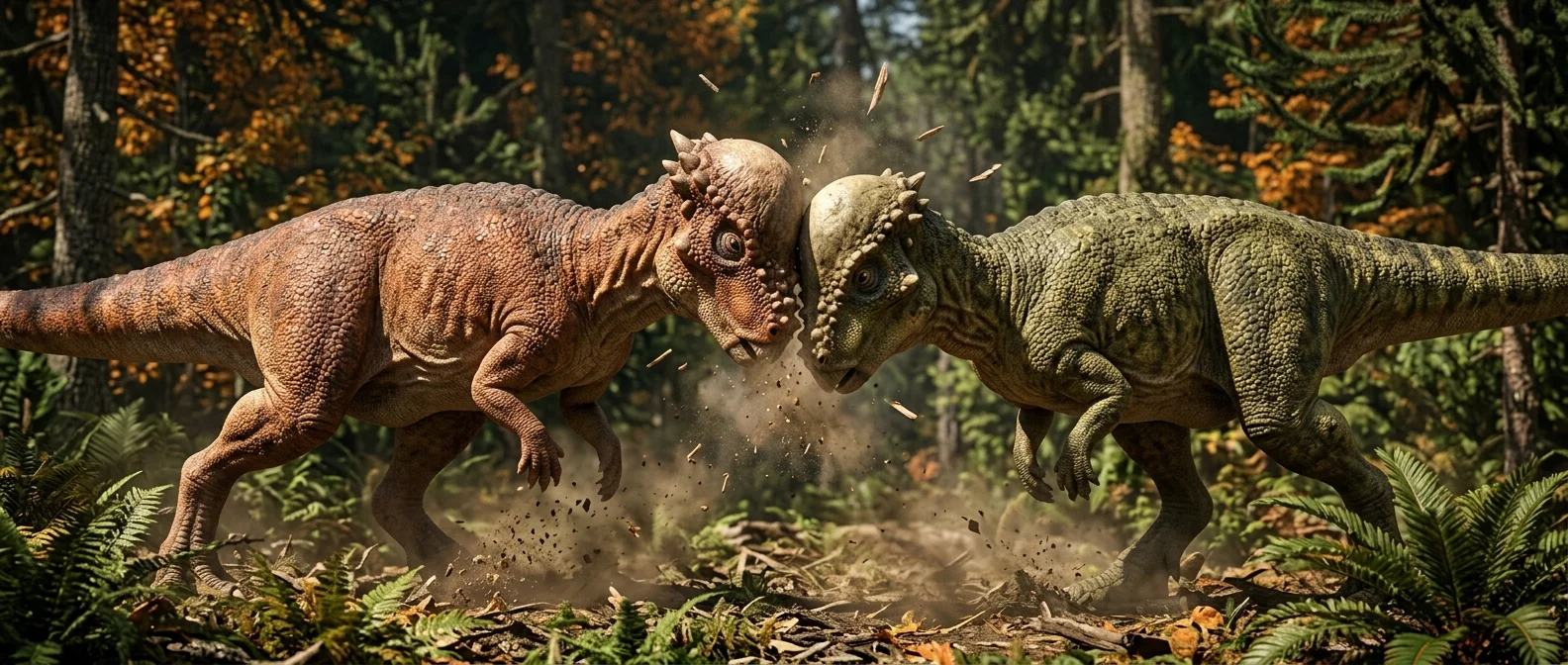
Two massive heads, armored with 10 inches of solid bone, slam into each other across a subtropical plain 69 million years ago. Or did they? Pachycephalosaurus — literally “thick-headed lizard” — is the dinosaur nobody can agree on. What exactly did it do with that incredible skull? The scientific debate continues, and the truth is far more complex than Hollywood suggests.
A Skull Without Precedent
Picture a bipedal reptile 10 feet long and weighing 1,000 pounds, walking among flowering plants in what's now Montana, South Dakota, Wyoming, or Alberta, Canada. Atop its head rises a massive bony dome — like a helmet made of solid bone — surrounded by spikes and knobs. This impressive dome isn't hollow. It's pure, solid bone, so dense it resembles stone more than biological tissue.
Pachycephalosaurus lived during the Late Cretaceous, 69-66 million years ago — the final chapters of the dinosaur age. It shared its habitat with Tyrannosaurus, Triceratops, and Ankylosaurus in a subtropical environment of warm, humid air.
The Big Question: Head-Butting or Display?
The first — and most popular — hypothesis is what makes Pachycephalosaurus so famous: it used its dome for head-butting, exactly like modern rams use their horns. Males against males, in dominance contests or competition for females. The image is dramatic: two domes colliding with the force of hundreds of pounds, the sound echoing across the entire plain.
The second hypothesis is less spectacular but equally fascinating: the dome was used primarily for display — a recognition signal, indicator of age and health, tool of sexual selection. Think of deer antlers, which serve both in combat and visual intimidation of rivals.
The Debate: Head-Butting vs Display
Flank Strike: The Third Theory
A more recent hypothesis suggests something entirely different: Pachycephalosaurus didn't strike head-to-head, but used its dome to ram the flanks of rivals or predators — like a goat's headbutt. The dome's rounded shape, which makes frontal collision unreliable, becomes an advantage in side strikes: force distributes over a larger surface area, reducing injury risk to the animal itself.
This explains our article's title: head-butts that scared predators. A Tyrannosaurus receiving a 1,000-pound blow to the ribs would think twice before attacking again. The dome, in this interpretation, was both offensive and defensive weapon.
The Teeth That Confused Everyone
Experts consider Pachycephalosaurus herbivorous — its teeth were flat, curved, and serrated, suitable for plant material, leaves, fruits, and seeds. However, some of the front teeth look remarkably like those of carnivorous dinosaurs. This led some scientists to hypothesize it might have been omnivorous — or at least an opportunistic meat-eater.
The Contradictory Teeth
Most Pachycephalosaurus teeth indicate herbivory — but the front ones resemble carnivorous theropod teeth. Nobody knows with certainty what it actually ate. Perhaps it combined plants with small animals or insects — a strategy ensuring survival in changing environments.
Three Names, One Dinosaur
For decades, paleontologists believed three different related dinosaurs existed: Pachycephalosaurus, Stygimoloch ("demon of the river Styx," with long spikes around the dome), and Dracorex ("dragon king," with a flat skull full of spikes). The three genera seemed distinct.
Today, most scientists believe Stygimoloch and Dracorex were simply juvenile stages of Pachycephalosaurus. Like seeing a kitten, teenage cat, and adult cat — and thinking they're three different animals. The dome, according to this theory, developed gradually: young animals had flat skulls with spikes (Dracorex), juveniles had partial domes with long spikes (Stygimoloch), and adults had the full smooth dome (Pachycephalosaurus).
A History of Misunderstandings: From Armadillo to Dinosaur
Pachycephalosaurus's discovery story is one of continuous mistakes. The first fragment was found around 1860 by American fossil collector Ferdinand Vandeveer Hayden. Experts of the period thought it belonged to some armadillo-like creature and named it Tylosteus.
It took nearly a century — until 1943 — to be properly described by Barnum Brown and Erich Maren Schlaikjer, after more fossils were discovered. The name Pachycephalosaurus — “thick-headed lizard” — was finally accurate. But the connection to the earlier Tylosteus fragment wasn't recognized until the 1980s. This means the dinosaur was known to science for 120 years before we fully understood what it was.
The Dome's Biomechanics
Modern studies use CT scans and finite element analysis (FEA) to analyze how the dome responded to forces. Results show the internal structure — multiple bone layers with different densities — was designed to absorb impacts. It wasn't just hard bone. It was an energy absorption system — like a motorcycle helmet, with a hard outer shell and inner layer that disperses force.
Some specimens show injury marks on the dome — micro-lesions in the bone that could result from repeated impacts. This strengthens the hypothesis that, regardless of whether the dome was used frontally or laterally, it certainly received blows. The spongy internal structure resembles that found in ram skulls — an evolutionary design appearing separately in species separated by millions of years of evolution, a striking example of convergent evolution.
"The dome could have multiple uses — like modern deer antlers, used for both combat and display."
Pachycephalosaurus's Final World
Pachycephalosaurus didn't live alone. In the same habitat ruled Tyrannosaurus — the ultimate apex predator. Triceratops, with three horns and a giant shield, was the dominant herbivore. Ankylosaurus, with armored back and club-tail, was the tank. In this world, Pachycephalosaurus was something entirely different — neither massive, nor armored, nor armed with horns. Its only “technology” was that mighty dome.
It belonged to the Marginocephalia, a group including ceratopsians (like Triceratops). These dinosaurs were characterized by strange structures on the back or top of the skull — shields, horns, domes. Evolution, it seems, was testing every possible cranial “armor” design.
Eventually, Pachycephalosaurus vanished along with other non-avian dinosaurs in the mass extinction 66 million years ago. But its dome remains one of paleontology's most intriguing questions: a tool so impressive, so specialized, that we still can't agree what purpose it served.