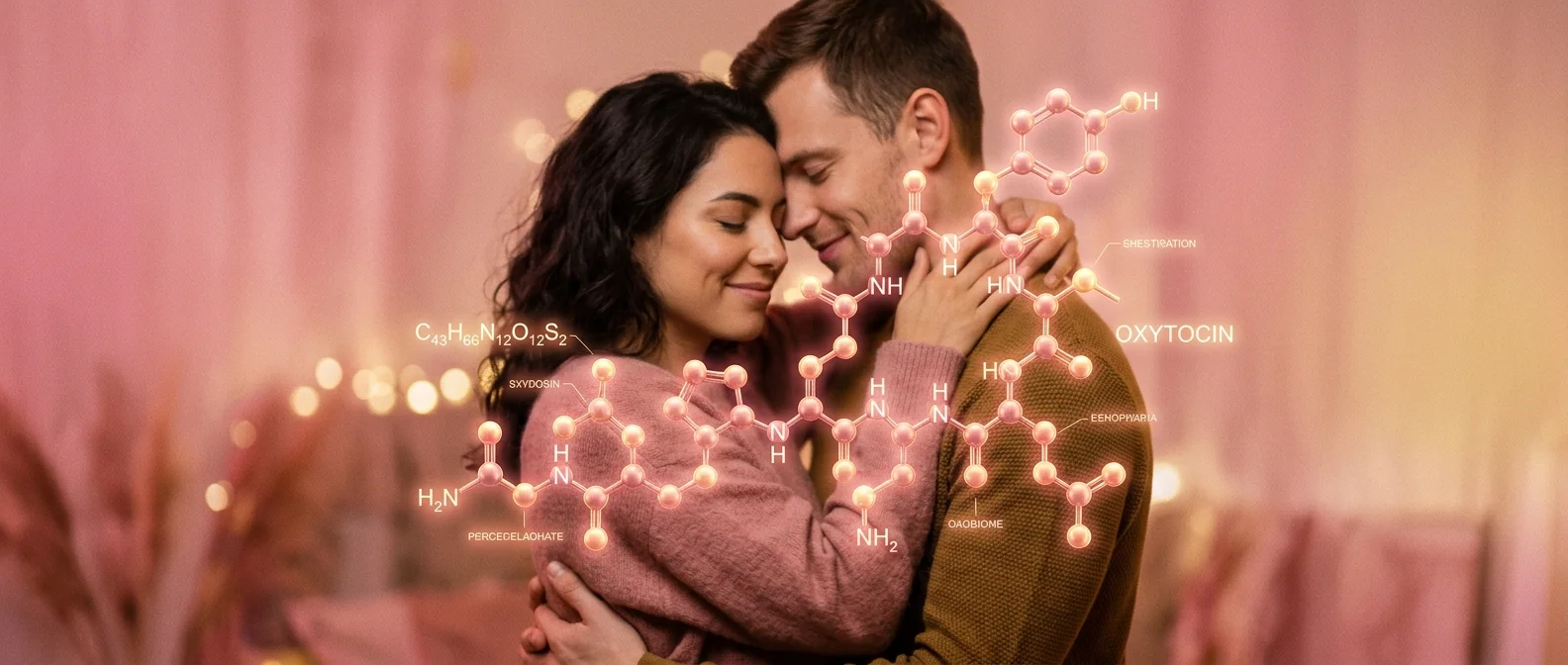
Why do you feel safe in someone's embrace? Why does a mother feel an irresistible connection to her newborn? When does the brain start to “trust”?
📖 Read more: We Don't Have 5 Senses But 33: What Are the Hidden Ones?
Behind these deeply human experiences lies a tiny peptide of just 9 amino acids: oxytocin. Called the “love hormone,” reality is far more complex — and far more fascinating — than a simple chemistry fairy tale. A hormone that simultaneously enhances love but also our ethnocentrism forces us to rethink what “human connection” truly means.
What Is Oxytocin: Structure and Origin
Oxytocin is a 9-amino acid neuropeptide (cysteine-tyrosine-isoleucine-glutamine-asparagine-cysteine-proline-leucine-glycine) with a disulfide bond between two cysteines. Produced in the supraoptic nucleus and paraventricular nucleus of the hypothalamus, stored in the neurohypophysis. Discovered by Henry Dale in 1906 — the name means “quick birth” (oxys + tokos) because the first identified function was triggering uterine contractions. Vincent du Vigneaud chemically synthesized oxytocin in 1953 — winning the Nobel Prize in Chemistry in 1955. It was the first peptide hormone ever artificially synthesized in history.

Maternal Bonding: The First Role
During childbirth, oxytocin levels skyrocket — triggering rhythmic uterine contractions (used pharmaceutically as Pitocin). After birth, breastfeeding activates new waves: infant suckling stimulates nipples, sends signals to the hypothalamus, oxytocin is released in pulses → positive feedback loop. Sue Carter (Psychoneuroendocrinology, 1998) proved the critical role in prairie voles (Microtus ochrogaster): these monogamous rodents, when exposed to exogenous oxytocin, form pair bonds. Closely related montane voles (M. montanus), polygamous, have fewer oxytocin receptors — the genetic basis of a “monogamous brain” is partly due to a single receptor gene (OXTR). When researchers introduced the prairie vole OXTR gene into montane voles, the polygamous animals suddenly began displaying characteristic monogamous behavior, staying close to their mate. Oxytocin acts synergistically with vasopressin (AVP) in males — AVP relates more to protectiveness, territorial marking, and sexual jealousy.
📖 Read more: Why We Dream: The Science Behind Our Nightly Visions
Trust in Strangers: The Zurich Experiment
The study by Kosfeld et al. (Nature, 2005) from the University of Zurich became a landmark: 128 volunteers inhaled oxytocin or placebo via nasal spray, then played an economic trust game. Result: those who received oxytocin invested 17% more money in a stranger — showing increased trust without changes in mood or cognitive function. The study didn't increase generalized risk tolerance — only social risk. Published on Nature's cover, it opened “neuroeconomics” — the study of biological bases of economic decisions. Later studies showed oxytocin also increases generosity, empathy, and lie detection — like a chemical social signal detector — like chemical radar for social cues.
Romantic Love: Dopamine + Oxytocin
Romantic love activates a cocktail: dopamine (desire, reward), noradrenaline (heart palpitations, sweating), serotonin (obsession — decreases, like OCD). Oxytocin is added later — converting passion into bonding. fMRI studies show that couples in love display increased activity in the ventral tegmental area (VTA) — the same reward center activated by addictive substances. Oxytocin increases during orgasm in women (3-5x) and men (1.5-2x) — creating post-coital bonding. During the romantic attachment phase, oxytocin works with endorphins (opioid system) — endorphins provide slow, deep satisfaction that maintains long-term relationships after the dopaminergic “intoxication” of the beginning ends. Couples in early relationships (6 months) have 2 times higher oxytocin levels compared to singles — and levels predict relationship duration. Interesting: physical contact (20-second hug, massage, handshake) increases oxytocin without drugs — which is why touch soothes, lowers cortisol, and reduces blood pressure.

The Dark Side: Ethnocentrism and Aggression
Oxytocin isn't just a “love hormone.” The study by De Dreu et al. (Science, 2011) revealed it increases in-group favoritism while simultaneously enhancing aggression toward out-groups (out-group derogation). In economic games, Dutch volunteers under oxytocin favored Dutch people but were harsher with German and Arabic names. In another experiment, oxytocin increased “Schadenfreude” (gloating) when the out-group failed — proving the molecule's dual nature. Oxytocin doesn't create universal love — it creates "us versus them." In rat mothers, oxytocin triggers maternal aggression — protective violence toward anything threatening the pups. Oxytocin isn't a “morality hormone” — it's a hormone of social selectivity, strengthening bonds with “our own” while simultaneously sharpening fear and aggression toward “others.” This explains why the most bonded groups are often the most aggressive outward.
📖 Read more: Why We Fear Spiders: Millions of Years of Evolution
Neural Networks and Receptors
The oxytocin receptor (OXTR) is found in amygdala, hippocampus, nucleus accumbens, prefrontal cortex. Polymorphisms of the OXTR rs53576 gene (G/G, G/A, A/A) correlate with empathy, sociability, and stress sensitivity. GG individuals show significantly higher empathy, social skills, and emotional stability — while AA relates to difficulty recognizing emotions. Oxytocin reduces amygdala activity — explaining why it significantly reduces fear, increases trust, and facilitates social interactions in new environments. In people with social phobia, intranasal administration reduces amygdala hyperactivity to the level of healthy volunteers. It also acts as a neurotransmitter (within the brain) and as a hormone (in blood) — two parallel systems with different actions. The peripheral system controls uterus, lactation, cardiovascular function, and digestion — the central system affects behavior, anxiety, and social recognition. Optogenetic studies in mice proved that activating specific oxytocinergic neurons in the paraventricular nucleus immediately reduces fear by 50% — confirming the anxiolytic role.
Therapeutic Applications and Risks
Intranasal oxytocin is being tested in autism (controversial results — some studies show improvement in social perception, others don't), social anxiety and generalized anxiety disorder, schizophrenia (reduction of negative symptoms), anorexia, PTSD. The risks: chronic use may desensitize receptors, overdosing causes hyponatremia (dangerously lowers blood sodium, causing seizures and confusion). The idea of creating a “trust spray” for free commercial use raises enormous ethical issues of manipulation — someone could use oxytocin in negotiations, sales, or political events. The FDA hasn't approved intranasal oxytocin for psychiatric indications — despite over 200 clinical trials underway worldwide. The biggest problem in clinical research is the "replication crisis": multiple initial studies weren't confirmed, and effects are context-dependent.
Oxytocin Everywhere: Animals, AI, and Evolution
Oxytocin evolutionarily exists for 500 million years — homologous peptides (isotocin in fish, mesotocin in birds, vasotocin in amphibians) regulate social behavior in all vertebrates. Even C. elegans (worm with 302 neurons) has nematocin — controlling sexual behavior. Oxytocin regulates social behavior in all vertebrates, from fish to humans — proving 500 million years of evolutionary significance. The study by Nagasawa et al. (Science, 2015) showed that dog-owner eye contact increases oxytocin levels in both — an interspecies mutual relationship that evolved during the long domestication process 15,000 years ago — a unique biochemical bond between two completely different species. Wolves don't display this phenomenon — it appeared exclusively during dog domestication. Oxytocin proved that “love” isn't abstract — it's molecules, receptors, and neural circuits that connect us. Carter's work with prairie voles and the Kosfeld experiment with humans form a unified story: from pair bonding, maternal bonding, to social trust and interspecies relationships with our pets, oxytocin is the molecule that weaves the social fabric of life.
Sources:
- Kosfeld, M., Heinrichs, M., Zak, P.J., Fischbacher, U. & Fehr, E. (2005). “Oxytocin increases trust in humans.” Nature, 435(7042), 673-676.
- Carter, C.S. (1998). “Neuroendocrine perspectives on social attachment and love.” Psychoneuroendocrinology, 23(8), 779-818.