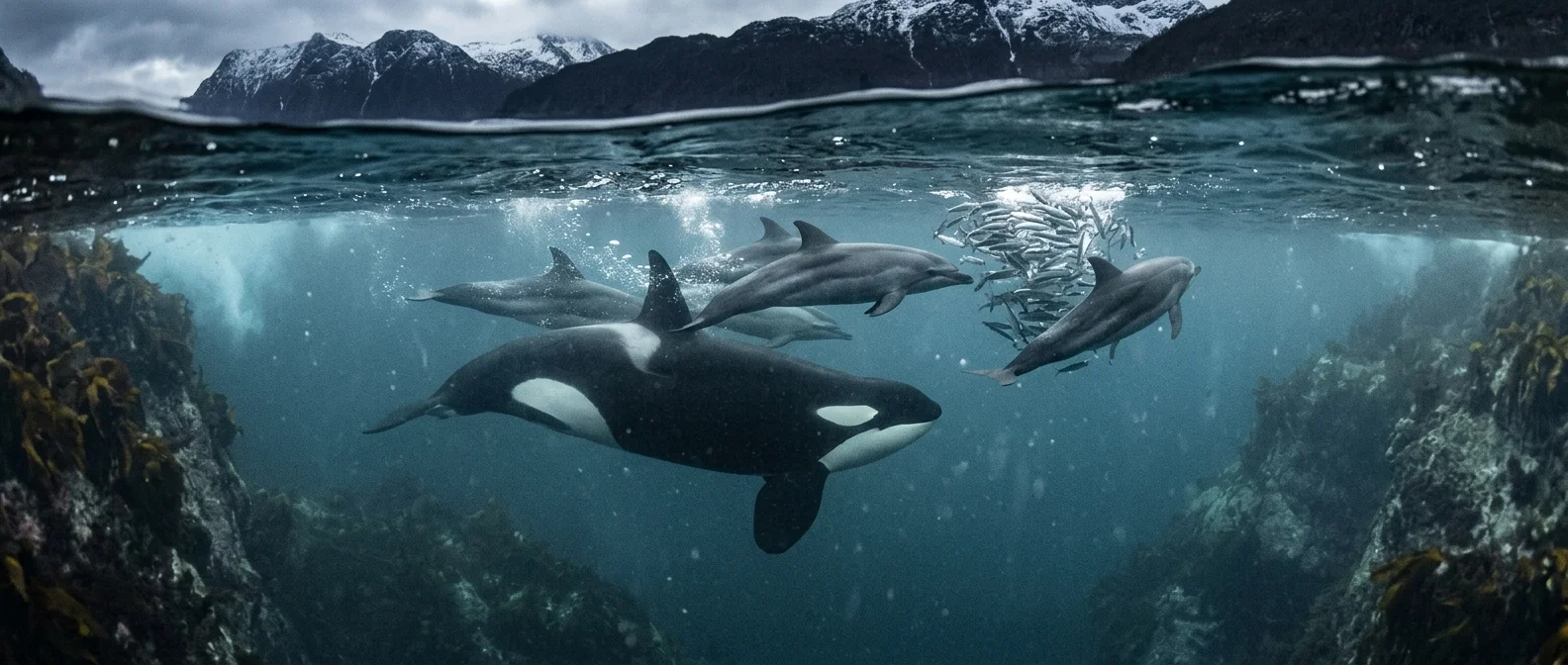
Off the coast of Mossel Bay, South Africa, an orca with a collapsed dorsal fin — known as “Starboard” — approached a juvenile great white shark measuring 2.5 meters. Within two minutes, she killed it, extracted its liver, and surfaced in front of a research vessel holding the organ in her mouth. The scene, captured by researchers and citizens, represents the first documented solo killing of a great white shark by an orca.
🦈 The Flipping Technique
Orcas (Orcinus orca) are the ocean's apex predators — and they're evolving faster than anyone expected. Two separate research teams, on two continents, have documented hunting techniques that overturn everything we knew about interactions between top marine predators.
In the Gulf of California, Mexico, the Moctezuma pod — a group of five orcas — employs a chillingly precise technique: they flip juvenile great white sharks upside down, inducing tonic immobility — a temporary paralysis that occurs when sharks are inverted. This renders them completely defenseless.
🇲🇽 The Moctezuma Pod — Gulf of California
In August 2020, five orcas hunted a juvenile great white shark, drove it to the surface, and flipped it in coordinated fashion. They dragged it underwater and resurfaced holding the liver. Minutes later, they repeated the exact same attack on a second juvenile shark. Two years later, in August 2022, the same five orcas flipped another juvenile white that bled from its gills and exposed its liver.
"This temporary state renders the shark defenseless, allowing the orcas to access the highly nutritious liver — and potentially consume other organs before abandoning the rest of the carcass," explained Erick Higuera Rivas, marine biologist at Pelagic Life and lead author of the study in Frontiers in Marine Science.
What makes the behavior even more impressive is the risk optimization. The injuries observed on the sharks show that orcas have developed a refined technique that minimizes the chance of being bitten — particularly effective against juvenile sharks that lack the strength or experience to escape. Researchers identified each individual orca through dorsal fin markings, confirming it was the same group in every incident.
Dr. Francesca Pancaldi from Instituto Politécnico Nacional (CICIMAR) notes: "So far we have observed this pod feeding exclusively on elasmobranchs. Generating information on their extraordinary feeding behavior will lead us to understand their critical habitats, so we can establish protected areas."

Cultural Transmission
Higuera Rivas emphasizes: "This behavior is testament to orcas' advanced intelligence, strategic thinking, and sophisticated social learning — hunting techniques are passed down through generations within the pod." The Moctezuma pod was already known for hunting rays, bull sharks, and whale sharks — their experience likely helped them refine the strategy for great whites.
🇿🇦 Starboard — The Solo Hunter
Until recently, killing great white sharks was considered exclusively a group affair. Dr. Alison Towner from Rhodes University, who has studied great white sharks for 17 years, overturned this perception in South Africa.
At Mossel Bay, an orca nicknamed Starboard — due to her collapsed right dorsal fin — was observed hunting alone a juvenile great white measuring 2.5 meters. Within two minutes, she immobilized it, removed the liver, and surfaced in front of the boat holding it in her mouth. A second shark carcass measuring 3.55 meters was found nearby — evidence that Starboard had already killed before.
Starboard, along with her companion “Port,” were already research “stars” — documented since 2017 hunting great white sharks in groups in South Africa, causing mass shark evacuations from entire coastlines. The new observation proves Starboard has reached a new level — she no longer needs help to defeat the apex predator.
Esther Jacobs, from the Keep Fin Alive initiative, witnessed the event: "Arriving at Seal Island, the smell of shark liver oil and a greasy slick on the water indicated a recent kill. The moment Starboard grabbed my favorite shark species was simultaneously devastating and incredibly powerful."
Why the Liver?
A great white's liver comprises up to 28% of body weight — packed with lipids (squalene), rich in energy. The perfect caloric “bomb” for a predatory cetacean.
Shark Flight Response
Adult great whites react immediately — abandoning their territories for months. But juveniles don't recognize the danger, making them easy targets.
El Niño and New Targets
Climate cycles shift shark “nurseries” — bringing inexperienced juveniles to the Gulf of California, where orcas are waiting.
Ecological Disruption
The disappearance of white sharks from an area can trigger mesopredator release — mid-level predators increase unchecked, disrupting the food chain.

🧠 What These Observations Reveal
Both studies show a common pattern: orcas aren't static predators — they actively evolve their techniques. They learn, teach, innovate. The Moctezuma pod progressed from rays to bull sharks and finally to great whites. Starboard moved from pack hunting to solo kills — an evolution no one anticipated.
Dr. Salvador Jorgensen, co-author of the Mexican study (California State University), observes: "This is the first time we've seen orcas repeatedly targeting juvenile great whites. Adult sharks react quickly — they completely abandon their seasonal aggregation sites and don't return for months. But juveniles may be naive to orcas."
Dr. Simon Elwen (University of Stellenbosch) adds regarding South Africa: "As intelligent apex predators, orcas can quickly learn new hunting techniques by themselves or from others — monitoring these behaviors is crucial to understanding these animals."
Climate cycles like El Niño shift the nursery zones of juvenile great whites, bringing inexperienced fish to new areas — exactly where orcas are waiting. If this trend continues, juvenile sharks will become seasonal menu items. Meanwhile, research showed that in areas where orcas hunt actively, great white sharks disappeared for months — creating imbalances in mid-level predators normally controlled by sharks. This phenomenon, known as mesopredator release, can have cascading effects on entire ecosystems.
"This behavior is testament to orcas' advanced intelligence, strategic thinking, and sophisticated social learning. Hunting techniques are passed down through generations within their pods."
— Erick Higuera Rivas, Pelagic Life / Frontiers in Marine Science (2025)