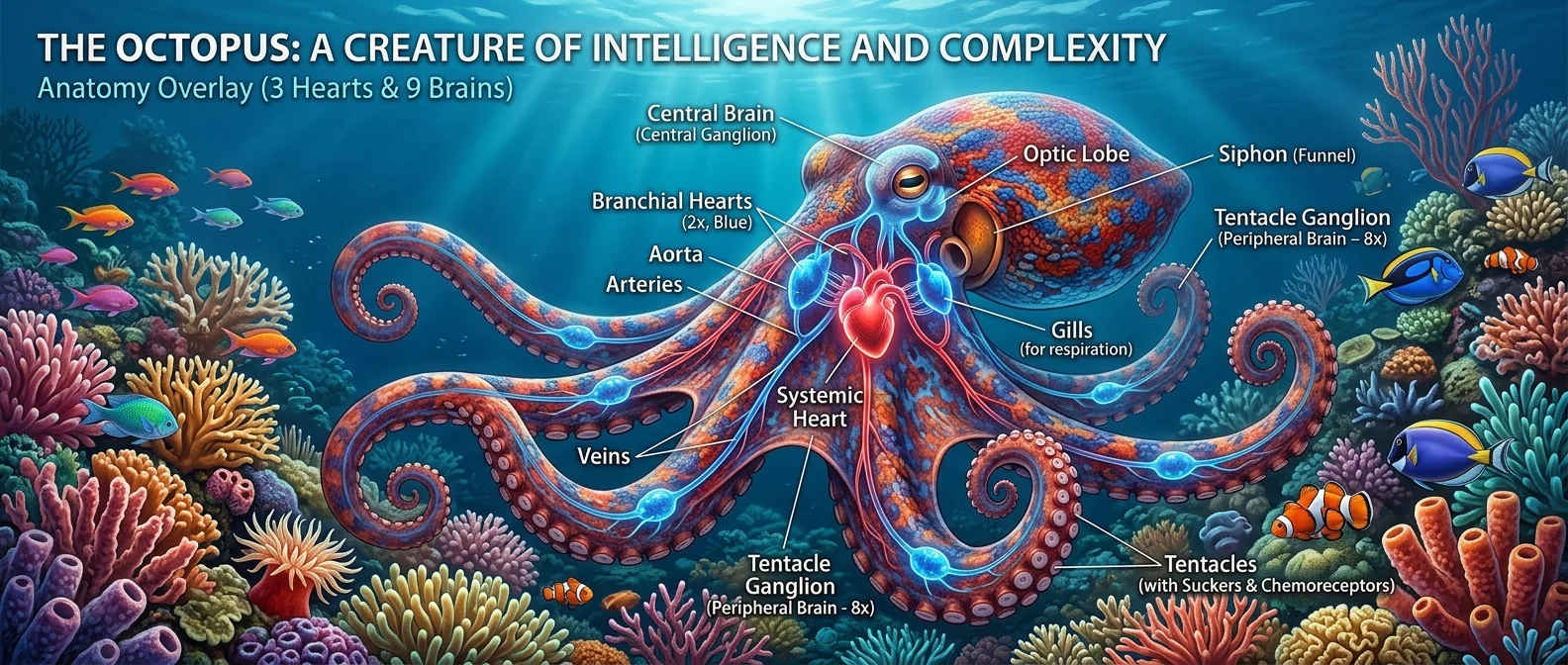
If an alien civilization designed an animal from scratch — no spine, no bones, but maximum adaptability — they'd probably end up with something like an octopus. Three hearts. Nine brains. Blue blood. And the ability to vanish before your eyes. This isn't science fiction — it's biology. Here's how it works.
📖 Read more: Octopus Rides Mako Shark: The Ocean's Most Bizarre Photo
⚙️ Module 1 — Circulatory System: 3 Hearts, 1 Mission
The octopus doesn't have one heart — it has three hearts. Two branchial hearts pump blood through the gills, where it gets enriched with oxygen. The third, the systemic heart, pushes oxygenated blood throughout the body. Why three? Because hemocyanin — the copper-based protein that carries oxygen instead of hemoglobin — is less efficient. Three hearts compensate for this disadvantage.
And the blood? Blue. Not metaphorically — literally blue. Hemocyanin relies on copper instead of iron, making it more effective in cold, low-oxygen conditions. When oxygenated, it turns blue. A creature full of blue blood flowing through three pumps — nature, apparently, doesn't read design manuals. Here's the catch: the systemic heart stops beating when the octopus swims. That's why it prefers crawling along the seafloor — swimming exhausts it quickly. Hemocyanin carries oxygen less efficiently than hemoglobin, but it pays off: it works perfectly in cold waters and low oxygen levels, ensuring survival in oceans from tropical to Arctic.
🧠 Module 2 — Neural Network: 9 Brains, Distributed Intelligence
The octopus's central brain sits in its head — but it's not alone. Each of the 8 arms contains a massive ganglion of nerve cells, essentially a mini-brain. Total: 9 brains. About two-thirds of the octopus's neurons are located in its arms, not its head. This means each arm can taste, touch, and make decisions independently from the central brain.
Picture this: cut off an octopus arm and it continues reacting to stimuli, grabbing objects, moving. This isn't reflex — it's local intelligence. The octopus is considered the smartest invertebrate on Earth. It solves mazes, opens jars, recognizes humans, and — according to a 2009 study — the veined octopus (Amphioctopus marginatus) excavates half coconut shells from the seafloor and carries them as portable shelters. First documented tool use by an invertebrate. A 2025 study examined octopuses in the Caribbean and near Spain and found that the front pairs of arms are used more frequently for complex activities — grabbing objects, substrate exploration, walking, even attacking prey. The rear arms, conversely, serve mainly as support bases. The central brain coordinates, but doesn't control everything — each arm has its own “opinion.” In laboratory tests, octopuses solve mazes, open screw-top jars, and recognize human faces — actions that until recently were considered exclusive to vertebrates. Even more impressive: they learn through observation. An octopus watching another open a container can repeat the process without trial and error. Social learning in a solitary animal — a paradox that defies every categorization.

Each arm = one mini-brain. Two-thirds of neurons are located outside the head — distributed intelligence.
🎨 Module 3 — Camouflage: Invisible in 0.1 Seconds
Every chromatophore (pigment cell) in the octopus's skin is controlled directly by the brain through a separate nerve. This means hundreds of thousands of independent color “pixels,” each under brain control. The result: the giant Pacific octopus can change color in one-tenth of a second.
It doesn't just change color — it changes texture. It develops protrusions, spiky patterns, smooth surfaces, coral mimicry, seaweed imitations, rock simulations. Sharks, eels, and dolphins pass by without noticing. This isn't simple camouflage — it's three-dimensional environment simulation, in real-time, executed by a creature without a skeleton. Beyond chromatophores, the octopus has iridocytes — cells that reflect light, creating metallic flashes and iridescent effects. The change isn't just for defense: when agitated, the octopus displays dramatic patterns — dark stripes, huge fake “eyes” on its arms, bright outlines — alarm signals that confuse even experienced predators. And there's the mimic octopus (Thaumoctopus mimicus), discovered only in 1998 in Indonesia: it changes shape, color, and movement to imitate at least 15 different species — lionfish, sole fish, sea snakes, starfish, jellyfish. No other animal on Earth employs such polymorphic mimicry.
🛡️ Module 4 — Defense: Ink, Venom, Regeneration
If invisibility fails, plan B activates: a cloud of ink — a mixture of melanin and mucus — shoots out through the siphon near the anus. The ink doesn't just block vision — it contains a substance that paralyzes the predator's sense of smell. The shark literally goes “blind” in two senses simultaneously.
Plan C: if something grabs an arm, the octopus amputates it and escapes. The arm regenerates completely without permanent damage. Plan D: venomous saliva. Used mainly to subdue prey (crabs, lobsters), but the blue-ringed octopus (Hapalochlaena) can kill a human. And — bonus — the only hard part of its body is the beak: meaning it can squeeze through any opening larger than that. The size variety? Enormous. The smallest octopus (O. arborescens) measures just 2 inches. The giant Pacific octopus (Enteroctopus dofleini) reaches 18 feet in length with an arm span of nearly 30 feet. Across this range, each species has optimized for its own habitat.

Color change in fractions of a second — each chromatophore is controlled separately by the brain.
💀 Module 5 — Life Cycle: The Mother's Sacrifice
The octopus lives briefly — usually 1-2 years, rarely 3-5 (in larger species). But its death is dramatic. The male transfers sperm through a specially modified arm (hectocotylus) directly to the female — and often dies immediately after. The female lays up to 100,000 eggs in hidden rock crevices, and for the next 4-8 weeks eats nothing.
She dedicates herself exclusively to the eggs: cleaning them with her suckers, aerating them with water, protecting them day and night. Exhaustion and starvation kill her before the young hatch. Newborn octopuses — microscopic copies of adults — float in the plankton for weeks before descending to the seafloor. They're born orphans. A recent development: in 2018, scientists discovered an “octopus graveyard” on the Pacific floor near Monterey Bay — thousands of females concentrated in warm seafloor vents, guarding eggs. It was the largest known octopus concentration on Earth — a “nursery” at 10,500 feet depth, where warm currents accelerate hatching. Even in death, the mother octopus chooses strategically. Newborns start as planktonic larvae — microscopic, transparent, carried by currents. For weeks they float at the surface, feeding on microorganisms, until they gain enough weight to dive to the seafloor. Fewer than 1 in 1,000 survive to adulthood — ruthless selection that explains why a female lays 100,000+ eggs the only time in her life.
If you want to summarize an octopus in one sentence: it's a creature that reinvented intelligence, physiology, and invisible defense — without a single bone. Three hearts, nine brains, blue blood. And no rule of biology it doesn't break.