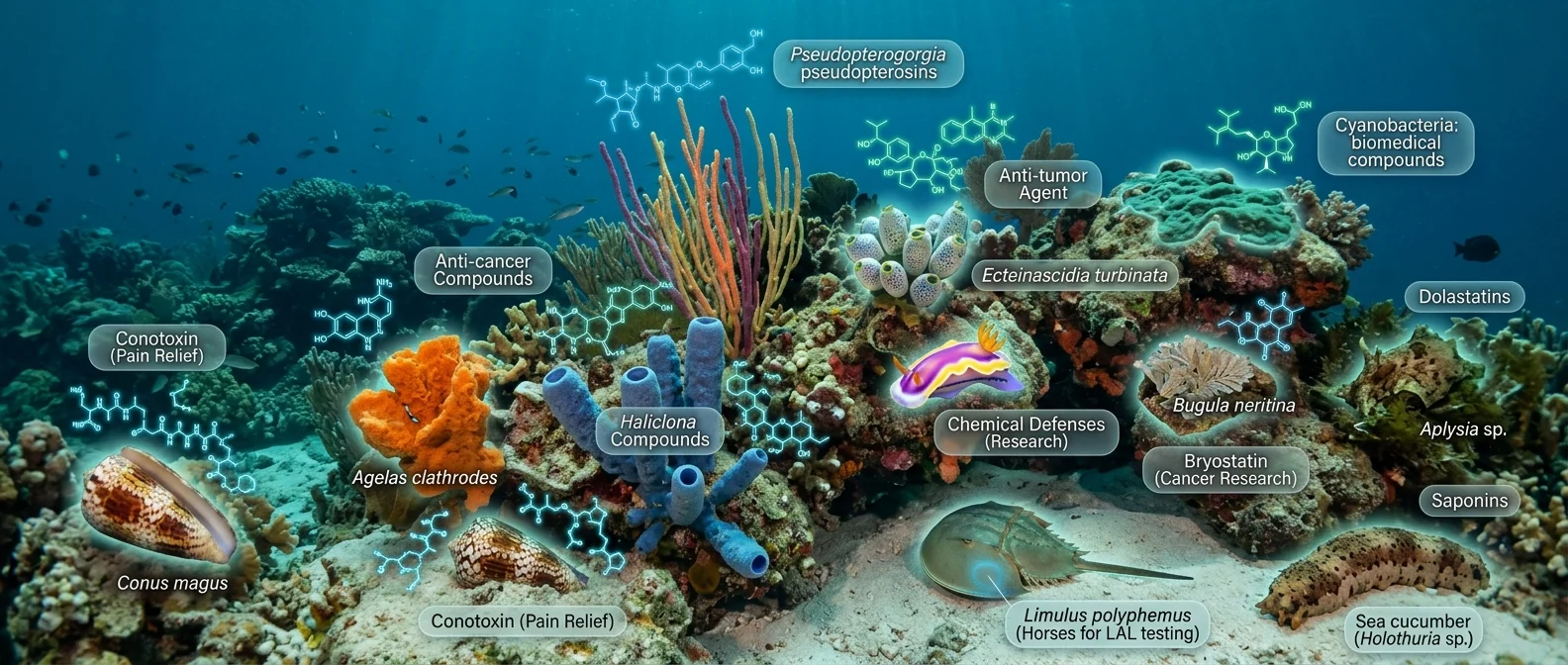
A tiny snail in the Pacific kills fish with venom a thousand times stronger than morphine. A sponge in the Caribbean depths produces compounds that destroy cancer cells. A jellyfish in Washington waters gave humanity a tool that led to a Nobel Prize. The ocean isn't just food and scenery — it's a pharmacy. The planet's largest pharmacy, and we've barely started opening its shelves. Of the 250,000 known marine species, fewer than 5% have been screened for pharmacological activity — yet this tiny fraction has already yielded over 15,000 new bioactive molecules.
📖 Read more: Blue-Ringed Octopus: Tiny but Deadly Ocean Predator
Cone Snails: The Venom That Heals
The cone snail (Conus magus) looks harmless — a small shell on the seafloor. But its venom contains hundreds of neurotoxins called conotoxins that block specific ion channels in nerves. One of these, ω-conotoxin MVIIA, became the drug ziconotide (Prialt), FDA-approved in 2004 for chronic pain. It's 1,000 times more potent than morphine, without addiction — a feat no synthetic molecule has achieved. Today, researchers study over 100,000 different conotoxins from 800 cone species, hunting for new painkillers and anti-seizure drugs. Each cone species has its own "library" of toxins — an estimated one million unique peptides exist across all cone shells, waiting for analysis. Every cone is essentially a pharmaceutical factory that's been evolving for 55 million years. Nature already did the work — we just need to read it.
Sponges: The Silent Chemists
Marine sponges can't move, have no shells, no spines. Their only defense? Chemistry. They produce thousands of bioactive molecules that deter predators and microbes. Arabinoside from the sponge Tectitethya crypta led to Ara-C (cytarabine), one of the first chemotherapy drugs, still used today against leukemia. The discovery happened in the 1950s, but the ocean keeps giving us new molecules — over 1,000 new marine compounds are reported annually in scientific journals. Some show antiviral, antifungal, or even neuroprotective properties that don't exist in any terrestrial organism. Arabinoside opened the door to marine pharmacology, proving the ocean isn't just a food source but a healing source. Since then, the field has evolved into an entire branch — marine pharmacology — employing thousands of researchers worldwide. In 2023 alone, over 1,200 new marine molecules were published in specialized journals like Marine Drugs.

Sharks: Immunity Without Cancer?
Sharks show remarkably low cancer rates. Their immune system contains unique antibodies — IgNAR (Immunoglobulin New Antigen Receptor) — the smallest known antibodies in nature. Due to their microscopic size, they penetrate areas human antibodies cannot reach. Researchers at the University of Aberdeen are using IgNAR in experimental therapies against cancer tumors and infectious diseases. Squalamine, a compound from shark liver, is being tested as an antiviral drug. Worth noting that the myth "sharks never get cancer" is an exaggeration — they do, but extremely rarely. The truth, however, is equally impressive: their immune system has been evolving for 450 million years, and this time created unique defensive tools. Sharks survived five mass extinctions — and their immune system was part of the reason.
Jellyfish: Fluorescence That Won a Nobel
The jellyfish Aequorea victoria glows green in the dark. The responsible protein — GFP (Green Fluorescent Protein) — doesn't treat diseases in the traditional way. It does something more important: allows scientists to "see" biological processes in real-time inside living cells. Researchers attach the GFP gene to any other gene, and wherever it's expressed, it glows green. This way they track cancer cell metastasis, neuron behavior, embryo development. GFP is used in every biomedical research lab worldwide and earned the 2008 Nobel Prize in Chemistry for Shimomura, Chalfie, and Tsien.
Horseshoe Crabs: The Blood That Tests Vaccines
The blue blood of the horseshoe crab (Limulus polyphemus) contains LAL (Limulus Amebocyte Lysate), a substance that clots immediately in the presence of bacterial endotoxins. Every vaccine, every injectable drug, every surgical implant is mandatorily tested with LAL before release. Without this animal, the pharmaceutical industry would be blind to deadly contamination. Every year, 500,000 horseshoe crabs donate blood in laboratories — an ethical dilemma that led to developing synthetic rFC (recombinant Factor C) as an alternative. The horseshoe crab has existed virtually unchanged for 450 million years — it's literally a living fossil, yet carries in its blood one of modern medicine's most critical tools. In 2020, during the COVID-19 pandemic, LAL was used massively to test vaccines — without the horseshoe crab, vaccinating billions would have been impossible.

Tunicates and Bryozoans: Hidden Treasures
Tunicates — these little sacs of the seafloor — produce ecteinascidin-743, known as trabectedin (Yondelis), an approved anticancer drug for soft tissue sarcoma. Its mechanism is impressive: it binds to the minor groove of DNA and directly interferes with the cancer cell's repair mechanism. Bryozoans (Bugula neritina), small colonial animals, produce bryostatins — compounds that activate the immune system against cancer cells. Bryostatin-1 is being tested in phase II clinical trials against lymphomas and melanoma. Overall, over 30 marine drugs are in various stages of clinical trials — a number that doubled in the last decade. Many of these compounds aren't produced by the animals themselves, but by symbiotic bacteria living inside them — a discovery that opens even more possibilities for biotechnological production.
Marine Worms and Corals: New Antibiotics
Antibiotic resistance is one of the world's biggest health threats. The ocean offers solutions. Corals produce pseudopterosins, compounds with powerful anti-inflammatory action — some more effective than indomethacin. Marine worms of the Polychaeta family contain hemoglobin 250 times more efficient than human hemoglobin at oxygen transport, being researched for blood substitutes in transfusions. The French company Hemarina is already developing this hemoglobin as a product for organ transplants, keeping them alive longer during transport. This capability could save thousands of lives in disasters or remote areas without access to blood banks.
The Danger: We're Losing Drugs Before We Discover Them
Ocean pollution, overfishing, acidification, and climate change threaten exactly the ecosystems that produce these compounds. Only 5% of marine species have been studied pharmacologically — this means 95% of the ocean's pharmaceutical treasure remains completely unknown. Every coral reef lost, every deep-sea zone polluted, removes potential drugs before we discover them. According to the UN, the planet has already lost 50% of its coral reefs. Marine pharmacology isn't just science — it's a race against time. The 15,000+ marine molecules we've cataloged so far represent only a fraction of what exists out there. Protecting the ocean doesn't just save fish — it saves our drugs too. And perhaps the lives of people who don't yet know they'll get sick. Every time we hear about a species going extinct, we didn't just lose an animal — we lost perhaps a cure we never got to find. This invisible loss drives ocean conservation. Our planet is 71% water — and in that water hide drugs we haven't named yet.
«The ocean is the planet's largest pharmacy — but it's closing before we open all its drawers.»
— William Fenical, Professor of Marine Chemistry, Scripps Institution of OceanographySources:
- Molinski, T. F. et al. — «Drug development from marine natural products», Nature Reviews Drug Discovery, 2009
- Mayer, A. M. S. et al. — «Marine pharmacology in 2014–2017: clinical pipeline», Marine Drugs, 2020