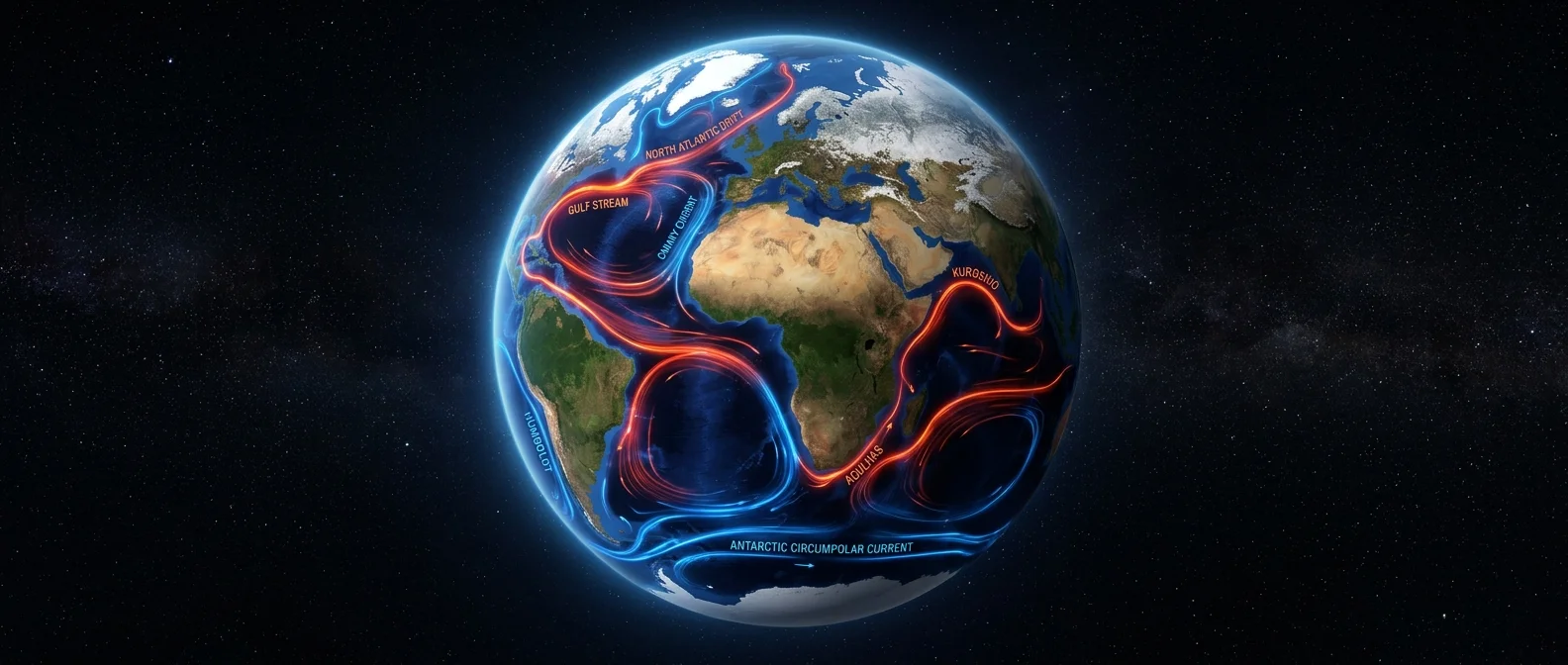
Imagine a river 100 times larger than the Amazon. It doesn't flow through any continent — it moves silently beneath the Atlantic's surface. Ocean currents transport heat, nutrients, oxygen, and regulate the climate of entire continents. When they stop, the world changes — literally within a decade. Let's explore how these invisible rivers work, why they're so critical, and what happens when they begin losing their strength.
📖 Read more: 3 Billion Birds Lost Since 1970: The Silent Sky Crisis
What Are Ocean Currents
Ocean currents are permanent flows of seawater that move in predictable patterns across the planet. They're divided into two categories: surface currents, driven by wind in the upper 400 meters, and deep currents, driven by density differences in the water. Surface currents represent only about 10% of total ocean volume, but move quickly — the Gulf Stream flows at 2.5 meters per second in some areas. Deep currents, conversely, move extremely slowly — just centimeters per second — but transport massive volumes of water. A water molecule takes roughly 1,000 years to complete the full thermohaline circulation cycle, traveling from the North Atlantic to the Antarctic Ocean and back.
Gulf Stream: Europe's Invisible Space Heater
Without the Gulf Stream, London would have Quebec's winters. This warm current starts in the Gulf of Mexico, travels up the eastern coast of North America, and crosses the Atlantic toward Northwestern Europe. It carries energy equivalent to a million nuclear power plants — approximately 1.4 petawatts of thermal power. This heat makes Scandinavia habitable, keeps Britain green in winter, and allows Norway to maintain ice-free ports north of the Arctic Circle. Benjamin Franklin was the first to map the Gulf Stream in 1769 — he observed that ships following it traveled two weeks faster on the Philadelphia-London route. The Gulf Stream is so powerful that surface water temperature can differ by 10°C from neighboring water — like an invisible wall of heat within the ocean.

Thermohaline Circulation: The Great Conveyor Belt
Thermohaline circulation — the so-called “global ocean conveyor belt” — moves water between surface and depths through temperature and salinity differences. In the North Atlantic, near Greenland, warm surface water cools, becomes saltier (as forming ice expels salt), and sinks to depths of 2,000-4,000 meters. This “deep water formation” drives the entire system. From there, cold deep water flows south along the Atlantic floor, around Africa, into the Indian Ocean, and eventually surfaces in the Pacific — a journey lasting centuries. The Atlantic Meridional Overturning Circulation (AMOC), the Atlantic portion, is the most critical part of this system.
El Niño and La Niña: Oscillations That Change Everything
In the tropical Pacific, another current system periodically goes haywire. Normally, easterly trade winds push warm surface waters westward toward Indonesia, allowing cold deep water to rise along Peru's coast — feeding massive fishing grounds. Every 2-7 years, this pattern reverses: winds weaken, warm water remains in the east, and cold upwelling stops. This is El Niño. The consequences are planetary: floods in South America, drought in Australia, weak monsoons in India, and a 0.1-0.2°C increase in global average temperature. The 1997-98 El Niño caused $35 billion in damages worldwide. La Niña, the opposite phenomenon, brings excessive cooling and enhanced storms — La Niña seasons correlate with increased Atlantic hurricane activity and floods in Southeast Asia.
📖 Read more: Amazon Rainforest: The Dying Lung of Our Planet
AMOC: Collapse Risk?
The AMOC is slowing down. Studies show its strength has decreased by 15% since the mid-20th century. The cause? Greenland ice sheet melting dumps massive amounts of freshwater into the North Atlantic, reducing salinity and preventing deep water formation. A paper in Nature Climate Change (Rahmstorf et al., 2015) used 1,000-year sea temperature records and concluded the current slowdown is unprecedented in the last millennium. If AMOC collapses — no longer a theoretical scenario — Europe would experience 5-10°C temperature drops within decades, African monsoons would shift south, and sea levels would rise unevenly along America's eastern coast. Some models also predict dramatic rainfall reductions in the Iberian Peninsula and North Africa.

Currents and Life: How the Ocean Feeds Itself
Ocean currents don't just transport heat — they transport life. Cold upwelling, where deep cold waters rise to the surface, brings nutrients — phosphorus, nitrogen, iron — that fuel phytoplankton blooms. These upwelling zones, covering less than 1% of ocean surface, produce nearly 50% of global fisheries. Peru's, Namibia's, California's, and Northwest Africa's coasts owe their highly productive fishing grounds to this exact phenomenon. During El Niño years, cold upwelling weakens, fisheries collapse, and entire fishing communities face crisis — as happened in Peru in 1972, with a collapse that changed the global fish meal market. Without currents, the ocean would be a calm, warm, nearly dead desert — a stagnant water body without nutrients, without oxygen in the depths, without the food chains supporting marine ecosystems. The phytoplankton fed by these nutrients also produces over 50% of the oxygen we breathe — every second breath you take, you owe to the ocean.
The Future: Can We Save the Conveyor Belt?
AMOC is likely at a tipping point. Models show complete collapse could occur at 3-4°C above pre-industrial levels — an increase achievable if emissions aren't drastically reduced. The last time AMOC stopped was during the Younger Dryas, 12,800 years ago — Europe plunged into glacial conditions within decades. But history also shows currents can restart. Stommel's seminal 1961 study in Tellus predicted thermohaline circulation has two stable states — active and inactive — and transitions can be abrupt. Prevention, through CO₂ emission reductions and limiting ice melt, remains the only realistic solution. The oceans aren't asking for our help — but without them, Earth becomes unrecognizable.
Why We Must Care — Now
Ocean currents aren't abstract concepts in science textbooks — they affect what we'll eat, how much it will rain this year, and whether the coasts we know will exist in 50 years. A dying Gulf Stream means destroyed crops in Northern Europe, collapsed North Atlantic fisheries, and millions of climate refugees. This isn't science fiction — it's the most likely path if we continue on the same trajectory. The sea hides the planet's most important messages. Only if we start reading them can we still avoid the worst. Next time you look at the ocean, remember: beneath that calm surface flow rivers that keep the planet alive.
«The ocean isn't just a big bathtub — it's a thermal engine that governs the planet.»
— Wallace Broecker, oceanographer who coined the term “conveyor belt”Sources:
- Rahmstorf, S. et al. — «Exceptional twentieth-century slowdown in Atlantic Ocean overturning circulation», Nature Climate Change, 2015
- Stommel, H. — «Thermohaline convection with two stable regimes of flow», Tellus, 1961