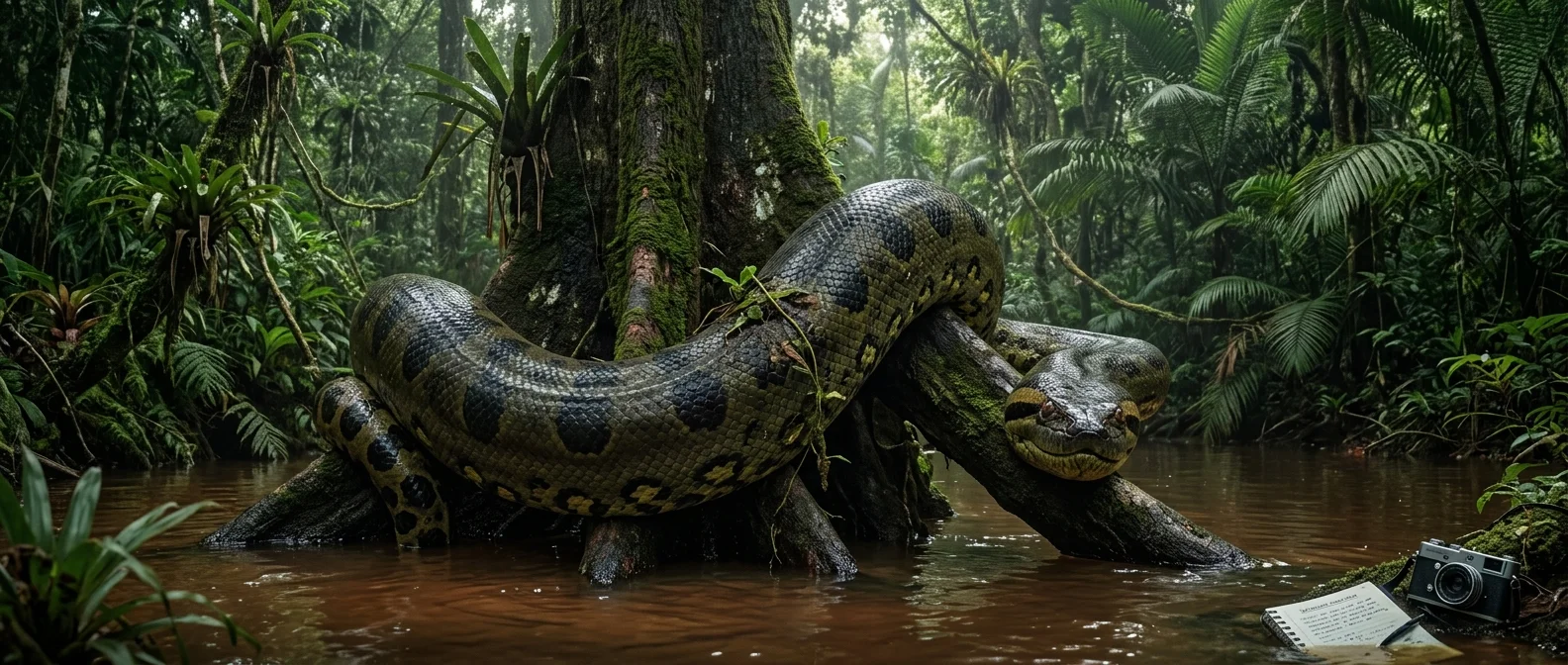
In a muddy river deep in the Ecuadorian Amazon, a team of scientists with Waorani tribal guides immobilized a 16-foot female green snake. They took skin samples, analyzed them — and what they found overturned 200 years of scientific belief. The green anaconda isn't one species. It's two.
📖 Read more: Electric Eel Delivers 860 Volts That Can Kill Alligators
The Discovery That Changed Everything
After nearly 20 years of research across nine countries, Professor Bryan Fry from the University of Queensland and his team revealed that what we considered a single green anaconda species actually comprises two genetically distinct species. The already known Eunectes murinus — the southern green anaconda — and the brand-new Eunectes akayima, the northern green anaconda.
"The discovery of a new species isn't often the result of active searching, but rigorous scientific process," Fry explained to LiveScience. The two species look nearly identical externally — but genetically, their difference is staggering: 5.5% DNA divergence. For comparison, the genetic difference between humans and apes is just 2%.
Eunectes akayima — Species Profile
- Range: Ecuador, Colombia, Venezuela, Trinidad, Guyana, Suriname, French Guiana
- Weight: over 550 pounds — the world's heaviest snake
- Length: over 23 feet (largest females)
- Published: Diversity, February 2024
10 Million Years Apart
The two species split approximately 10 million years ago — well before the first Homo sapiens appeared on Earth. Since then, they've accumulated thousands of genetic differences. And while there's no obvious geographic barrier separating them — no mountain, no ocean — their evolutionary paths took radically different directions.
E. murinus (southern) lives in Peru, Bolivia, Brazil, and French Guiana. E. akayima (northern) is found in Ecuador, Colombia, Venezuela, Trinidad, Guyana, and Suriname. Both species inhabit wetlands and rivers, spending most of their time submerged in water. Their greenish coloration provides perfect camouflage in their environment.

How It Was Found
The crucial expedition was a 2022 exploration in the Bameno region of Baihuaeri Waorani territory in the Ecuadorian Amazon. Waorani leader Penti Baihua invited researchers onto his land. The team paddled through muddy rivers, navigating swamps under relentless heat and swarms of insects.
Actor Will Smith also participated in the expedition, filming material for National Geographic's “Pole to Pole” documentary series. The tissue and blood samples collected revealed what no eye could see: two identical-looking snakes, two completely different species.
Males vs Females: Two Worlds
Northern green anaconda females reach 23 feet and 550 pounds, while males are significantly smaller and more slender. But the biggest difference isn't size — it's diet. Females feed lower on the food chain, hunting animals like deer. Males prefer predatory fish and caiman — predators that accumulate toxins.
"Females and males live in the same environment but feed differently," Fry explained. This difference means males and females occupy different ecological niches — almost like two separate species within the same species. This discovery has enormous implications for ecosystem studies.
Pollution Bioindicator
The dietary difference between males and females revealed something disturbing. Males, feeding higher on the food chain, accumulate dramatically more toxins. Fry's team measured concentrations of heavy metals — cadmium and lead, endocrine disruptors that are signatures of oil spills — and found they were over 1,000% higher in males compared to females.
"This isn't a subtle difference. It's a danger flare," Fry stated. Male dietary patterns mirror those of humans living in the Amazon. If males carry this much pollution, local populations are exposed to similar levels. Fry is now developing a food guide for the Waorani, recommending pregnant women avoid top predators.

Southern vs Northern Green Anaconda
E. murinus (Southern)
Peru, Bolivia, Brazil, French Guiana — known for centuries but only now genetically separated
E. akayima (Northern)
Ecuador, Colombia, Venezuela, Trinidad — new species, 5.5% genetic divergence, 5th recognized anaconda species
Why It Matters for Conservation
Until now, both species were treated as one. This means conservation programs may have ignored the unique needs of the northern anaconda. As apex predators, anacondas regulate entire ecosystems — their presence changes the behavior of dozens of species, affecting where they feed, reproduce, and migrate.
"Despite their reputation, anacondas are actually very poorly known," Fry admitted. E. akayima is only the fifth recognized anaconda species — and there may be others. Deforestation, climate change, and pollution from oil spills threaten the aquatic habitats of both species. Now that we know there are two, we need two separate protection strategies.
The Role of Indigenous People
The discovery wouldn't have been possible without the Waorani tribe. Leader Penti Baihua and his community not only invited the scientists but guided the expeditions — knowing exactly where the snakes hide, how to approach them, and how to safely immobilize them. Their traditional knowledge was irreplaceable.
Collaboration between indigenous communities and Western scientists is increasingly vital in modern biology. In the Amazon, the Waorani have lived alongside these giant snakes for millennia — and their knowledge proves as valuable as any genetic analysis. Without them, E. akayima might have remained hidden for decades more.
What It Means for Science
If the world's heaviest snake — a 23-foot creature weighing over 550 pounds — can hide an entire second species within it, then how many other “known” animals are actually two or more species? Genetic taxonomy is constantly overturning what we thought we knew.
"When species aren't recognized, they can slip through the gaps of conservation programs," Fry emphasized. Somewhere in the muddy waters of the Amazon, an anaconda that no one knew existed swims silently — reminding us that our planet still harbors secrets waiting to be discovered.