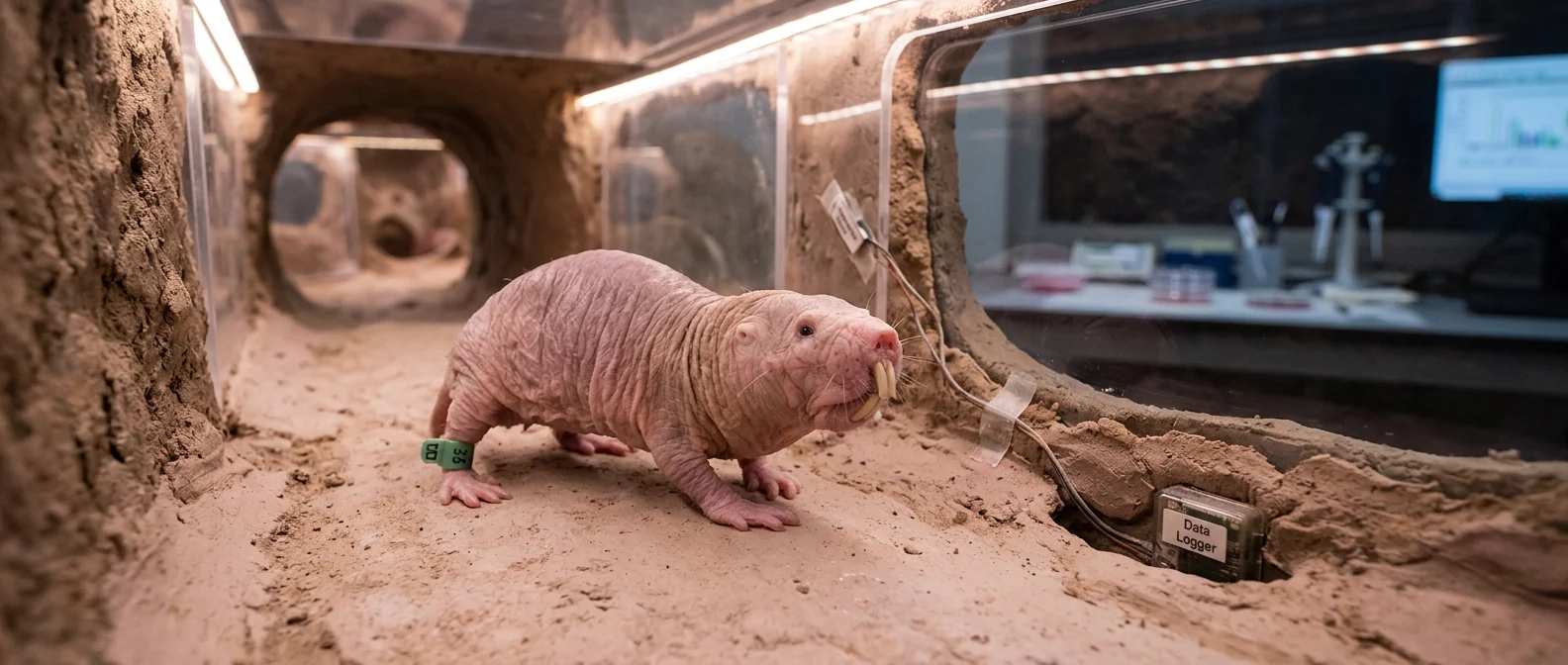
Imagine an animal that doesn't age — literally. Its probability of death doesn't increase with time. It almost never gets cancer. It can survive 18 minutes without oxygen. And it looks like a sausage with teeth. This creature exists — and it might hold the key to our own longevity.
📖 Read more: 5,000-Year-Old Tree: Methuselah Still Stands Strong
🐀 A Rodent That Looks Like an Alien
The naked mole rat (Heterocephalus glaber) is a hairless rodent with wrinkled, pink skin and teeth that protrude from its lips — designed for digging without getting dirt in its mouth. It lives in underground tunnel systems in the deserts of East Africa, primarily in Kenya, Ethiopia, and Somalia, where underground temperatures remain relatively stable but oxygen is often scarce.
At just 3-4 inches long and weighing about 35 grams, you'd hardly imagine this tiny creature would become one of the most studied animals in the world. But its biology is so bizarre, so contrary to everything we know about mammals, that scientists can't stop researching it.
👑 One Queen, Hundreds of Subjects
Unlike virtually all mammals, naked mole rats live in colonies with a structure reminiscent of insects — bees or termites. Only one queen reproduces, mating with a few select males. The remaining hundreds of workers dig miles of tunnels, collect roots and tubers for food, and care for the queen.
The social hierarchy is strict with no exceptions. If the queen dies, a brutal succession battle begins among females — a fight that can turn deadly. The winner physically transforms: her spine elongates to accommodate more embryos. It's one of the few mammals where physiology changes based on social role.
📖 Read more: 507-Year-Old Clam: Earth's Oldest Known Animal
⏳ They Don't Die from Aging
According to Gompertz's law — the fundamental principle of aging in mammals — the risk of death increases exponentially with age. In humans, the probability of death doubles every 8 years after 40. A lab mouse begins aging rapidly after its first year of life. The naked mole rat? It categorically refuses to follow this rule.
A study by Rochelle Buffenstein, senior researcher at Calico Life Sciences, tracked 3,329 naked mole rats for over 30 years. The findings were unprecedented: the probability of death remains constant at 1 in 10,000 each day — regardless of age. A one-year-old animal has the same death probability as a 25-year-old. It would be like a human having the same death probability at 30 and 90. In other words, this animal's death follows the pattern of exponential decay — like radioactive material, not like a mammal.

“It doesn't matter how old you are. Your death is random” — Rochelle Buffenstein, Calico Life Sciences
📖 Read more: Why We Age: The Biology Behind Human Aging in 2026
🛡️ Nearly Impervious to Cancer
Beyond aging, naked mole rats defy another scourge: cancer. Malignant tumor rates are extremely low, almost zero — unlike lab mice that frequently develop tumors as they age. The explanation was found in a protein: high molecular weight hyaluronic acid (HMW-HA).
A 2013 study revealed that naked mole rats produce a unique form of this protein with anti-cancer properties. Combined with extremely effective DNA repair mechanisms and rapid removal of cellular mutations, their bodies function like a biological fortress against cancer. Additionally, their proteins maintain integrity throughout their entire lifespan — something unique among mammals.
DNA Repair
Ultra-fast detection and correction of genetic damage at the cellular level
Mutation Clearance
Automatic removal of damaged cells before they become dangerous
HMW-HA Protein
Unique form of hyaluronic acid with proven anti-cancer properties
📖 Read more: Greenland Shark: 500-Year Superpowers in Freezing Waters
🫁 18 Minutes Without Oxygen
Another “impossible” biological feat: naked mole rats can survive 18 full minutes without oxygen, without any permanent damage. For comparison, the human brain suffers irreversible damage after just 4-6 minutes. How do they do it?
According to a 2017 study in Science led by Gary Lewin from Berlin's Max Delbrück Center, naked mole rats do something no other mammal can: they switch fuel. Instead of glucose, they begin metabolizing fructose — a sugar that doesn't require oxygen to convert to energy. This happens thanks to high concentrations of two molecules: the GLUT5 transporter and the KHK enzyme. Under normal oxygen conditions, their metabolism resembles that of mice and humans. But when oxygen is depleted, the backup fructose system automatically activates.
"Our research is the first proof that a mammal can switch to fructose as fuel" — Gary Lewin, Max Delbrück Center
🔬 Why Don't They Age? The Molecular Secrets
Buffenstein and her team have been researching the molecular mechanisms behind this incredible longevity for decades. What stands out isn't one mechanism, but an entire suite of protections. The genome is actively protected, proteins don't degrade, damaged cells are removed before they can accumulate.
Remarkably, naked mole rats don't go through menopause. They can reproduce even at advanced ages — something unthinkable for most mammals. Even stranger, male sperm quality is described by researchers as “dismal,” yet fertilization occurs normally. Each new discovery raises ten new questions.
📖 Read more: Forest Therapy: How Trees Heal You Through Science

🏥 What Does This Mean for Humans?
The medical significance of these discoveries is enormous. If scientists can genetically “activate” a fructose metabolic pathway in the human brain or heart, they could protect tissues during stroke or heart attack — buying precious minutes until oxygen supply is restored. This would be revolutionary for emergency medicine, where every minute without oxygen means permanent damage.
The naked mole rat's anti-cancer mechanisms can also inspire new therapies. The HMW-HA protein is already being studied as a potential target for pharmaceutical interventions. No aging, no cancer, no hypoxia — this tiny rodent seems to have solved problems humanity has struggled with for centuries.
Naked Mole Rat vs Common Mouse
Naked Mole Rat
- Lives 30+ years in captivity
- Nearly zero cancer rates
- 18 minutes survival without oxygen
- Doesn't age according to Gompertz
Common Mouse
- Lives 2-3 years
- High cancer frequency
- Brain damage in minutes without O₂
- Normal exponential aging
🔮 The Future Hides in a Burrow
"We firmly believe that when we discover these mechanisms, they will lead to interventions that could halt the aging process in humans" — these words from Buffenstein aren't hyperbole. Calico Life Sciences, founded by Google, is investing millions precisely in this line of research. And they're not alone — labs worldwide, from the US to Japan, are studying naked mole rats as a model for longevity.
Naked mole rats remind us that nature has already solved problems we're just beginning to understand. A 35-gram animal, buried in desert burrows, may hold the keys to cancer, aging, and ischemic death. No chronic diseases, no Alzheimer's, no diabetes — none of what plagues elderly humans. Sometimes, the most important answers are found in the most unlikely places.