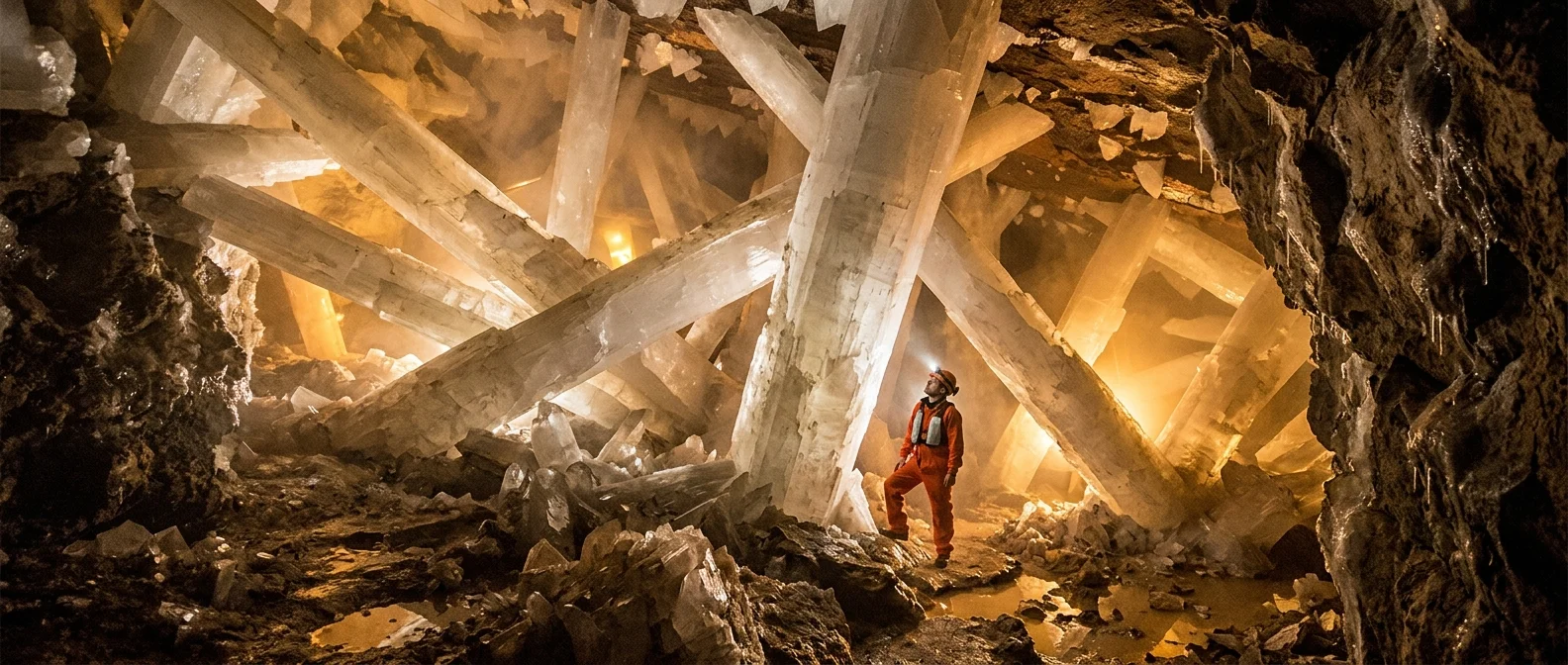
Picture descending 1,000 feet beneath Mexico's Chihuahua Desert. The temperature hits 136°F. Humidity slams 99%. Without a specialized cooling suit, you're dead in 10 minutes. Then you step into a chamber that doesn't belong on Earth: selenite crystals tall as three-story buildings, gleaming like ice but hot as an oven. The Naica Cave isn't just a geological wonder — it's a biological riddle. Because inside these crystals, scientists found microorganisms that have been alive for 50,000 years.
📖 Read more: Life Below the Abyss: Bacteria at 2.5-Mile Depths
📖 Read more: Hidden World of Life Beneath Antarctic Ice
The Discovery: Miners Hit the Underworld
Naica Cave was discovered by accident in 2000 when lead and zinc miners at the Naica mine in Chihuahua state pumped out groundwater. What emerged was the Cueva de los Cristales — a chamber filled with gypsum (selenite) crystals reaching 40 feet long and weighing 55 tons. These were the largest natural crystals ever found on the planet. The initial reaction was awe — followed immediately by questions: How did they form? How old are they? And could anything possibly live in this hellscape? The Naica mine had operated since 1794, but nobody imagined what lay 1,000 feet deeper. Beyond the main cave, smaller chambers were discovered — the Queen's Eye and Cave of Swords — with crystals smaller but equally stunning.
136°F and 99% Humidity: A Lethal Environment
Conditions inside the Cueva de los Cristales rank among the most extreme humans have ever faced in speleological exploration. Temperatures range between 113°F and 136°F, while relative humidity hits 99%. Under these conditions, human sweat doesn't evaporate — the body's cooling mechanism fails and internal temperature begins rising dangerously. Without specialized cooling suits packed with ice and breathing apparatus delivering cold air, researchers can survive inside only 20-30 minutes. NASA participated in designing the equipment because conditions resemble what astronauts will face in extreme environments. Some expeditions had to abort when researchers showed heat stroke symptoms despite the gear.

📖 Read more: How Many Animals Live on You Right Now? The Answer Shocks
📖 Read more: 332m Dive Without Breathing: How Does the Body Survive?
Half a Million Years of Crystal Growth
Naica's selenite crystals didn't form quickly. They required roughly 500,000 years of uninterrupted growth under exceptionally stable conditions: temperatures around 133°F, saturated calcium sulfate solution, and zero disturbance. The García-Ruiz et al. (2007) study in Geology proved growth was extremely slow — a few millimeters per century — but in a perfectly uniform environment, that's enough to create giants. The crystals consist of gypsum (CaSO₄·2H₂O), a soft mineral that typically forms microscopic crystals — but at Naica, perfect conditions allowed development to incredible size. Stability was key: the magma chamber beneath the cave maintained temperature almost unchanged for hundreds of millennia. For comparison, the largest quartz crystals ever found weigh just a few tons — Naica far surpasses them.
Life Inside Crystals: The Extremophiles
In 2017, Penelope Boston of the NASA Astrobiology Institute announced her team discovered microorganisms trapped inside fluid inclusions within the crystals. These organisms — primarily bacteria and archaea — were dormant but viable: when placed in nutrient medium, they "awakened" and multiplied. Their estimated age: 10,000-50,000 years. This means living organisms survived in stasis inside crystal, at temperatures above 122°F, without light, without food, without oxygen in conventional form, for tens of millennia. They belong to at least 40 different strains — and many resemble nothing in known organisms. Some use chemosynthesis — drawing energy from chemical reactions with iron and sulfur instead of light — making them ideal analogs for extraterrestrial life.
📖 Read more: Tardigrades: The Immortal Microscopic Bears
Astrobiology: Lessons for Mars and Europa
NASA took immediate interest. If microorganisms can survive inside crystals at 136°F for 50,000 years, then life could easily hide in similar minerals on Mars, Jupiter's moon Europa — which has a subsurface ocean — or Saturn's Enceladus, with its active water geysers. Naica became a natural astrobiology laboratory — an analog for alien environments, here on Earth. The technique for extracting microorganisms from crystalline inclusions was developed specifically at Naica and can be applied to samples from future missions. NASA's Mars Sample Return mission plans to bring back rocks from Mars — and Naica expertise could be key to detecting ancient life in Martian minerals. In other words, what we learned 1,000 feet under Mexico might someday answer the question: are we alone in the universe?

📖 Read more: 507-Year-Old Clam: Earth's Oldest Known Animal
The Flood: Why the Cave Sank Again
In 2015, mining company Industrias Peñoles shut down the pumps that kept the mine dry. Groundwater returned within months — and the Cueva de los Cristales flooded again. This means the crystals continue growing, but nobody can visit them anymore. The cave now sits under 100 feet of hot water — temperatures around 122°F, making any dive impossible with current technology. Some geologists consider this development positive: human presence risked contaminating the environment and irreversibly destroying the unique ecosystem. Naica belongs to the crystals again — and the microorganisms living inside them. Perhaps in 100 years, future researchers with better technology will return — and find the crystals even larger. At Naica, crystals add millimeters each century while civilization rises and falls above — growth that began before humans walked upright.
📖 Read more: Mariana Trench: What Lives at 36,000 Feet Deep?
Controversy and Scientific Debate
Boston's announcement sparked scientific controversy. Critics argued the microorganisms might be contamination from the researchers themselves, from mining water, or even from laboratory materials. Boston countered that genetic analysis showed strains with no homology to known environmental contaminants. The debate remains open — but regardless of age, the existence of living microorganisms under such extreme conditions is undisputed. Boston presented 16S rRNA phylogenetic analysis showing strains related to other subsurface extremophiles — not surface contaminants. Naica confirmed something fundamental: life always finds a way — even inside crystals, in the depths of a hot underground world where no human can survive more than half an hour. This isn't just geology — it's a reminder that our planet still hides secrets we haven't even begun to understand.
Greece: Crystals and Speleology
Greece doesn't have crystals like Naica's, but boasts exceptional speleological heritage. The Diros caves in Mani, Alistrati in Serres, Melissani Cave in Kefalonia, and Kapsia Cave in Arcadia — all contain stalactites and stalagmites millennia old. Greek limestone formations host microorganisms similar to Naica's, though under milder temperature conditions and lower humidity. University of Athens studies in Cretan caves identified bacteria using chemosynthesis instead of photosynthesis — a phenomenon also known from deep thermal springs. Underground Greece harbors chemosynthetic bacteria — and astrobiologists are mapping their distribution. The cave networks of the Peloponnese, Epirus, and Cyclades are among Europe's densest, and many remain biologically unexplored.
«If life can survive inside crystal at 136°F for 50,000 years, then we have no idea where else it might be hiding.»
— Penelope Boston, NASA Astrobiology Institute, 2017Sources:
- García-Ruiz, J. M. et al. — «Formation of natural gypsum megacrystals in Naica, Mexico», Geology, 2007
- Boston, P. J. et al. — «Microbial life in Naica crystal cave fluid inclusions», Astrobiology Science Conference, 2017