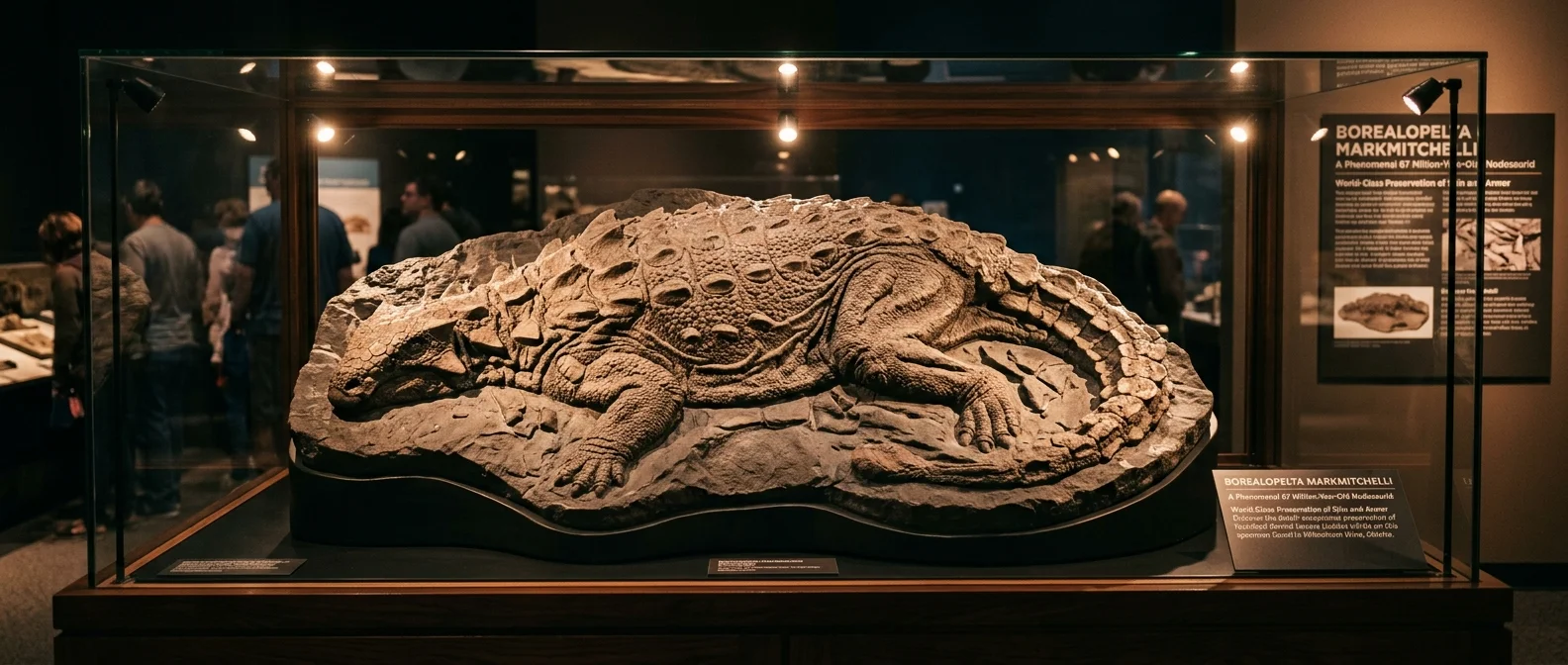
In March 2011, a heavy equipment operator at an oil sands mine in Alberta, Canada, struck something hard. It wasn't rock. It was a face — a 110-million-year-old dinosaur face so perfectly preserved it looked like it was sleeping. Borealopelta markmitchelli, a nodosaur, was seeing daylight again after eons in darkness.
📖 Read more: T-Rex: 10 Shocking Facts About the King of Dinosaurs
The Discovery: From Mine to Museum
Shawn Funk, a machine operator at the Suncor Millennium Mine in northern Alberta, wasn't a paleontologist. But that day, his excavator bucket revealed a shape impossible to ignore: a snout, entire rows of armor plates, even patches of skin — 110 million years after the animal's death. The discovery was transported in pieces to the Royal Tyrrell Museum in Drumheller, Alberta.
What followed was one of the most painstaking laboratory endeavors in paleontology history. Technician Mark Mitchell devoted over 7,000 hours — nearly 5.5 years — to meticulously revealing the specimen. Every millimeter had to be exposed carefully without destroying the skin, keratin, or pigment elements. The specimen was named Borealopelta markmitchelli — the second part honoring Mitchell, because without him, the dinosaur would have remained raw stone.
Transporting the specimen was a nightmare. The rock encasing the dinosaur weighed over 5,500 pounds. During transport, a piece broke — splitting the dinosaur into two large sections. But even within this mishap, preservation remained stunning. The front half — head, neck, torso, and front limbs — was nearly flawless. It was like looking at a living animal inside stone. Paleontologist Caleb Brown, who led the 2017 study in Current Biology, said it was “like looking at a statue” — but it wasn't artificial. It was 110 million years of nature.
Why This Fossil Is Different
Most dinosaurs reach us as broken bones. A complete skeleton is considered rare. But Borealopelta wasn't just complete — it was three-dimensionally preserved. Skin, the keratin covering armor plates, even subcutaneous fatty tissue were found in exceptional condition. This is the best-preserved armored dinosaur ever discovered.
Color-Camouflage: A Red Armor
The most striking revelation came from chemical analysis. Researchers examined melanosomes — microscopic structures that store pigments — and discovered that Borealopelta had a reddish-brown color on its back and sides, while its belly was lighter. This pattern is called countershading and is used today by many animals — from deer to penguins — as camouflage.
What Was Preserved
- Skin and epidermis
- Keratin armor plating
- Subcutaneous fatty tissue
- Pigments (melanosomes)
- Stomach contents
What Was Revealed
- Reddish-brown coloration
- Countershading (camouflage)
- Diet: ferns (last meal)
- Three-dimensional body shape
- Armor: complete system
Consider what this means: an 18-foot, 2,900-pound animal, covered with massive armor plates and spikes, still needed camouflage. This suggests the predators it faced were terrifying — likely large theropods hunting in Early Cretaceous forests. Even an armored tank needs to hide if its opponents are big enough.
Countershading works through optical illusion: dark color on the back counteracts sunlight brightness, while the light-colored belly counteracts shadow. The result is that the animal appears flat, without depth — making it difficult for predators to calculate distance and size. In modern animals, this pattern is common in small prey. The fact that a 2,900-pound armored colossus needed it shows how threatening the Early Cretaceous environment was.
📖 Read more: Titanoboa: The 50-Foot Snake That Ruled Ancient Earth
The Last Meal
In a 2020 study published in Royal Society Open Science, researchers analyzed stomach contents — yes, even stomach contents were preserved. Borealopelta's last meal consisted mainly of ferns, with charcoal among the plant remains. This suggests it had recently browsed in a burned area — perhaps after a natural fire that exposed tender new growth.
This is a window into life, not just anatomy. Borealopelta fed on very specific food — it wasn't an indiscriminate herbivore. It selected ferns, probably for their nutritional value, and followed landscape changes — going where nature was regenerating after destruction. This discovery was the first time an armored dinosaur's diet was precisely determined — an achievement possible only because of the unique preservation.
Nodosaurs: Armored Without Clubs
Borealopelta belongs to the nodosaurs — a subgroup of ankylosaurs. According to Encyclopaedia Britannica, the earliest ankylosaurs, known as nodosaurs, “lacked tail clubs and had quite different armor patterns” compared to later ankylosaurs. Instead of a clubbed tail, nodosaurs relied exclusively on their passive armor — a mosaic of small and large osteoderms that completely covered back and sides.
The Armor Up Close
Thanks to Borealopelta, we could study a nodosaur's armor in real three-dimensional space for the first time — not as detached pieces, but as an integrated system. Each osteoderm was covered with keratin — the same material that makes up nails and horns. This means the actual armor sizes were significantly larger than what bare bones show. Two large spiky horns protruded from the shoulders — like javelins on a living wall.
The position of each plate was visible. This allowed researchers to do something unprecedented: recreate the animal's external form without guesswork. Borealopelta looked like a low, wide armored vehicle — heavy, slow, and practically impenetrable from above. Only the belly remained vulnerable, something typical in several armored dinosaurs.
What 110-Million-Year-Old Skin Tells Us
Alberta's mummified dinosaur isn't just an impressive museum exhibit — though it's undoubtedly one of the most impressive in the world, currently displayed at the Royal Tyrrell Museum. It's a record of actual life. It tells us dinosaurs had color — and strategic color at that. It tells us even the most armored animals needed camouflage. It tells us what they ate and where they went for food.
Every other dinosaur fossil gives us skeleton and imagination. Borealopelta gives us flesh, color, and stomach. And this fundamentally changes how we understand the world 110 million years ago — because now we're not imagining. We're seeing. And what we see is an animal that, despite its heavy armor, lived in a world so threatening it needed color to hide.