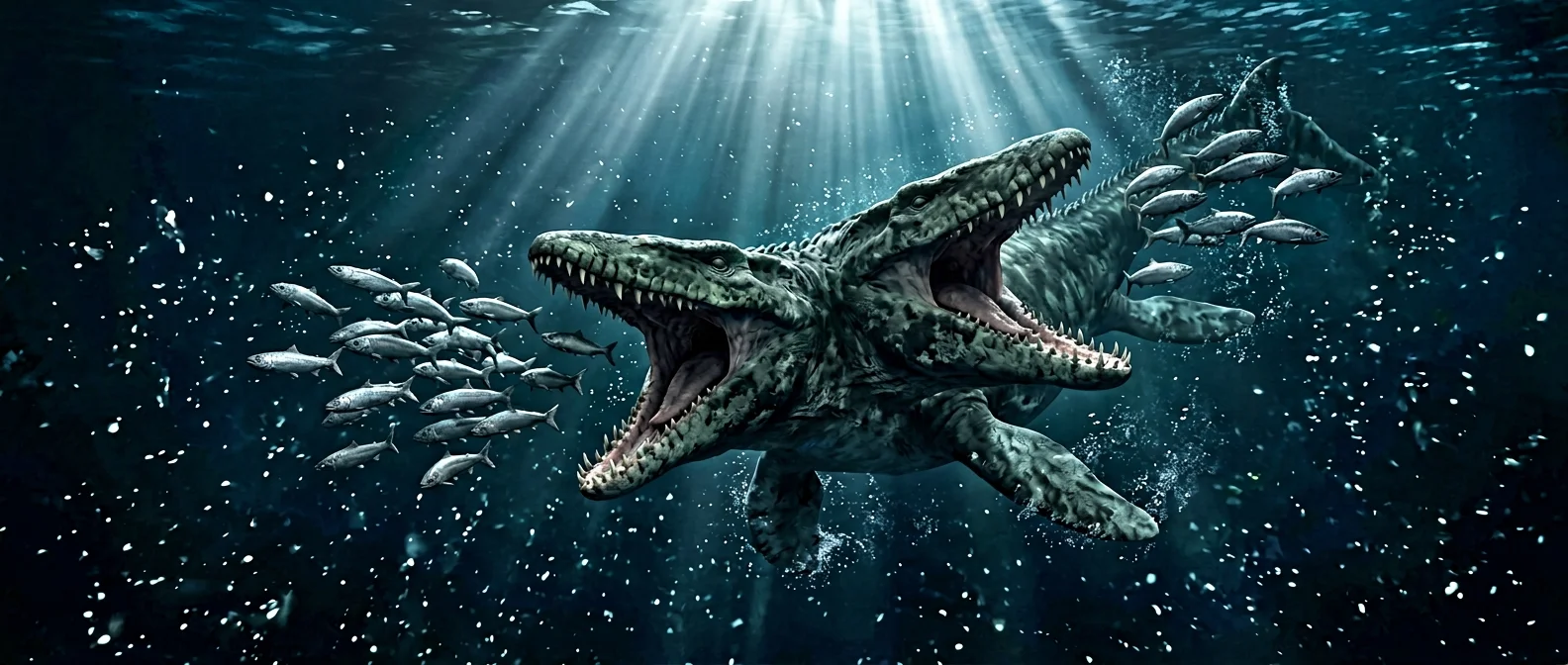
You probably know it from Jurassic World — that jaw-dropping moment when a massive sea creature rockets from the water and swallows an entire pterosaur whole. Great cinema. But the real Mosasaurus is so different — and so much more fascinating — that it's worth separating Hollywood myth from scientific fact.
📖 Read more: Pterosaurs: Ancient Sky Kings That Ruled Before Birds
Myth #1: Mosasaurus Was a Dinosaur
Let's start with the biggest misconception: Mosasaurus wasn't a dinosaur. It was a marine reptile — specifically a squamate, meaning it belonged to the same group as lizards and snakes. When the first fossil was discovered in a limestone quarry near Maastricht, Netherlands around 1766, the word “dinosaur” wouldn't be coined for another 80 years.
That discovery sparked a fascinating story. A better-preserved skull was found a decade later, triggering heated debate: fish? Crocodile? Whale? Adriaan Camper was first to recognize similarities with modern reptiles, and the legendary French naturalist Georges Cuvier confirmed it was a giant lizard. In 1822, the animal was named Mosasaurus — “lizard of the Meuse River.” But there's something even more significant: Cuvier used this exact fossil to develop his theory of extinction — a revolutionary idea for the time, that species could disappear forever.
Myth #2: It Was Movie-Monster Huge
In Jurassic World, Mosasaurus appears blue whale-sized — roughly 80-100 feet long. Reality is more modest, though still impressive. The largest known Mosasaurus hoffmannii is estimated at 36-59 feet long, weighing around 10 tons. The problem is we mostly find skulls (up to 6 feet long) and must estimate the rest — leaving room for uncertainty.
Still, while not a blue whale, Mosasaurus was undeniably a giant. Its vertebral column contained over 100 vertebrae, creating a serpentine, flexible body. The limbs had evolved into flippers — with shorter bones and more digits than their terrestrial ancestors. The tail ended in a slight vertical lobe (like a dolphin), providing powerful propulsion. It was, essentially, a death factory optimized for the ocean.
Five recognized Mosasaurus species existed, with M. hoffmannii by far the largest. Other species — M. missouriensis, M. beaugei — were smaller, around 26-33 feet. Many mosasaurs (as a group) were no larger than modern dolphins. “The real Mosasaurus certainly couldn't swallow a T. rex-sized animal in one bite,” notes Dr. Marc Jones, curator of fossil reptiles at London's Natural History Museum.
Jurassic World
- Blue whale size
- Smooth skin
- Swims like an eel
- Swallows T. rex-sized prey
Real Mosasaurus
- 36-59 feet long
- Snake-like scales
- Tail fin (like dolphin)
- Ate fish, squid, sharks
The Real Death Machine
If the movie exaggerates size, it underplays something far more terrifying: jaw mechanics. Mosasaurus had an articulated jaw with a ligament in the middle — exactly like modern snakes. This meant it could open its mouth unusually wide and expand the lateral sections to swallow prey larger than seemingly possible. The palate featured a second row of teeth — pterygoid teeth — that held prey steady while swallowing. “We know they could eat plesiosaurs and other mosasaurs,” explains Marc Jones.
📖 Read more: Stegosaurus Back Plates: Defense or Display? Mystery Solved
Mosasaurus didn't swim like an eel, as the movie shows. Preserved tails from related species reveal it had a tail fin with a large vertical lobe — making it far more efficient in water. Its body was covered with snake-like scales that reduced drag — something the movie completely ignores. Remarkably, analysis of a related Tylosaurus fossil revealed mosasaurs had black skin — perfect camouflage for deep-water hunters.
Rulers Until the End
Mosasaurs evolved around 94 million years ago, when Earth was 9-18°F warmer than today. Underwater volcanoes released massive amounts of CO2, sea levels were 720 feet higher, and many marine species — ichthyosaurs, plesiosaurs — went extinct. The ecological void was enormous, and mosasaurs filled it.
Some mosasaurs were warm-blooded, unlike most reptiles — allowing them to live in both warm tropical waters and cold polar oceans. They gave birth to live young in the open sea — no need for land to reproduce. By the end of the Cretaceous, they were thriving more than ever: rocks in Morocco from the final million years before extinction contain 16 different mosasaur species — an incredibly rich ecosystem of apex predators.
They didn't go extinct from decline. They vanished because an asteroid struck Earth 66 million years ago. Dust blocked the sun, photosynthetic algae collapsed, the food chain disintegrated from bottom to top — and mosasaurs, as apex predators, were most vulnerable.
Their diversity was stunning. Globidens had rounded teeth specifically for crushing shells and ammonites. Xenodens had saw-like teeth designed to slice chunks of flesh. Tylosaurus featured a bony snout it likely used to ram and stun prey — like modern dolphins. This diversity allowed many different species to coexist without direct competition, supporting rich and complex ecosystems. There was even a freshwater mosasaur — Pannoniasaurus in modern Hungary — with a crocodile-like skull that hunted in shallow waters.
"Mosasaurs have very characteristic lizard skulls — with a mobile quadrate bone, just like snakes — that allows different parts of the skull to move independently, swallowing larger prey."— Dr. Marc Jones, curator of fossil reptiles, Natural History Museum London
A Fossil That Changed Science
Mosasaurus's legacy extends beyond paleontology. It was one of the first extinct animals ever recognized — and studying it inspired Cuvier's theories of extinction, which later fed into natural selection theory. Mosasaur fossils have been found everywhere — from Canada to islands near Antarctica, from Kansas (once submerged under the Western Interior Seaway) to Britain. They're creatures that remind us the oceans once belonged to something far more terrifying than any modern marine predator.
Mosasaurs evolved from aigialosaurs — small reptiles that lived on land but could swim. Gradually, their limbs became flippers, their tails lengthened, and the connection to dry land was permanently severed. 94 million years ago, they were exclusively marine. 66 million years ago, they were the apex predators of every ocean. Then, in a geological instant, they vanished — along with two-thirds of all life on Earth.