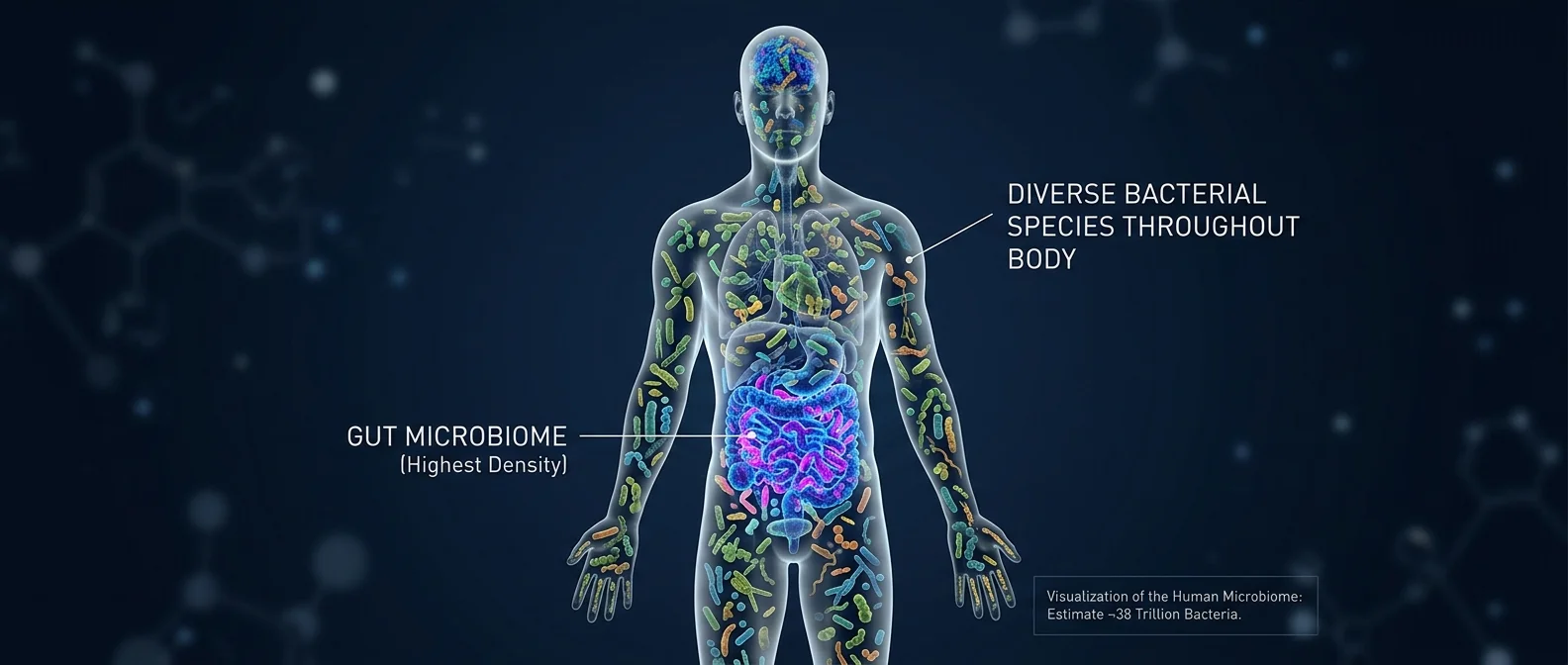
The cells that make up “you” aren't even the majority. For every human cell in your body, there's at least one bacterium — together 38 trillion microorganisms, with total genetic material 150 times larger than the human genome. Consider this: 22,000 human genes versus 3.3 million microbial genes — 99% of the genetic information in your body isn't yours. Every adult hosts 500-1,000 different bacterial species, and no two people's microbiomes are identical — it's more unique and complex than your fingerprints. This vast ecosystem isn't just “germs” — it's a vital organ that controls digestion, immunity, mood, even your food choices.
📖 Read more: How Many Creatures Live on You Right Now? The Answer Shocks
The 10:1 Myth and Reality
For decades, biology textbooks claimed bacteria outnumber human cells 10:1. This number came from a rough estimate by Thomas Luckey in 1972 — who essentially multiplied the number of bacteria in one gram of intestinal content (10¹¹) by the volume of the gut — without accounting for the fact that bacterial density varies enormously from the stomach (minimal, due to HCl) to the large intestine (extremely dense). The Sender team at the Weizmann Institute recalculated in 2016, using actual data from MRI scans, biopsies, and modern 16S rRNA sequencing techniques. The result: 3.8 × 10¹³ bacteria versus 3.0 × 10¹³ human cells — a ratio of roughly 1.3:1, not 10:1. The number fluctuates significantly: after a large meal it increases, after defecation it can drop by 30%. The majority (99%) lives in the large intestine — a warm, anaerobic environment with pH 5.5-7 and steady temperature of 37°C.
Digestion: The Bacteria That Eat First
Intestinal microorganisms digest what you can't. Plant fibers — cellulose, inulin, resistant starch — aren't broken down by human digestive enzymes (the human genome encodes only 17 carbohydrate-digesting enzymes, while the microbiome provides over 60,000). Bacteria of the genera Bacteroides and Prevotella ferment them, producing short-chain fatty acids (SCFAs): butyric, propionic, acetic. Butyric acid is the main energy source for colonocytes (large intestine cells) — without it, the intestinal wall weakens and allows pathogen penetration ("leaky gut"). Propionic acid travels to the liver, regulating gluconeogenesis. Bacteria also synthesize vitamins B12, K2, thiamine, and folic acid — substances the body can't produce alone. SCFAs are estimated to provide 5-10% of daily energy intake — the microbiome literally feeds you, protects you, and biochemically supplements you.

The Gut-Brain Axis
Bacteria “talk” to your brain through three pathways: the vagus nerve (100,000 nerve fibers directly connecting gut-brain), through immunological mediators (cytokines that cross the blood-brain barrier), and through neurotransmitters produced by the bacteria themselves. 95% of serotonin — the “happiness molecule” — is produced in the gut, mainly by enterochromaffin cells regulated by Clostridium and Enterococcus. Bacteria also produce GABA (the inhibitory neurotransmitter targeted by anti-anxiety medications), dopamine, and acetylcholine. Studies in germ-free mice (without microbiome) show increased anxiety, reduced sociability, and excessive stress response — symptoms that reverse with microbiome restoration. In humans, preliminary research links dysbiotic microbiomes to depression, autism, and even Parkinson's.
📖 Read more: White Blood Cells in Action: Your Body's Microscopic Army
Immunity: The Hidden Training
70-80% of the immune system is located in the gut (GALT — Gut-Associated Lymphoid Tissue), including Peyer's patches, mesenteric lymph nodes, and billions of IgA-producing plasma cells in the mucosa. Bacteria train T-cells to distinguish “friends” from foes. Bacteroides fragilis produces polysaccharide A (PSA) that activates regulatory T-cells (Tregs) — cells that suppress excessive immune responses and prevent autoimmunity. Faecalibacterium prausnitzii, one of the most abundant bacteria in the healthy gut, produces anti-inflammatory substances — its reduction is a biomarker for Crohn's disease. In countries with high hygiene, microbial diversity decreases dramatically — and simultaneously allergies, asthma, Crohn's, and celiac disease skyrocket. David Strachan's “hygiene hypothesis” (1989) evolved into the "old friends hypothesis": eliminating microorganisms that co-evolved with us leaves the immune system without proper calibration.

Microbiome and Obesity
In 2006, Jeffrey Gordon's team at Washington University revealed something stunning: they transplanted intestinal bacteria from obese mice into lean germ-free mice — and the lean mice gained weight, eating exactly the same food. The reason? “Obese” bacteria extract more energy from the same food — increasing the Firmicutes/Bacteroidetes ratio. The experiment was repeated with human microbiomes: bacteria from obese twins made mice gain weight, while bacteria from lean twins didn't. The same principle applies to humans: diets rich in sugar and saturated fats favor Firmicutes, while plant fibers favor Bacteroidetes. The LifeLines-DEEP study (Zhernakova, 2016) in 1,135 Dutch participants showed that 126 factors (diet, medications, lifestyle) affect microbiome composition — significantly more than genetics. And it's not just diet: PPIs (proton pump inhibitors) and metformin dramatically alter the microbiome.
📖 Read more: Electric Eel Delivers 860 Volts That Can Kill Alligators
Antibiotics: A Nuclear Bomb for the Microbiome
One course of broad-spectrum antibiotics (ciprofloxacin, amoxicillin, clindamycin) can eliminate 30-50% of intestinal species in days — some never return. The destruction isn't random: anaerobic bacteria that produce butyric acid (like Eubacterium and Roseburia) are disproportionately affected, leaving “gaps” filled by opportunistic pathogens. Recovery takes 3-6 months, but full restoration may never occur — studies show differences even 2 years later. Antibiotic use in childhood (before age 2) correlates with increased risk of obesity, allergies, and autoimmune diseases later in life — because the immune system is trained during the first 1,000 days of life and antibiotics disrupt this critical period. In Europe, antibiotic consumption decreased 15% in the 2010-2020 decade, but in South Asia it increased 60%. Clostridioides difficile — an opportunistic pathogen normally kept in check by competition — explodes after antibiotics, causing severe colitis that kills 29,000 Americans annually. This exact devastation led to the development of the most radical therapy in modern gastroenterology: fecal microbiota transplantation.
Fecal Microbiota Transplantation (FMT): The Radical Therapy
Fecal Microbiota Transplantation sounds shocking — but it saves lives. Feces from healthy donors are processed, filtered, and administered via colonoscopy, nasogastric tube, or capsule to patients with recurrent C. difficile infection. The effectiveness exceeds 90% — better than any antibiotic. Donors are rigorously screened: blood, stool, antibiotic history, BMI, mental health — only 3% of candidates are accepted. In 2022, the FDA approved Rebyota (fecal microbiota spores) as the first approved microbiome therapy, and in 2023 Vowst (SER-109), the first oral capsule. Research trials are examining FMT for Crohn's disease, ulcerative colitis, autism, even Parkinson's — the idea that “therapy” lies in someone else's feces is radically changing pharmacology.
How to Care for Your 38 Trillion
Diversity is key — not the quantity of a specific strain. Studies show that people who eat 30+ different plant foods per week (American Gut Project) have significantly richer microbiomes than those eating fewer than 10. Fermented foods — yogurt, kefir, sauerkraut, kimchi, kombucha — introduce live bacteria. A Stanford study (Sonnenburg, 2021) showed that 10 weeks of fermented foods increased diversity and reduced 19 inflammatory markers, while plant fibers alone didn't achieve the same result. Prebiotics (inulin from garlic, onions, artichokes, bananas) feed beneficial strains. The most harmful factors: unnecessary antibiotic use, excessive consumption of sugar and processed foods, chronic stress (which through cortisol changes microbiome composition), and lack of sleep. And birth matters: babies born vaginally acquire the mother's microbiome (vaginal + fecal), while C-section babies acquire skin/hospital bacteria — a difference lasting at least 6 months. The microbiome isn't something you “have” — it's something you “cultivate” every day, with every meal.
Sources:
- Sender, R., Fuchs, S., & Milo, R. (2016). “Revised estimates for the number of human and bacteria cells in the body.” Cell, 164(3), 337-340. DOI: 10.1016/j.cell.2016.01.013
- Zhernakova, A., Kurilshikov, A., et al. (2016). "Population-based metagenomics analysis reveals markers for gut microbiome composition and diversity." Science, 352(6285), 565-569. DOI: 10.1126/science.aad3369