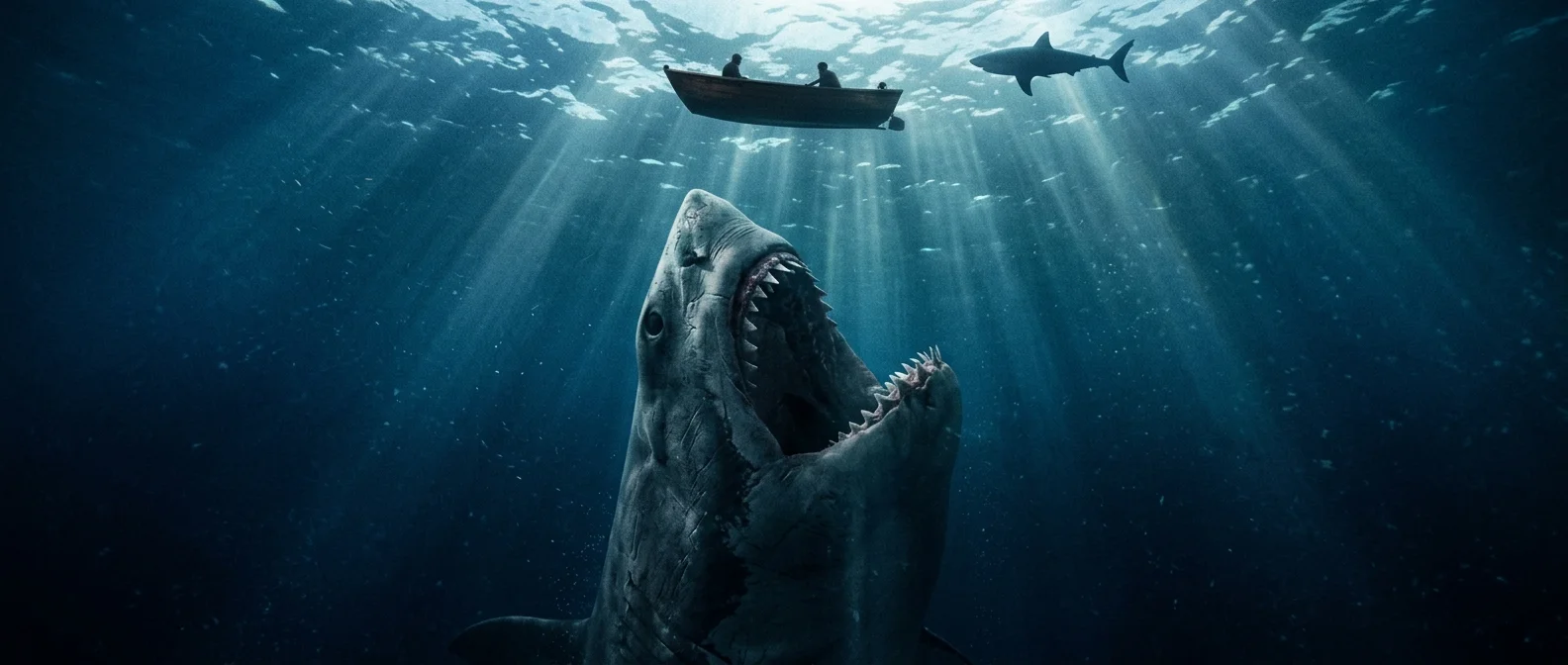
Picture walking along a South Carolina beach and finding a tooth the size of your hand. Glossy, triangular, with serrated edges — a remnant from a creature that ruled the oceans for millions of years. This isn't movie fiction. Such discoveries happen regularly because Megalodon — the largest shark that ever lived — left behind millions of teeth scattered across every continent except Antarctica.
A Name Written in Teeth
Megalodon's very name reveals what we know best about it. The word megalodon comes from ancient Greek — “megas” and “odous” — literally meaning “big tooth.” With teeth reaching 7 inches in height and jaws measuring 9 × 11 feet, this characterization couldn't be more accurate.
Its full scientific name is Otodus megalodon and it belongs to the Otodontidae family of the order Lamniformes — the mackerel sharks. Its jaws contained 276 teeth arranged in multiple rows, and like all sharks, it continuously replaced them. Scientists estimate that a single Megalodon could lose and regenerate up to 40,000 teeth during its lifetime — explaining why its fossilized teeth are found on beaches worldwide.
Power That Crushes Imagination
Megalodon's bite was the most powerful ever developed by a living organism. With a bite force between 108,514 and 182,201 Newtons, it could crush almost anything in its path. To understand the scale: human bite force reaches 1,317 N, while the great white shark — the most powerful contemporary ocean predator — touches 18,216 N. Megalodon was ten times stronger.
The Megalodon You Didn't Expect
For decades, science imagined Megalodon as a supersized great white shark — thick, bulky, terrifyingly broad-bodied. This image dominated museums, movies, and documentaries. The Shimada et al. (2025) study in the scientific journal Palaeontologia Electronica revealed a completely different reality.
Analyzing a vertebral column of 141 vertebrae from the Belgian Miocene (specimen IRSNB P 9893), researchers found that just the animal's torso measured 36.4 feet — without counting head and tail. Using body proportions from 165 shark species, instead of relying exclusively on the great white, they calculated that this particular individual reached 53.8 feet total length. An even larger vertebral specimen from Denmark, with a 9-inch diameter, indicates a maximum length of 80 feet.
Old Image (pre-2025)
- Bulky body like great white
- Maximum length ~50-65 ft
- Weight based on wrong model
- Short snout, broad body
New Image (2025 study)
- Slender, hydrodynamic body
- Maximum length ~80 ft
- Weight up to 94 tons
- Long pectoral fins
The reason is purely physical: a great white-type body at 80 feet would create enormous hydrodynamic drag, making efficient swimming impossible. Megalodon likely resembled the modern lemon shark more — slender, with elongated pectoral fins and a flattened jaw. Its cruising speed is estimated at 2.2 mph, comparable to the whale shark.
Dominant Predator of Neogene Oceans
At the top of the food chain, Megalodon hunted whales, large fish, sea turtles, and other sharks. Fossilized whale bones bear its tooth marks, while broken tooth tips have been found embedded in prey bones — silent witnesses to ancient hunts. Its jaws, measuring 9 feet high and 11 feet wide, could accommodate two adult humans side by side. A 2022 zinc isotope study confirmed it occupied an extremely high trophic level — higher even than the modern great white.
Birth of Giants
Megalodon was born already massive. Newborns reached 12.7 feet — larger than most adult sharks today. This extraordinary birth size is likely explained by oophagy: embryos fed on unfertilized eggs inside the womb, a strategy still used by some modern mackerel sharks.
Analysis of growth rings in the Belgian specimen's vertebrae revealed 46 annual rings — at least 46 years old at death. The largest individuals (80 ft) likely exceeded 80 years. The growth rate was extremely slow — a characteristic that made it vulnerable to environmental changes.
Dynasty of 100 Million Years
Megalodon was the culmination of a lineage of marine giants. The earliest known ancestor, Cretalamna, appeared 105 million years ago during the Cretaceous period. This was followed by Otodus obliquus 55 million years ago, reaching 33 feet, before evolution led to the colossal Otodus megalodon.
A crucial distinction: the great white shark (Carcharodon carcharias) is not a descendant of Megalodon, despite popular misconception. The two species coexisted in the same oceans as competitors, with overlapping dietary habits — a fact that likely contributed to the giant's demise.
The Final Dive
Megalodon disappeared approximately 3.6 million years ago, at the end of the Pliocene. It wasn't killed by a single event but by a combination blow: global cooling reduced ocean temperatures, destroying the tropical habitats it used as nurseries for its young. Its prey — whales and marine mammals — adapted to colder waters and migrated to polar zones. Falling sea levels destroyed coastal habitats, while competition with the great white intensified.
Interesting finding: a 2022 study showed that Megalodon grew larger in colder waters, following Bergmann's rule. However, its extinction is definitive.
"The results indicate that Otodus megalodon may indeed have had a more slender body than previous reconstructions — a finding with significant implications for understanding its biology, ecology, and ultimately its extinction."— Kenshu Shimada, DePaul University, Palaeontologia Electronica (2025)
A Fossil That Changes Shape
Shark skeletons are made of cartilage, not bone — material that rarely fossilizes. Almost everything we know about Megalodon comes from teeth and rare vertebral finds the size of dinner plates. Only one skull has been discovered, in Peru. The absence of complete skeletons means each new find can overturn previous theories — exactly as the 2025 study overturned decades of incorrect reconstructions.
At 80 feet, Megalodon was four times larger than the great white, bigger even than the whale shark. With weight equivalent to an 82-foot blue whale, it was one of the largest predatory animals that ever existed on this planet. And although it disappeared millions of years ago, its teeth continue washing up on shores — reminding us how small humans are compared to Earth's true rulers.