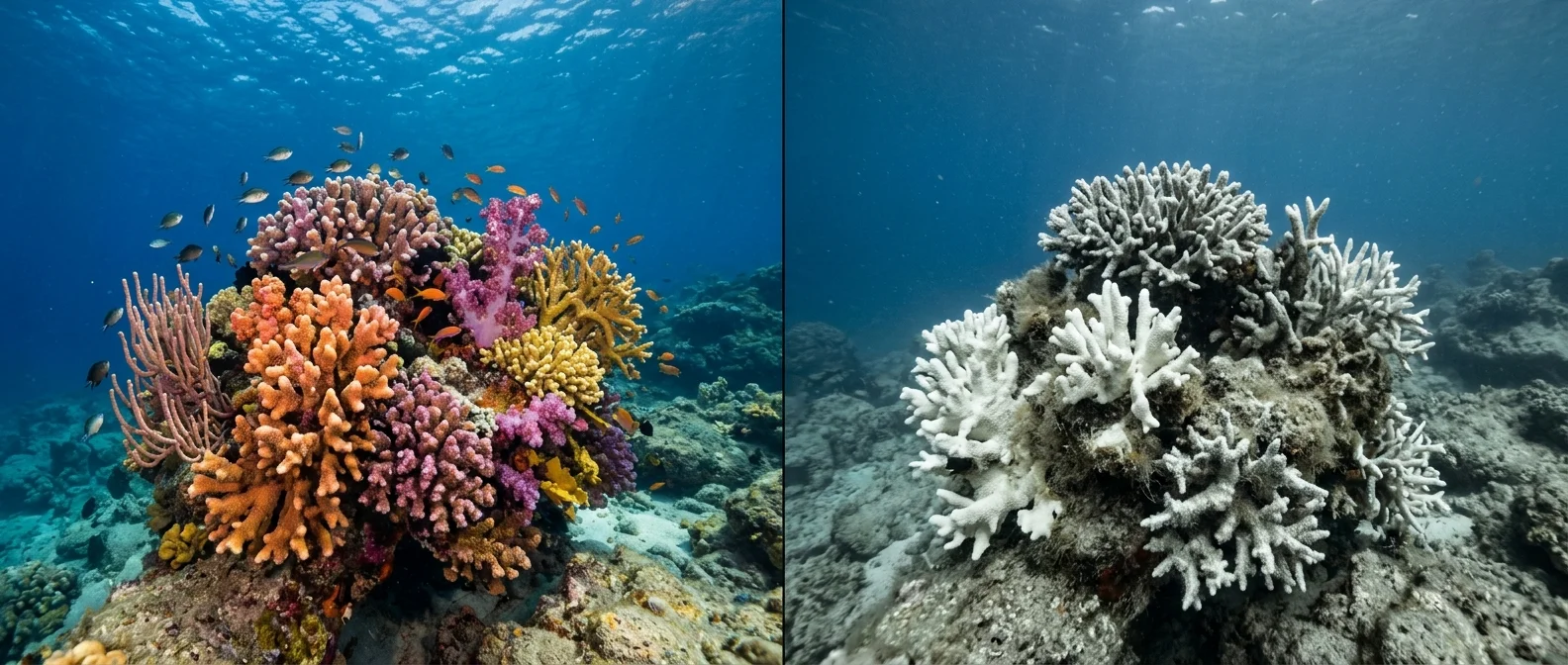
A diver drops into the waters near Marseille and sees something wrong. Gorgonians that blazed red and orange last summer now stand white as bone — skeletal, ghostlike. The Mediterranean, the sea we thought we knew, is dying beneath the surface. Mediterranean corals are bleaching, Posidonia meadows are retreating, sponges are vanishing. The cause isn't mysterious — it's temperature. The Mediterranean is warming 20% faster than the global average and the results are already visible on the seafloor. You don't need to be a diver to understand this. Fishermen in Crete, Sicily, Provence see the change daily: fewer fish, alien species, empty bottoms where life once thrived.
📖 Read more: Nautilus: Living Fossil 500 Million Years Old
📖 Read more: Marine Caves: Life Thrives in Earth's Sunless Underworld
The Mediterranean Boils: Record Temperatures
Summer 2023 shattered every Mediterranean temperature record, hitting 28.7°C at the surface — nearly tropical levels. But the problem isn't just the peak: it's the duration. Marine heatwaves now last weeks instead of days, and the heat penetrates 40-50 meters deep where sensitive species live. The Mediterranean is a closed basin — water doesn't refresh easily. Every temperature record gets "locked in," creating suffocating conditions for bottom-dwelling organisms. Scientists call them "marine heatwaves" and they've become 5 times more frequent since the 1980s. Every summer is now a threat — not a relief. The marine heatwaves of 2003, 2006, 2022 and 2023 caused mass mortalities across the Mediterranean — each time reaching deeper waters and affecting more species. The problem isn't just heat — it's the frequency that leaves no time for recovery. Older generations remember seafloors teeming with life — young divers will never see what was lost, unless something changes drastically.
Why They Bleach: The Biology of Coral Death
Corals don't bleach from old age — they bleach from stress. Inside their tissues live microscopic algae, zooxanthellae, that give them color and food through photosynthesis. When temperature rises above normal for extended periods, corals expel the zooxanthellae — losing their color and their primary energy source. If temperature drops quickly, they can recover. If not, they die. In the Mediterranean, thermal cycles are becoming increasingly frequent, leaving minimal recovery time. Zooxanthellae are plant cells that provide up to 90% of the coral's energy — without them, the coral essentially starves. Sometimes, the coral can reabsorb the algae if conditions improve within 2-4 weeks. But modern marine heatwaves often last 6-8 weeks — too late for most corals.

📖 Read more: World's Largest Coralline Reef Discovered in Mediterranean
Gorgonians: The Red Corals Are Dying
Gorgonians (Paramuricea clavata and Corallium rubrum) are the Mediterranean's iconic corals — slow-growing, long-lived, critical for biodiversity. A study in Global Change Biology (2022) recorded mass gorgonian mortality in the northwestern Mediterranean after the 2022 marine heatwave. In some locations, over 80% of colonies showed tissue necrosis. Red coral grows just millimeters per year — a 50-year-old colony dies in one summer. In the Greek Aegean, gorgonians at 30-40 meter depths now face temperatures that existed only at the surface 30 years ago. The Eastern Mediterranean warms faster than the Western, and the Levantine Sea is already at the tolerance limit for many species.
📖 Read more: 2,000-Year-Old Seed Sprouted: Palm from Herod's Era
Food Chain Under Threat
Corals aren't just decorative — they're homes. Around them live fish, lobsters, shrimp, sea urchins, polychaete worms. Coral destruction means disappearing refuges, reduced breeding grounds and collapse of local food webs. Posidonia oceanica, the seagrass meadows that form the Mediterranean's "lungs," are also under pressure. Overheating combined with pollution creates a "double hit" that Mediterranean ecosystems can't withstand. Studies show that 34% of Posidonia meadows in the Mediterranean have retreated, according to 2023 research. Every square meter of Posidonia lost means less oxygen in the sea and less CO₂ sequestration.
📖 Read more: Why Orcas Are Attacking Boats in Europe: The 2026 Mystery
Greece: Danger in the Aegean
Greece, with over 16,000 kilometers of coastline, hosts some of the most important Mediterranean coral ecosystems. Gorgonians in the Cyclades, red corals off Skiathos, Posidonia throughout the Aegean. The temperature of Greek seafloors has risen an average of 1.5°C over the past three decades. Fishermen report species that existed only in Libya 20 years ago — now found off Crete. This "tropicalization" is radically changing the composition of Greek marine life. The pufferfish (Lagocephalus sceleratus), a poisonous tropical fish, has established itself in the Aegean, and lionfish (Pterois miles) have already been recorded in Greek waters. The invasion of alien species through the Suez Canal is accelerated by warming — hot waters allow tropical species to survive where they previously couldn't. The consequences for Greece's fishing sector are already felt — but the worst hasn't come yet.

📖 Read more: Marine Caves: A World Without Sun
Restoration: Hope or Illusion?
Coral restoration programs exist, but the scale isn't enough. Researchers in France and Italy are testing gorgonian transplantation to deeper, cooler waters. Others experiment with "heat-resistant" zooxanthellae strains. But no program can replace what nature took thousands of years to build. Restoration without temperature reduction is like building a house on lava — the underlying problem doesn't disappear. In 2025, France's RESCAP program transplanted 300 gorgonian fragments to deeper waters — 70% survived, an encouraging but insufficient percentage. In Italy, the LIFE REWRITE program experiments with artificial substrates that favor gorgonian reestablishment on artificial reefs. But even the most successful programs are drops in the ocean without emission reductions.
📖 Read more: Why We Age: The Biology Behind Human Aging in 2026
Acidification: The Second Enemy
Beyond temperature, the Mediterranean faces acidification. Increased atmospheric CO₂ levels are absorbed by the sea, lowering pH. This makes it harder for corals to build calcium carbonate skeletons — essentially making them more fragile. The Mediterranean, as a closed basin, is particularly vulnerable to acidification because water renewal is slow. Studies near volcanic CO₂ vents (e.g., Ischia, Italy) show what the Mediterranean seafloor will look like in 50 years: no corals, no sea urchins, only algae. Scientists call it "ecosystem simplification": from complex, rich bottom to monotonous, poor desert. This isn't prediction — it's observation from existing locations. The volcanic CO₂ vents of Ischia are a natural laboratory for ocean futures — and the results are discouraging. The seafloor around them looks ruined, without structure, without diversity.
What We Can Do — Now
The Mediterranean doesn't just need research — it needs action. Global CO₂ emission reductions. Pollution limits from plastics, urban sewage and agricultural runoff. Creation of Marine Protected Areas (MPAs) with real enforcement, not just on paper. The Mediterranean has about 1,200 protected areas, but most lack practical protection measures. Today, only 8% of the Mediterranean is truly protected. The EU targets 30% by 2030 — an ambitious goal requiring political will. Every degree of temperature matters. Every coral saved means one less ecosystem lost. The Mediterranean fed us, cooled us, inspired us. Now it asks for help. And if it doesn't get it, it will fall silent forever — because dead seafloors make no noise. The Greek sea, the Italian Riviera, the French Côte d'Azur — spaces that define our civilization, risk becoming beautiful but empty. Warm but dead.
"The Mediterranean is a sea in crisis. If we don't act now, we'll inherit a colorless sea for our children."
— Joaquim Garrabou, marine ecology researcher, ICM-CSIC BarcelonaSources:
- Garrabou, J. et al. — "Marine heatwaves drive recurrent mass mortalities in the Mediterranean Sea", Global Change Biology, 2022
- Cerrano, C. et al. — "A catastrophic mass-mortality episode of gorgonians in the Ligurian Sea", Ecology Letters, 2000