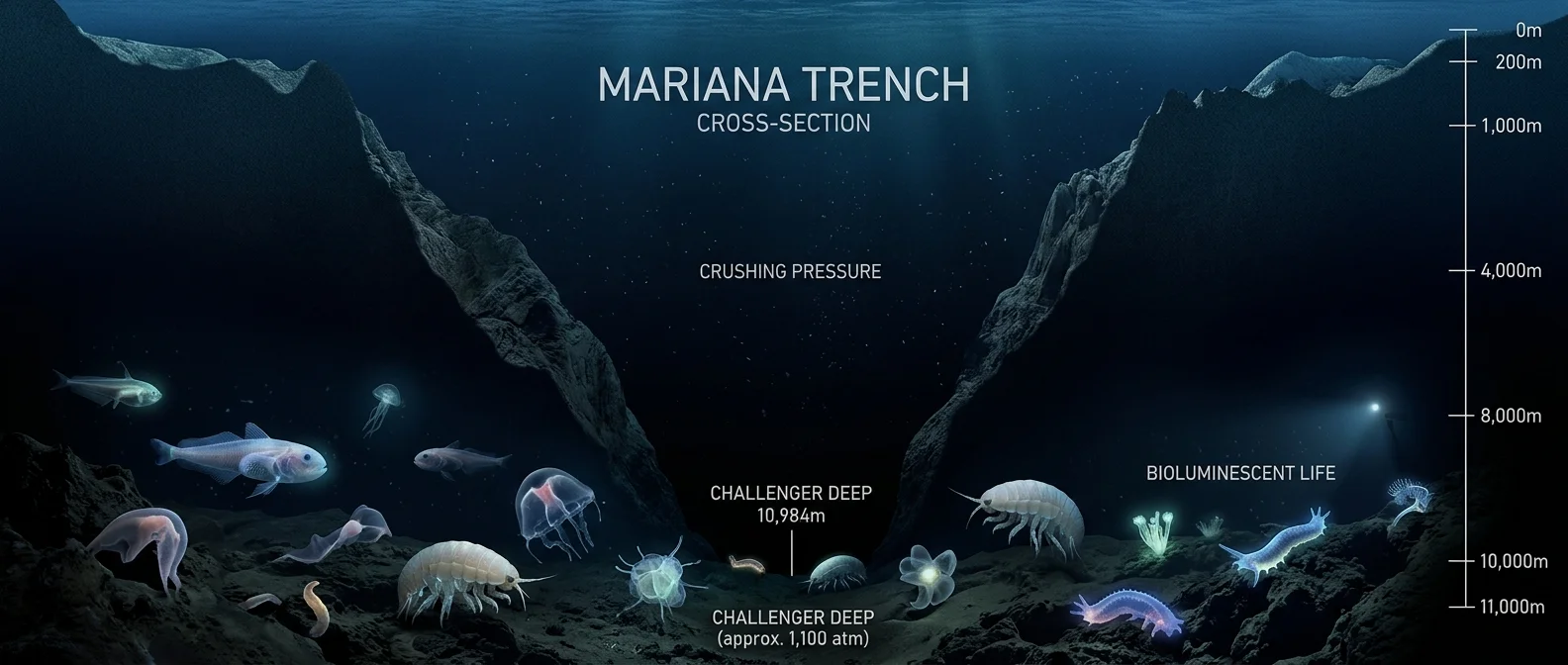
If you dropped Mount Everest into the Mariana Trench, its peak would still sit over a mile underwater. Down there, nearly seven miles below the surface, pressure reaches 1,100 times that at sea level — enough to crush anything we know. Yet something lives there. Many things, actually. And these creatures are rewriting everything we thought we knew about the limits of life.
📖 Read more: These Creatures Live 7 Miles Beneath the Ocean Surface
Challenger Deep: Earth's Ultimate Frontier
The Mariana Trench sits in the western Pacific Ocean, east of the Mariana Islands, stretching roughly 1,580 miles in length. Its deepest known point, called Challenger Deep, plunges 35,876 feet below the surface — according to 2010 measurements by NOAA. The trench formed from the collision of two tectonic plates: the Pacific Plate subducts beneath the smaller Mariana Plate in a process called subduction. This geological dance has continued for roughly 180 million years. Temperatures at the bottom hover between 34 and 39 degrees Fahrenheit, and darkness is absolute — no photon of sunlight penetrates beyond the first 3,300 feet. The first dive to Challenger Deep happened on January 23, 1960, when Jacques Piccard and Don Walsh descended in the bathyscaphe Trieste and spent just 20 minutes on the bottom before a cracked window forced them to surface.
1,100 Atmospheres: Pressure That Crushes Everything
At 35,800 feet, hydrostatic pressure reaches 110 megapascals — 1,100 times greater than at the surface. A metal soda can would implode in milliseconds. For organisms living there, this means every protein, every cell membrane, every enzyme must function under conditions that would disorganize the biochemistry of any surface organism. Deep-sea creatures have evolved unique biochemical adaptations: their cell membranes contain unusually high levels of unsaturated fatty acids that remain flexible under pressure. Instead of small amounts of trimethylamine-N-oxide (TMAO), their cells are literally packed with this molecule — it acts as a molecular protein stabilizer.

Amphipods: Giant “Insects” of the Deep
Amphipods are small crustaceans — relatives of shrimp — that at the surface rarely exceed a few millimeters. In the hadal zone of the Mariana Trench, they become giants. Species like Hirondellea gigas reach two inches long and are the most abundant multicellular animals at the deepest points. They feed on dead organic matter that falls like “marine snow” from upper layers — fish carcasses, phytoplankton particles, even pieces of wood. Analysis of their digestive system revealed a special enzyme, a cellulase, that allows them to break down plant fibers — something rare for marine arthropods and perhaps explains how they survive in an environment with such sparse food. Some deep-sea amphipods appear to withstand months without food, dramatically reducing their metabolic rate — a strategy resembling hibernation in slow motion.
Xenophyophores: Giant Single Cells in the Dark
Among the strangest creatures of the hadal depths are xenophyophores. These are single-celled organisms that reach sizes over four inches — the largest single cells on the planet. They construct external “shells” from sediment particles, sponge spicules, and even sand grains, gluing them together with biological cement. Each xenophyophore contains thousands of nuclei within a single cytoplasm. Their existence on the Mariana Trench floor was documented through the bathyscaphes Kaiko (Japan, 1995) and Nereus (Woods Hole, 2009). Scientists believe these creatures represent an extremely ancient evolutionary lineage that has thrived in extreme conditions for hundreds of millions of years. Despite their enormous size, xenophyophores have no nervous system, no muscle tissue — just a continuous flow of cytoplasm that slowly unfolds within their “shell,” absorbing nutrients from sediments.
Barophilic Bacteria: Life That Defies Physics
The most numerous creatures in the hadal zone aren't animals — they're microbes. Barophilic (or piezophilic) bacteria were discovered in Challenger Deep sediments during James Cameron's 2012 mission with the Deepsea Challenger submersible. These bacteria don't just tolerate pressure — they require it. At normal atmospheric pressure, they die. Their membranes contain unusual fatty acids, while their ribosomes have modified structures to synthesize proteins normally under extreme pressure. A paper in Nature Geoscience (Glud et al., 2013) showed that microbial activity on the trench floor was much higher than expected — sediments consumed oxygen at twice the rate of neighboring 20,000-foot depths.

The “Ghost” of the Deep: Fish at the Limits
The deepest fish ever recorded belongs to the genus Pseudoliparis — a snailfish spotted at 27,349 feet in the Izu-Ogasawara Trench in 2023. In the Mariana Trench, snailfish have been recorded at depths exceeding 26,000 feet. These creatures are nearly transparent — the absence of pigments saves energy. They lack swim bladders (air under this pressure is impossible) and their bones are barely calcified — soft as cartilage. Below about 27,000 feet, no fish can survive: theoretical calculations show that at this depth, pressure forces proteins to lose their structure even with maximum TMAO concentration. Beyond this biological barrier, only invertebrates and microbes dominate. These snailfish, despite their fragile appearance, are apex predators in their environment — feeding exclusively on amphipods, which they trap with reaction speeds remarkable for creatures living in such frigid waters.
Plastic at Earth's Deepest Point
In 2019, explorer Victor Vescovo descended to Challenger Deep in the DSV Limiting Factor and recorded something disheartening: a plastic bag and candy wrappers at 35,853 feet deep. Earlier, studies had already detected microplastics in bottom sediments and inside amphipod digestive systems. Research published in Nature Ecology & Evolution found detectable levels of PCBs (polychlorinated biphenyls) — industrial pollutants banned since the 1970s — in tissues of amphipods living in the trench. Pollution reaches even where no human lives. This isn't just an environmental problem — it's proof that human activity touches every corner of the planet. The fact that pollutants banned half a century ago still exist in the bodies of creatures at 36,000 feet deep shows how slowly damage heals — and how urgent it is to consider what we leave behind.
Why We Explore the Deep Instead of Just Space
The hadal zone — depths below 20,000 feet — represents about 1-2% of the ocean floor, but remains less mapped than the surface of Mars. Only three people have reached Challenger Deep: Jacques Piccard and Don Walsh in 1960 with Trieste, James Cameron in 2012, and Victor Vescovo in 2019. Studying these extreme ecosystems isn't just about biology — NASA actively studies hadal creatures because ice oceans on moons like Europa (Jupiter) and Enceladus (Saturn) might harbor similar life. If organisms thrive in Earth's most extreme conditions, then the limits of where life can exist in the universe are far broader than we imagined.
"We know more about the surface of the moon than we do about the bottom of our oceans."
— Robert Ballard, oceanographer, discoverer of the TitanicSources:
- Glud, R.N. et al. — "High rates of microbial carbon turnover in sediments in the deepest oceanic trench on Earth," Nature Geoscience, 2013
- Jamieson, A.J. et al. — “Bioaccumulation of persistent organic pollutants in the deepest ocean fauna,” Nature Ecology & Evolution, 2017