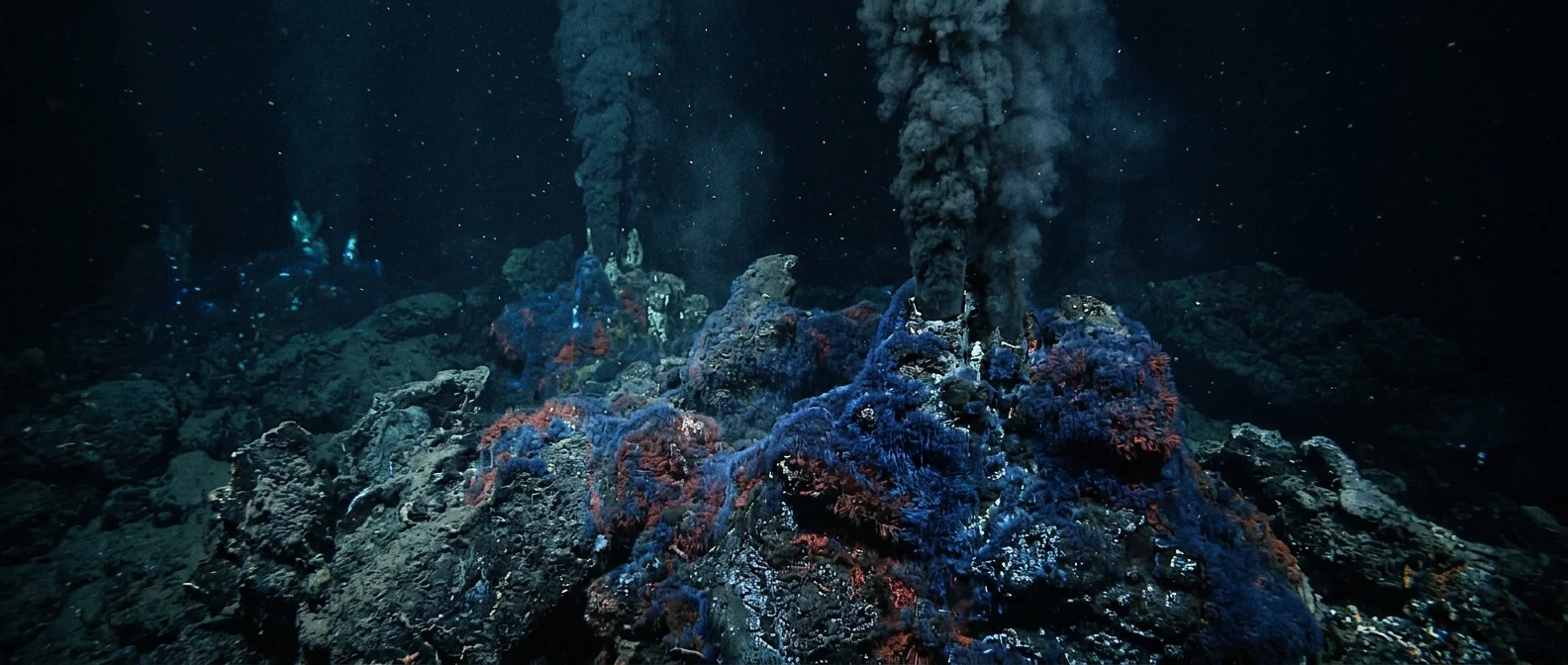
Drill deep enough and you expect to find only rock, heat, and darkness. But beneath your feet, four kilometers down through granite and basalt, in fractures filled with scalding water where temperatures reach 60°C and crushing pressure would kill any surface organism — conditions that should sterilize everything — something lives. Bacteria, ancient and resilient, that have never seen light, don't depend on the sun, know no seasons or days, and divide once every century. The deep biosphere isn't speculation — it's a reality that overturns everything we thought we knew about life's limits.
📖 Read more: 12-Meter Crystal Cave: Life Thrives in Extreme Heat
Discovery of the Underground World
Until the 1990s, science assumed life stopped a few meters below the surface. The first clues came from oil drilling and gold mines in South Africa, where researchers found bacteria at 2.8 kilometers depth. The surprise was twofold: not only did microbes exist, but they were alive, active, and had developed entirely unique metabolisms that didn't rely on photosynthesis — metabolisms that no one had imagined in theoretical biology.
Since then, every new borehole — whether in mines, oil wells, or scientific programs — reveals life even deeper. In 2018, an extensive analysis by the Deep Carbon Observatory calculated that the underground biosphere contains 15-23 billion tons of carbon in biomass — hundreds of times more than all of humanity. An invisible world beneath our feet, more populous than we ever imagined.
Life Without Sunlight
On the surface, nearly every ecosystem ultimately depends on the sun — plants photosynthesize, animals eat plants, decomposers recycle. But at 4 kilometers depth, not a single photon penetrates. The bacteria there feed through chemosynthesis — they extract energy from chemical reactions between rocks and water, mainly from oxidizing hydrogen and iron. They need no leaves, no chlorophyll — just rock and water.
Some use an even more exotic pathway: radiolysis. Natural radioactivity in rocks (uranium, thorium, potassium-40) breaks water molecules, producing hydrogen that becomes fuel for these microbes. The energy doesn't come from the sun — it comes from nuclear decay inside the rock. This is life literally powered by nuclear energy — the most exotic energy pathway we know in biology.

📖 Read more: World's Largest Spider Web: 111,000 Spiders Share One Colony
Life in Slow Motion
Forget everything you know about bacteria multiplying every 20 minutes. In the deep biosphere, metabolism is extremely slow — some organisms divide once every decade or even every century. The energy they have barely suffices for maintaining basic cellular functions: DNA repair, membrane maintenance, replacing damaged proteins. They don't reproduce to spread — they reproduce to avoid extinction.
This slow-motion life means some of these bacteria could be thousands or millions of years old. They don't die, they don't grow quickly — they simply exist, in a state between life and suspension. Researchers found living bacteria in seafloor sediments 100 million years old — and revived them in the lab, proving that life can endure across timescales that exceed every previous estimate.
The Chemistry of Rock
Serpentinization — the chemical reaction between water and iron-magnesium rocks — produces hydrogen and methane abiotically, meaning without any biological involvement. These gases become food for bacteria. At Canada's Kidd Creek mine, researchers found water trapped in rock for 1.5 billion years — the oldest known water on the planet — along with evidence of microbial activity that continued even under conditions no one expected.
The reaction of water with basaltic rocks also produces sulfate ions, iron, and manganese — a rich menu for organisms that evolved without ever needing the sun. Every crack in the rock is a potential ecosystem, every drop of water circulating through the lithosphere brings nutrients to communities that have waited patiently for centuries. Cell density is very low — perhaps 100-10,000 cells per gram of rock — but the total volume is enormous.
📖 Read more: Hidden World of Life Beneath Antarctic Ice
Who Are These Organisms
The deep biosphere consists not only of bacteria — it includes archaea, a separate domain of life. Many of these archaea belong to groups we've never cultured in the lab — we know them only from DNA sequences extracted directly from rocks, without seeing or studying them alive. Metagenomic analysis revealed that diversity down there is stunning — with thousands of recognized species that haven't been named yet and many that have no known relatives.
One of the best-known deep bacteria is Desulforudis audaxviator, discovered at 2.8 kilometers depth in a South African gold mine. It constitutes an entire autonomous ecosystem by itself — it needs no other organism to survive. It feeds on hydrogen from radiolysis, fixes nitrogen from rock, and makes every molecule it needs by itself. Its name comes from a Jules Verne phrase: “Descende, audax viator” — “descend, bold traveler.”

How Much Life Hides Down There
The 2018 estimate by Magnabosco and colleagues was seismic: underground biomass corresponds to 15-23 petagrams (billion tons) of carbon. This means more organisms live beneath our feet than on the surface — at depths reaching up to 5 kilometers on land and 10.5 kilometers below the ocean floor.
The deep biosphere extends beneath every continent and every ocean. There's no point on Earth where life stops abruptly — it fades gradually as temperature increases beyond 122°C, which appears to be the absolute limit for any known form of life — beyond that point, proteins denature and DNA is irreparably destroyed. The space is enormous: the volume of the habitable underground zone is estimated at 2-2.3 billion cubic kilometers.
📖 Read more: Tardigrades: The Immortal Microscopic Water Bears
The Connection to Life in Space
If life can thrive kilometers below Earth's crust, without sunlight, without oxygen, without anything we considered essential — then why not elsewhere? Mars, Jupiter's Europa, Saturn's Enceladus — all these bodies have underground water and rock reactions. Earth's deep biosphere became the reference model for astrobiologists.
NASA's Mars 2020 mission was designed searching for exactly this: signs of chemosynthesis in ancient rocks, particularly in Jezero crater that was once an ancient lake. If Mars ever had a deep biosphere, traces would hide in underground layers — not on the surface bombarded by ultraviolet radiation. The deep biosphere doesn't just teach us about Earth — it shows us where to look for extraterrestrial life — and perhaps shows us we're not alone in the universe.
How Old Is Life Down There
Some researchers argue that the deep biosphere may have been life's first home on Earth — before the surface even became habitable. Four billion years ago, the surface endured constant bombardment from asteroids and comets, but rocks at depth provided protection, stable temperature, and chemical substrates. Underground life may have preceded surface life — an idea that radically changes our understanding of where it all began.
Regardless of timing, one thing is certain: life doesn't need light, doesn't need oxygen, doesn't need surface. It needs only water, energy, and time. And Earth, beneath its crust, has provided all three in abundance — for billions of years, in silence — without needing anything from the surface world.
Sources:
- Magnabosco, C. et al. “The biomass and biodiversity of the continental subsurface.” Nature Geoscience, 11, 707-717, 2018
- Inagaki, F. et al. "Exploring deep microbial life in coal-bearing sediment down to ~2.5 km below the ocean floor." Science, 349(6246), 420-424, 2015