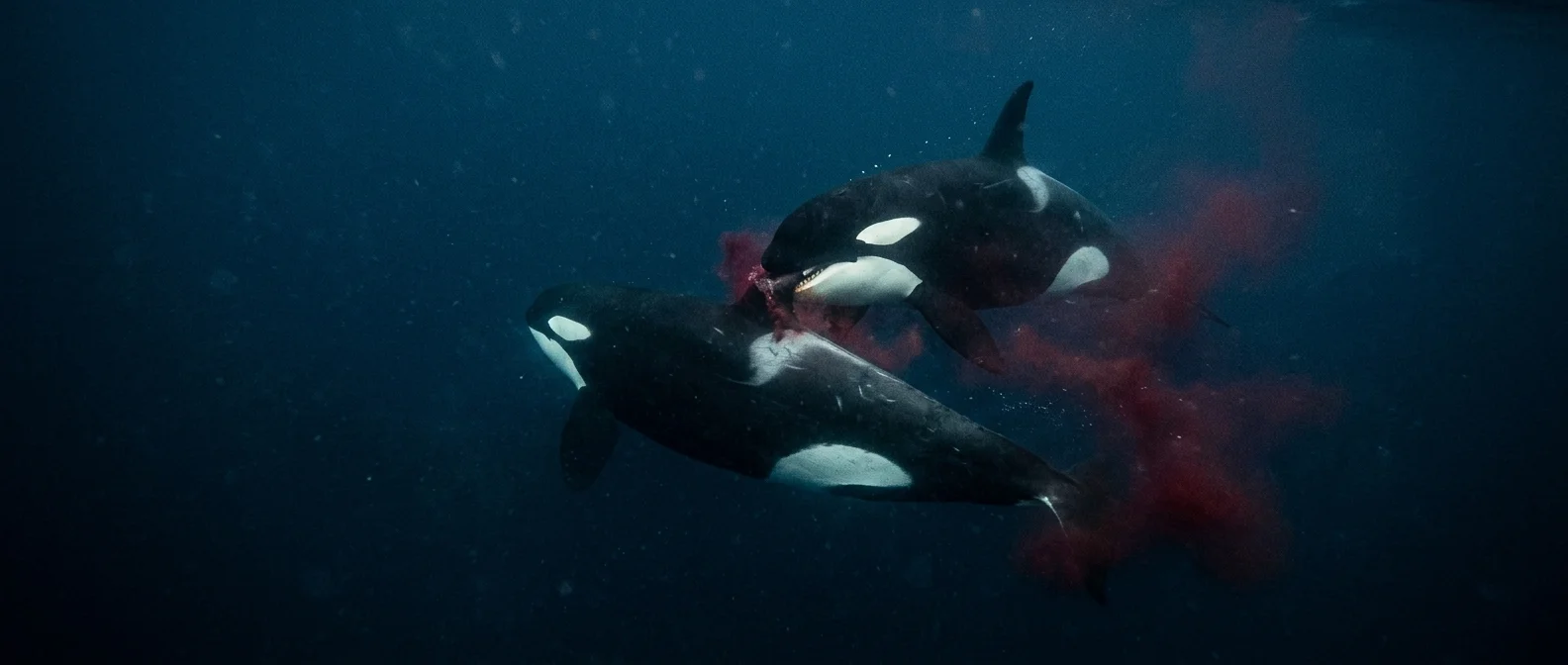
In August 2024, tourists at Russia's Commander Islands captured footage that shocked even marine biologists: a pod of killer whales pursuing, killing, and tearing the dorsal fin from a member of their own species. The video — seawater red with blood, a severed fin floating — went viral. But the story behind this “cannibalism” isn't as simple as it appears.
📖 Read more: Why Orcas Are Attacking Boats in Europe: The 2026 Mystery
🔍 Case File #1: The Facts
The word “cannibalism” in media reports was catchy but inaccurate. Scientists call this intraspecific predation — and not all the whales necessarily fed on the victim. In many documented cases, killer whales kill but don't consume. They kill for territorial control, food competition, or social dominance. The truth? More complex — and more disturbing — than simple cannibalism.
Killer whales (Orcinus orca) hold the title of apex marine predator. No ocean animal hunts them. Reaching over 32 feet in length and weighing up to 21,600 pounds, males are the largest members of the Delphinidae family — yes, they're technically dolphins, not whales. They possess the largest brain of any dolphin (average weight 12.3 pounds) and over 40 curved teeth, each roughly 4 inches long.
🧬 Case File #2: The Two Tribes
Here's where biology gets explosive. There isn't “one” killer whale. In the North Pacific, three genetically distinct groups coexist without interbreeding: residents (fish-eaters, primarily salmon), transients (mammal-eaters — seals, sea lions, even whales), and offshores (less studied, likely shark specialists).
Diet isn't just preference — it's identity. Residents and transients literally speak different "languages": different echolocation sounds and social structures. They share the same waters but live in parallel worlds. According to genetic analyses, Orcinus orca is actively undergoing speciation — splitting into two or three separate species. This is happening in both the North Pacific and North Atlantic.
This distinction is key. When transients encounter residents or solitary individuals, the conflict isn't about food. It's about internal geopolitical tensions of a species at an evolutionary crossroads.

🌊 Case File #3: The Russian Coast
The Commander Islands, at Russia's eastern edge near Alaska, aren't a random location. These frigid waters host some of the world's largest killer whale populations. The Sea of Okhotsk, Bering Sea, and Aleutian passes form interaction zones between different ecotypes.
Intraspecific predation here isn't an isolated incident. It's documented repeatedly. Transient pods, specialized in hunting mammals, don't distinguish between a seal and a smaller killer whale. The Commander Islands victim was likely solitary or from a different ecotype — essentially, foreign.
🧠 Case File #4: Why Kill Their Own?
The question doesn't have a single answer. Three hypotheses dominate the literature.
Hypothesis 1 — Resource competition. As climate change shifts fish populations, residents and transients are forced into greater spatial overlap. Food becomes scarce. Tensions escalate. A hungry transient doesn't see “family” — it sees competition.
Hypothesis 2 — Social dominance. Killer whales live in matriarchal groups. The female leader (matriarch) guides decisions. In fact, killer whales are one of the few species that experience menopause — along with humans, false killer whales, belugas, and narwhals. Elderly females stop reproducing to dedicate themselves to pod survival. This means the group functions like a “super-organism” — and when a foreign member invades, the response can be lethal.
Hypothesis 3 — Hunting practice. Young transients learn hunting techniques under real conditions. A solitary killer whale, weak or injured, makes an easy “lesson” for the pod's juveniles. Harsh? Nature doesn't operate by moral rules.
💡 Important clarification: Killer whales, despite their reputation as “killer whales,” have never killed a human in the wild. The name “killer whale” (from “whale killer”) was given by ancient sailors who saw them hunting large whales. Intraspecific violence concerns exclusively relationships between killer whales.
🔬 Case File #5: What Evolution Tells Us
In the North Atlantic, things get even stranger. Genetic analyses show two distinct populations diverging: a smaller-bodied one (maximum 22 ft) with worn teeth that feeds on fish, seals, and other animals, and a larger-bodied one (up to 28 ft) with nearly pristine teeth that likely feeds exclusively on whales and dolphins.
Two populations, same species, completely different ecology. This is speciation in real time — something extremely rare to observe in large mammals. The evolutionary record of Orcinus orca is fragmentary: the oldest known fossil, O. citonensis, was found in Italy (Pliocene, 5.3-2.6 million years ago). Just 13 feet long and 14 teeth — closer to a typical dolphin.
From that small dolphin, evolution created the apex predator of every ocean. And now, that predator is turning against itself. Intraspecific violence isn't a “bug” — it might be the mechanism through which nature splits one species into two.
🌍 Case File #6: The Ocean Changes — And They Change With It
Killer whales inhabit every ocean, from the poles to the equator. But their distribution isn't uniform — they concentrate where large prey is abundant: tuna, salmon, seals. As ocean temperatures rise, fish move northward. Residents follow. And they find transients.
The same logic applies to Russian coasts. Waters around the Commander Islands are warming. Killer whales that once rarely interacted now share the same hunting grounds. The data shows an increase in such incidents over recent decades. We don't know if violence is increasing or just observation. Probably both.

🏛️ Case File #7: The Intelligence Behind the Violence
These aren't random predators. Killer whales recognize themselves in mirrors — an intelligence test passed by few species beyond primates. Each pod has a unique “sound system” — a dialect that members recognize even from great distances. Mothers give birth to one calf every 3-10 years, after a 17-month pregnancy. In some pods, young stay with their mothers their entire lives.
What makes intraspecific warfare terrifying isn't the violence itself — it's that it happens strategically. Transients hunt in groups, use coordinated tactics, and sometimes kill without eating — suggesting purpose beyond hunger. Imagine wolves planning an ambush, but at 35 mph underwater.
«Killer whales don't hunt blindly — they plan, coordinate, adapt. When this intelligence turns against members of their own species, we're confronting something we still struggle to understand.»
🔮 Epilogue: What Does This Mean?
Intraspecific violence in killer whales isn't an anomaly. It's a symptom of evolutionary pressure, climate change, and ecological stress. The Commander Islands didn't show cannibalism — they showed an ocean in transition, where one of the planet's most intelligent creatures is renegotiating its boundaries.
Next time you see killer whales in a documentary, remember: behind those black-and-white bodies runs a millions-year evolutionary experiment. And the experimentation isn't over yet.