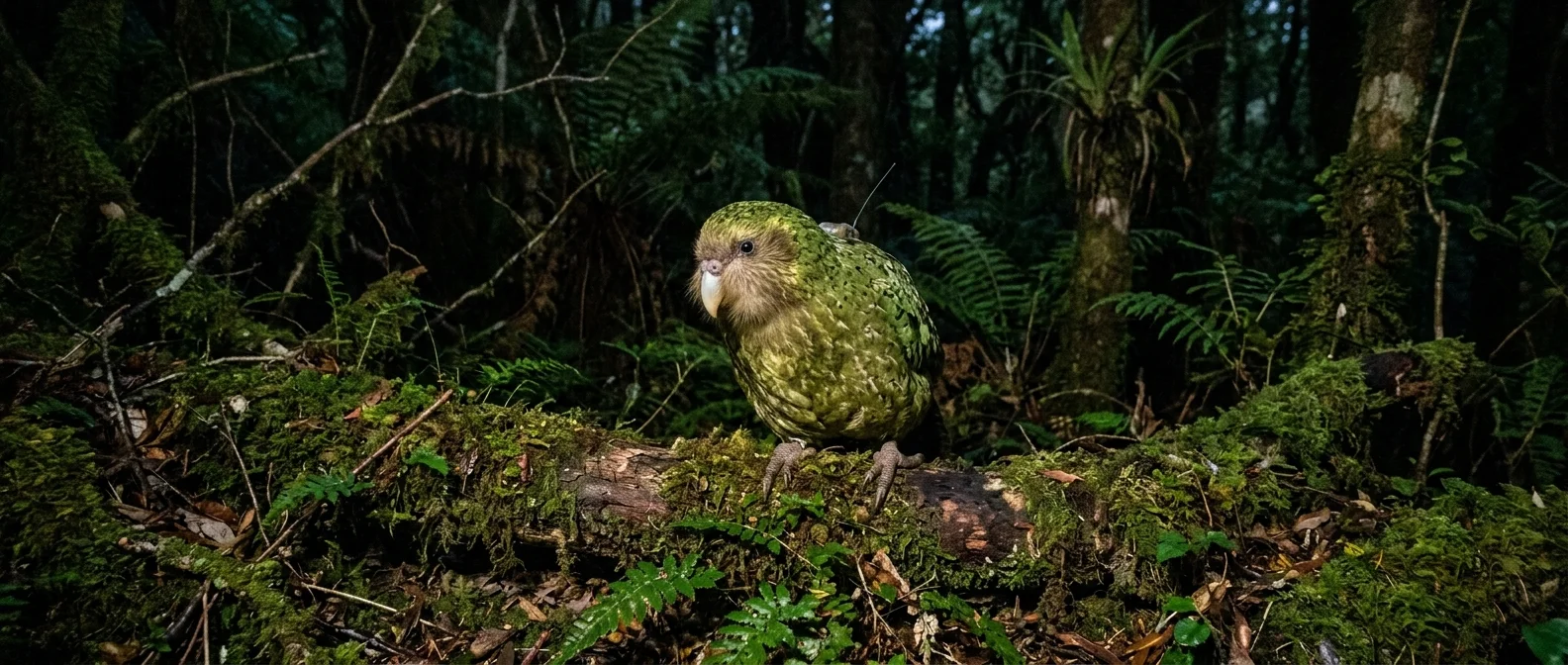
Picture a parrot that can't fly, weighs 9 pounds, emerges only at night, and breeds solely when a specific tree decides to fruit — something that happens every 2 to 4 years. If this sounds like a creature destined for extinction, the kakapo proves you right. Yet somehow, it still fights on.
📖 Read more: Angola's Ghost Elephant: Hidden for 10 Years
🦜 A Bird Like No Other
The kakapo (Strigops habroptilus) resembles no other parrot on Earth. It's the world's heaviest parrot, the only one that breeds using a lek system, and likely the longest-lived bird — 60 to 90 years. Owl-like face, greasy feather texture, bear-like waddle.
It lives exclusively in New Zealand, on predator-free islands. Once it inhabited the entire archipelago. Today, 236 individuals comprise the remaining population. Each one wears a radio transmitter like a backpack.
🌳 The Tree That Decides When They Breed
Kakapo don't breed every year. Their breeding season is triggered by the mass fruiting of the rimu tree (Dacrydium cupressinum), an endemic conifer that can live over 600 years. When rimu produces abundant fruit — something that happens every 2 to 4 years — females gain enough energy to lay eggs.
In January 2026, after a four-year gap, a new breeding season was officially announced. Deidre Vercoe, manager of the Kākāpō Recovery program at New Zealand's Department of Conservation (DOC), stated this season could produce the most chicks in 30 years.
🔊 Booming: The Call That Carries 3 Miles
Each breeding season, males construct networks of tracks and bowls in the ground — the so-called lek. These bowls aren't random: they function as acoustic amplifiers. At night, for weeks or months, males inflate an air sac in their chest and emit a deep, rhythmic “boom” — a subsonic sound so low-frequency it resembles a ship's horn.
Normally such a sound would be lost in dense forest. Yet thanks to the lek bowls, it carries up to 3 miles. Females follow the sound, evaluate males, mate, and then leave to incubate alone.

📉 From Millions to 51: The Collapse
Seven hundred years ago, kakapo were everywhere in New Zealand. They had no terrestrial predators — no mammals, no snakes. Their only threat was the Haast's eagle, a massive raptor that vanished along with the moa.
Then humans arrived. First the Māori, who hunted them and used their feathers, then Europeans, who brought cats, rats, stoats, and dogs. The flightless birds were easy targets. The population collapsed within decades.
By the mid-20th century, only 51 individuals remained. Drastic intervention began: transfer to predator-free islands, artificial incubation, genetic management. Thirty years later, 51 became 236.
Island Protection
All kakapo live on islands and fenced sanctuaries without invasive predators. The main islands are Codfish/Whenua Hou and Anchor Island.
Artificial Incubation
In previous seasons, many eggs were transferred to incubators. From 2026, the team is allowing more to hatch naturally.
Genetic Management
Every mating is planned based on genetic analysis to avoid inbreeding. The entire kakapo genome has been sequenced.
24/7 Monitoring
Radio transmitters on every individual. Cameras at nests. Weight sensors. Smart eggs that send real-time data.
📖 Read more: Blue Whale: Largest Animal That Ever Lived on Earth
🧬 Genetic Nightmare: 51 Founders for 236 Descendants
With just 51 founding individuals, kakapo genetic diversity is dangerously low. Every new chick must contribute genes missing from the population — otherwise inbreeding accumulates. A genomic study revealed dozens of harmful genes circulating at high frequency due to the bottleneck effect.
The problem isn't theoretical. Low genetic diversity translates to low fertility — roughly 40% of kakapo eggs never hatch, an extraordinarily high rate compared to other birds. Diseases like aspergillosis hit genetically impoverished populations disproportionately hard. Every loss of an individual means loss of unique alleles that can't be replaced.
The solution? The recovery team uses sperm from males living on different islands for artificial insemination. In some cases, they even use frozen sperm from males that died years ago. Real-time genetic rescue.
🌙 Nocturnal Life: A Creature Designed for Darkness
Unlike virtually every parrot on the planet, the kakapo is strictly nocturnal. During the day it hides under tree roots or in natural cavities. Once darkness falls, it emerges to forage — fruits, seeds, leaves, roots, even tree bark. Its nose, more developed than any other parrot's, guides it through the darkness.
The distinctive feathers on its face create a “disc” similar to an owl's — it's no coincidence the ancient Māori name means “night parrot.” This structure likely helps collect sound, though its exact function is still being studied. A bird that evolved in a world without predators didn't need speed or flight. It needed to find food in darkness — and at that, it's an expert.
⚖️ Kakapo vs. Other Parrots
Kakapo
Nocturnal, flightless, solitary. Breeds every 2-4 years. Heaviest parrot (9 lbs). Ground-dwelling. Lek system.
Typical Parrot
Diurnal, capable of flight, social. Breeds annually. Weight 0.02-3.3 lbs. Tree-nesting. Monogamous pairs.

😂 Sirocco: The Celebrity Kakapo
You can't discuss kakapo without mentioning Sirocco. A hand-reared male who imprinted on humans as potential mates, he became a global viral sensation in 2009: he attempted to mate with a zoologist's head during documentary filming. The scene provoked laughter, but also serious concern.
Imprinting on humans means Sirocco can't reproduce naturally. Instead, the team developed a special latex “ejaculation helmet” for sperm collection. Creative solution to an absurd problem. Today, Sirocco serves primarily as an ambassador for the species.
🎯 2026 Season: New Strategy
This year, the recovery team is changing approach. Fewer eggs will be transferred to incubators, fewer interventions in nests with multiple chicks. Goal: not just more kakapo, but kakapo that can survive on their own. “We want populations that thrive, not just survive,” stated Deidre Vercoe.
🌏 Lessons from the Brink of Extinction
The kakapo represents both nature's fragility and resilience. A species that evolved without predators for millions of years couldn't adapt to changes humans brought in mere decades. Simultaneously, the same human ingenuity that brought it to the brink now keeps it alive.
The conservation cost isn't small. Each kakapo costs tens of thousands of dollars annually in monitoring, medical care, and management. But the alternative — the silent extinction of a creature that predated us by millions of years — carries a far greater cost.
If the kakapo's story proves anything, it's that species conservation isn't just about technology or money. It's about time — and time waits for no one. Especially not a parrot that breeds only when a 600-year-old tree decides to fruit.