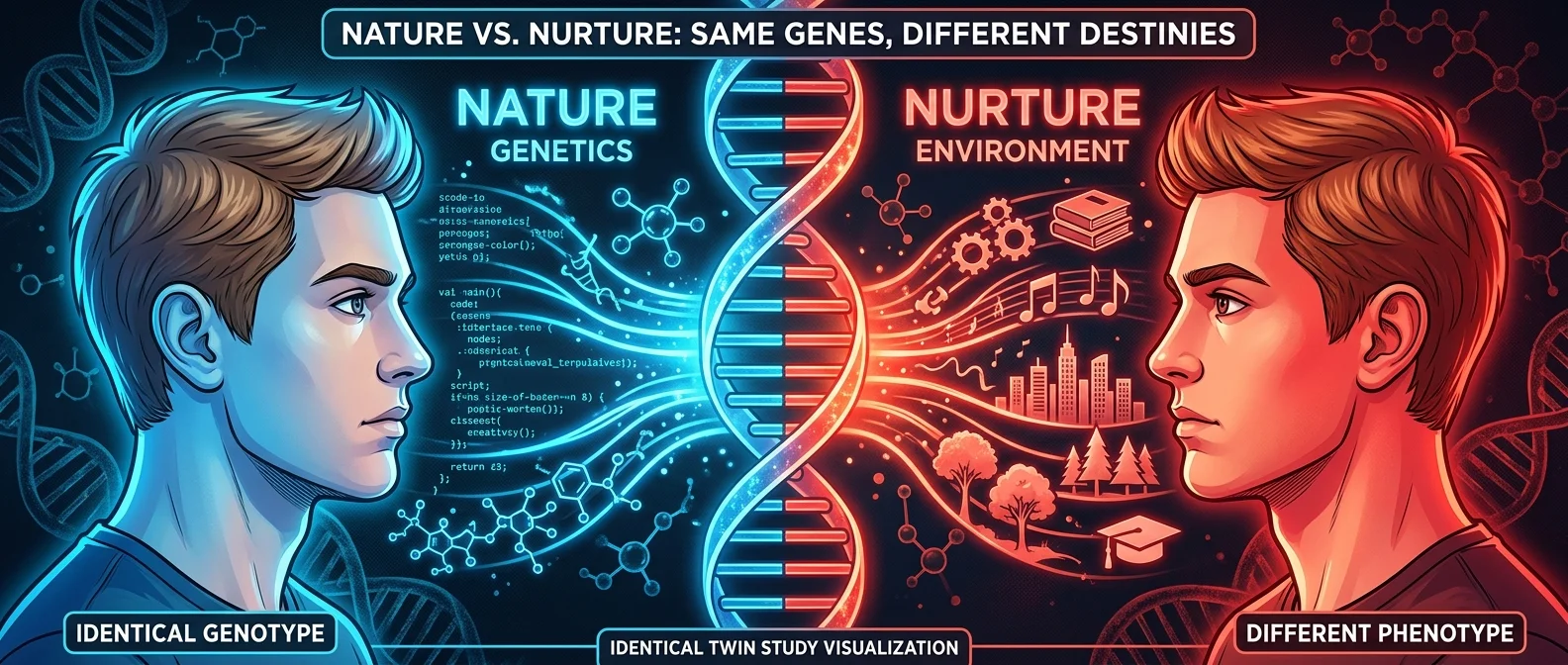
Picture two people with identical faces, same height, same DNA — yet one develops Parkinson's at 55 while the other remains perfectly healthy until 90. For decades, scientists assumed monozygotic twins were genetically identical, and any differences between them came purely from environment. Today, thanks to advanced genome sequencing techniques, we know this isn't true — and the reality is fascinatingly more complex.
📖 Read more: Trauma Gets Inherited: How Stress Rewrites Your DNA
How Identical Twins Are Created
Monozygotic (identical) twins arise when a single fertilized egg splits into two separate embryos within the first 14 days after conception. If the split occurs within 3 days, the twins will have separate placentas. If it happens between days 4 and 8, they'll share the same placenta but have separate amniotic sacs. Unlike fraternal twins, who share roughly 50% of their DNA, monozygotic twins begin life with practically identical genomes — 3.2 billion base pairs. They represent about 3-4 per 1,000 births worldwide, a rate remarkably consistent regardless of race, geography, or era. Why the zygote splits remains one of reproductive biology's greatest unanswered mysteries. But once cell division begins, so do the differences.
Not So Identical: CNV Genetic Differences
In 2008, a groundbreaking study by Carl Bruder and Jan Dumanski at the University of Alabama shattered assumptions. Studying 19 pairs of identical twins, they discovered copy number variations (CNV) in their DNA. CNV occurs when DNA segments are completely missing or appear in three, four, or more copies instead of the normal two. In most cases, these differences don't affect health. But sometimes, a missing gene or extra gene copies can trigger diseases in just one twin. "The assumption has always been that identical twins are identical down to their DNA," Bruder stated. "That's mostly true, but our findings suggest small, subtle differences due to CNV." The research revealed that even twins sharing a womb don't emerge with perfectly matching genetic blueprints.

Epigenetics: The Code Above the Code
Beyond changes in DNA sequence itself, there's a second way identical twins diverge: epigenetics. These are chemical “tags” added on top of DNA without changing the base sequence — mainly methyl groups (CH₃) that attach to cytosines. The word “epigenetics” literally means “above the genes.” This DNA methylation acts like switches: it can turn genes off or on without touching the underlying code. Every cell in your body contains the same 20,000+ genes, but a liver cell expresses different genes than a neuron — thanks to epigenetics. Twins living in different environments, eating different diets, or exercising at different levels gradually develop different epigenetic patterns. Researchers in Spain, led by Manel Esteller, showed that three-year-old twins are epigenetically nearly identical, but fifty-year-old twins show massive divergences — especially if they've lived apart.
📖 Read more: What You Eat Changes Your Genes: Epigenetics Explained
MicroRNA-30 and Type 2 Diabetes: The Lund Study
A striking example came from Lund University in Sweden. Emma Nilsson and her team studied 14 pairs of identical twins where only one sibling had developed type 2 diabetes. Analyzing fat tissue biopsies, they discovered that diabetic twins had reduced activity in a gene producing microRNA-30 — a microscopic RNA molecule that regulates protein production. Lower microRNA-30 levels in fat cells correlated with reduced glucose uptake capacity — a hallmark of insulin resistance. These results were confirmed in an independent control group of 56 unrelated individuals. "We see the same pattern in people with type 2 diabetes. Each piece of the puzzle brings us closer to better drugs," Nilsson stated. The findings were published in the journal Diabetes in 2021.
Parkinson's, Cancer, Arthritis: When One Twin Gets Sick
This phenomenon is called discordant twins — pairs where only one member develops a disease. These cases are gold mines for researchers because they remove genetics as a variable and make environmental and epigenetic causes visible. If twin A develops Parkinson's and twin B doesn't, the genomic regions where they differ become immediate targets for investigation. "If a missing gene or multiple copies of a gene are involved in disease onset, we can pinpoint them," Bruder explained. Discordant twins have helped understand multiple sclerosis, schizophrenia, breast cancer, rheumatoid arthritis, autism, and many other conditions. In breast cancer cases, a 2012 study found that epigenetic signatures could predict risk years before disease appeared. Each pair functions as a living experiment — a natural laboratory that nature created without ethical dilemmas.

📖 Read more: Why We Age: The Biology Behind Human Aging in 2026
Environment, Lifestyle, and Gene Expression
Twin studies reveal that even daily life “writes” on our DNA. A 2022 study at Washington State University showed that the more active twin in a pair had significantly different epigenetic profiles compared to the less active one — even when living in the same house and sharing the same genomic foundation. Diet, smoking, sleep, stress, chronic pollution exposure, even social relationships alter DNA methylation across hundreds of genes. Even more striking, certain epigenetic changes can be inherited by the next generation — a phenomenon known as transgenerational epigenetic inheritance. The old myth that “genes determine your fate” has been replaced by a complex interaction model: genes load the gun, but lifestyle pulls the trigger. Twins are the best proof of this principle.
Somatic Mutations: The Silent Transformations
Beyond CNV and epigenetics, there's a third divergence mechanism: somatic mutations. Every time a cell divides, it copies 3.2 billion base pairs — and makes roughly 0.5-1 errors per copy, despite repair mechanisms. From the moment twins separated in the womb, each acquires their own mutations with every cell division, in every organ, in every tissue independently. By adulthood, each twin carries hundreds of unique somatic mutations that don't exist in their sibling. This explains why even with identical starting DNA, twins might have different freckles on their faces or slightly different immune systems. Modern whole-genome sequencing estimates that identical twins differ by an average of 5.2 somatic mutations already at birth — a number that increases with each year of life.
Perfect Witnesses in Nature vs. Nurture
Identical twins remain genetic research's most valuable resource. Twin studies began with Francis Galton in the 1870s and today include registries of hundreds of thousands of pairs in countries like Sweden, Denmark, and Australia. The Swedish Twin Registry includes over 85,000 pairs. The method of comparing monozygotic and dizygotic twins has allowed calculation of heritability for almost every human trait — from height (80% heritable) to depression tendency (40%) and IQ (50-80%). Thanks to these databases, scientists can calculate how much of a behavior or disease is due to genes versus environment — a question that has plagued biology for a century. And each new study confirms the same message: no two humans are truly identical, not even those who started as one.
Sources:
- Bruder, C.E.G. & Dumanski, J.P. et al. «Identical Twins Not As Identical As Believed.» University of Alabama, 2008 — ScienceDaily
- Nilsson, E. et al. «Differential DNA Methylation and Expression of miRNAs in Adipose Tissue From Twin Pairs Discordant for Type 2 Diabetes.» Diabetes, 2021 — ScienceDaily